
If you want to get to know a particular river (or person), it seems respectful to travel back to their beginnings. For without the back story, you can only understand what’s on the page you opened at. Similarly, there’s little of interest to be found in the highlights reel. Complexity and reality reside in the false starts, the difficult years, the times they felt divided and had no choice but to leave the mainstream.
The river never says, ‘If only I had been different.’ It just flows on. ~ Paulo Coelho
photographers SONIA STRONG and GARY McARTHUR (aka WANDERING FOXBAT )
Despite the name, I think of this river as a woman. I feel a kinship with her, having both recently turned 50.
Or at least the dam that bifurcates her centre had a birthday – the river herself is immeasurably older, and cares little for anniversaries. Nor does she answer to Gordon. That’s just the name of a man who let another man borrow his whaleboat once, so he could sail around a distant island at the bottom of the world.*
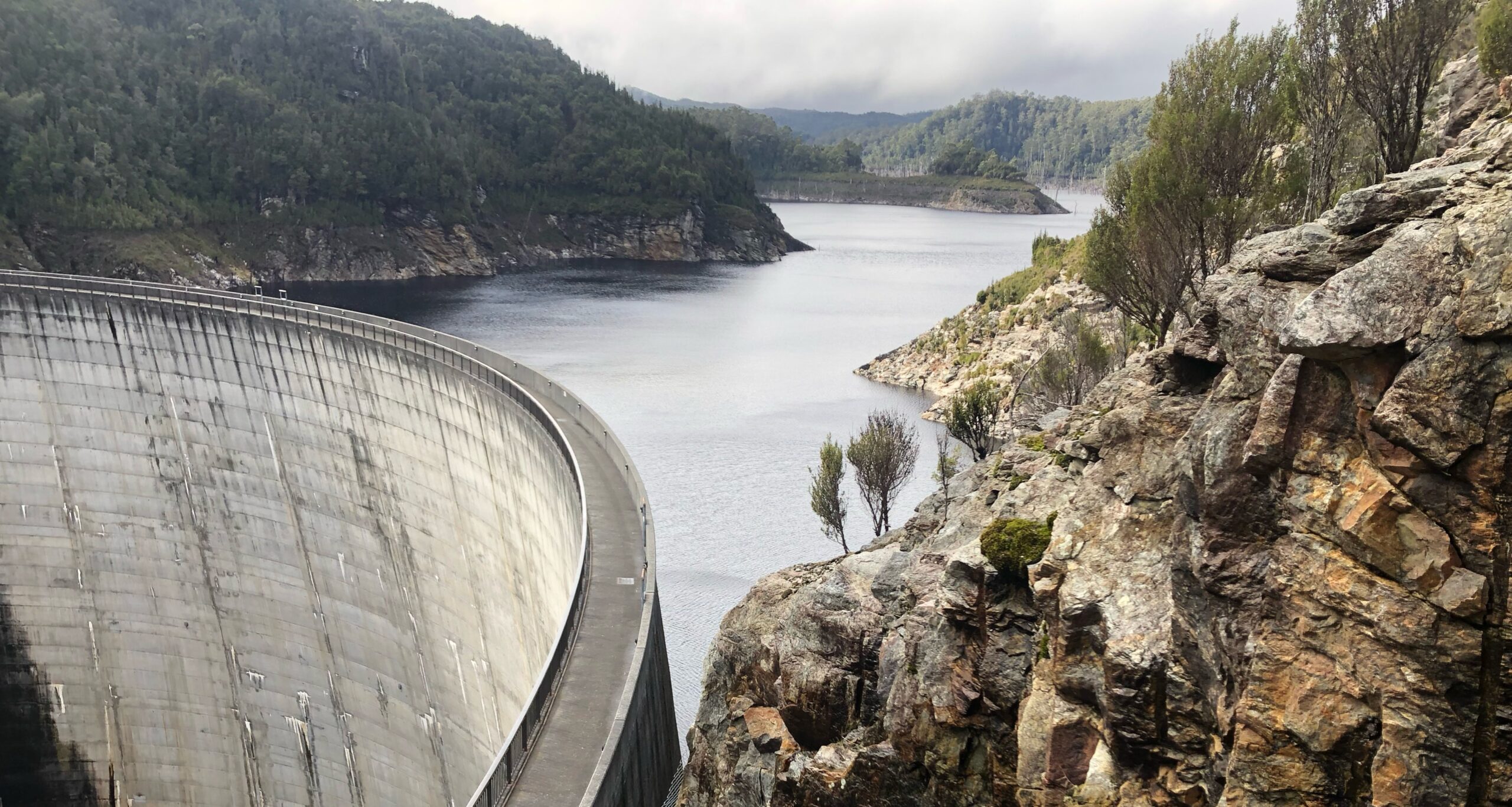
Many know some facts and figures about the Gordon Dam – 198 metres long, 140 metres high – but less of significance about the river. People mostly know her for how she’s been made useful. “So much power,” they say. “Just look at that wall, the tallest in the state,” and I wonder if a river feels shame. Despite the abrupt insult to her flow, which ended countless green and quiet lives, she persists, slowly, sinuously, and largely unwitnessed through the shadowy forest.
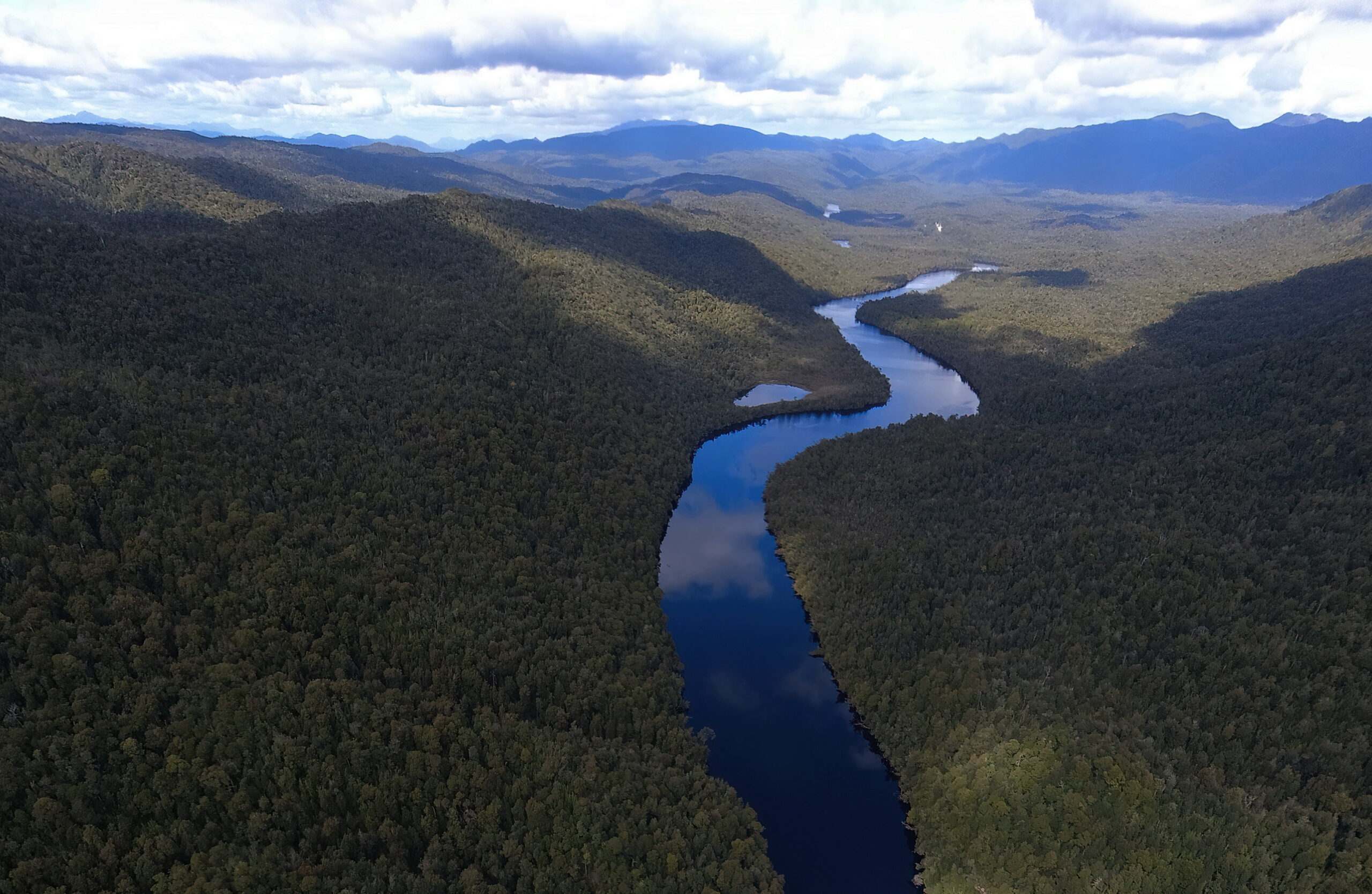
Below the wall, she begins to remember herself, regaining momentum. Liquid fingers trail across the land, gouging her many secret names into quartzite, dividing the darkest of places and bringing with her, light and life. For many miles she travels in silence through hidden valleys, foaming and raging where her anger can echo, hiding her most precious mysteries under moss and mist. Often, she is a lone traveller, narrow and focused; at other times gregariously expansive, welcoming Denison, Olga, Sprent and Franklin to join her (also not their real names). She stumbles occasionally, dropping all that she carries, and burbles off in a new direction, momentarily lighter and freer. But such states are fleeting. She will return, time and again, to these places where things could have been different.
I can’t help but feel the Gordon Dam 50th anniversary celebrations (on November 25, 2024) were honouring the wrong thing. After all, isn’t it the river who deserves acknowledgement? Without her, there’s no point to the dam. Nor is the dam the point. True worth, rivers and humans alike, is something uncoupled from power, potential and productivity. The value of something, surely, is just that it exists, in whatever unique form, as part of this world. Is not a river, in the absence of flow or any usefulness to humans, still a river? It seems unfair to question its identity in its darkest hour, simply because of a lack of forward momentum.
The Lhere Mparntwe/Todd River in Alice Springs, dry 95 per cent of the time, sets a precedent that rivers can opt out of imposed expectations and should be afforded a respite in times of struggle. I like the Todd, sauntering dryly through the centre of town, flatly refusing to be called a river bed and putting on an annual party in celebration of itself; a regatta no less.
The concept of rivers as living entities, isn’t new to Aboriginal people. Indigenous cultures the world over have long considered rivers to be ancestral beings, recognising their intrinsic value and right to exist. It’s only relatively recently that the rest of the world has been catching up, with a global movement evolving to acknowledge in law rivers’ inherent rights as individuals to thrive and to maintain their natural flows. Already, there are examples in Ecuador, New Zealand, India, Colombia and here in Australia.**
If you want to get to know a particular river (or person), it seems respectful to travel back to their beginnings. For without the back story, you can only understand what’s on the page you opened at. Similarly, there’s little of interest to be found in the highlights reel. Complexity and reality reside in the false starts, the difficult years, the times they felt divided and had no choice but to leave the mainstream. For can you really understand someone without knowing their struggles, the easier paths they could’ve taken, or the ones they followed which petered out into nothing? Do you deserve to be trusted with the tales they find hard to tell, when they felt punished for being too much or offering too little?
A river gives what it can, but is limited by what happens higher up, by the generosity of its headwaters. In short, you cannot truly know someone you’ve only known in flood. It is true of people, and it is true of rivers.
Like the Gordon and Franklin could be said to exist in parallel, we too, live in parallel with them. Our lives depend on rivers. We share their struggles and triumphs and could learn a great deal more than we seem to from them. In reciprocal respect, a river does not argue with the mountains or button grass plains through which it travels, but learns their language, in order to converse with the wider world.
Whilst these two rivers are obviously connected, it seems strange to me that they’re thrown together under the banner of The Franklin-Gordon Wild Rivers National Park. That the park is named after its great rivers isn’t odd at all, being located in the wettest part of Tasmania. What’s strange to me is the use of the word “wild”. I’ve heard many Aboriginal people express discomfort with the words “wild” and “wilderness”, which suggest a land unimpacted or inhabited by humans, which clearly south-west Tasmania is not. My own discomfort with the word wild is that only one of the rivers for which the park is named could reasonably be considered so.
Despite excluding the dam infrastructure and reservoir from the park, can we really still call the Gordon River wild? Whilst the Frankin follows its own path, crashing impressively through ravines and carving a name for itself in the international rafting community, the Gordon has been comparatively reduced. Harnessed by a high arched wall, she’s developed the middle-aged spread we call Lake Gordon (which, if more accurately named, would be Gordon Reservoir).
Tasmania’s west coast is often romanticised as a place of dense scrub, rugged peaks, wind-swept beaches, sparkling lakes and, of course, wild rivers. Again, the more complete story is more accurate when told in its entirety. If you watched the Tasmanian series of SBS’s Alone Australia, set on the banks of some undisclosed west coast waterbody, you’d be forgiven for assuming the participants were in pristine wilderness. However, as they struggled to keep their shelters unflooded in the face of fluctuating water levels, it was clear to many viewers that what was masquerading as a lake was in fact a hydroelectric dam. The rapidly encroaching shoreline was obviously being influenced, not by distant rainfall as the show suggested, but by the strategic release of megalitres of water to generate electricity.
It’s wrong of me to suggest that the Gordon has entirely lost her wildness though. There remain huge stretches where she can still drop her guard. Like the rest of us, however, she shows many faces to the world, depending on how and where you encounter her. She can be as feral and rugged as she can be serene and approachable. Neither of us have managed to consistently or entirely retain our wildness, as much as we each may try. If you look at our maps, both of us draw from many sources. We stop, start, run low in certain seasons, and in others are a deluge of progress and movement. Occasionally we lose our way, but spring up again from seeming nothingness.
There’s an infamous river crossing along the Gordon, a checkpoint for walkers heading into the Denison range. Wise hikers consider the weather, their plans, and their level of preparedness here for what lies ahead. Those choosing to cross must either wade through, or balance on a slippery fallen tree. Due to the surrounding easily-saturated peat, the river routinely rises without warning, submerging the crossing in a torrent. Many walkers have arrived to find her roiling and wild, and sensibly turned around here. Some have mistakenly taken her as perpetually placid and skipped across, blissfully ignorant. Some, having forded in fine weather, have subsequently found themselves stranded on the opposite bank.
Before the dam, she’s slower and safer to approach. You can get to know her a little. My partner and I paddled our inflatable pack-rafts to where she enters Boyes Basin; where she ceases for a time, to be a river. The Stepped Hills, overseeing her acrobatics around the last of the river boulders, are purple and rust in the late afternoon light. Strewn across the giant rocks are gnarled stumps of huon pine; cause of death evident in the marks of cross-cut saws. Introduced redfin and trout break the surface of the broad swathe of still water behind us, creating ripples. These fish are not her own, but they have possessed her to the point where she no longer recognises her own insides.
Paddling quietly across the smooth waters of this “lake”, I close my eyes and glide. Neither of us gets to choose when to wait and when to run on full noise, draining ourselves to sustain the external world. I could, perhaps, see my own stagnation as an opportunity to deepen, to be held awhile. I could be like this water, surrender the need for constant movement, and maybe welcome the chance to regain a little strength. With each paddle stroke, my own ripples fan out and merge with those of the fish, colliding with the grey ghosts of long-dead eucalypts and celery top pines. I think of lives lost beneath the tannin depths: drowned plants, animals and valleys which once existed here in peace. Back on shore in the last rays of the day, I stand with the sentinels in recognition of our shared loss, the cost of progress.
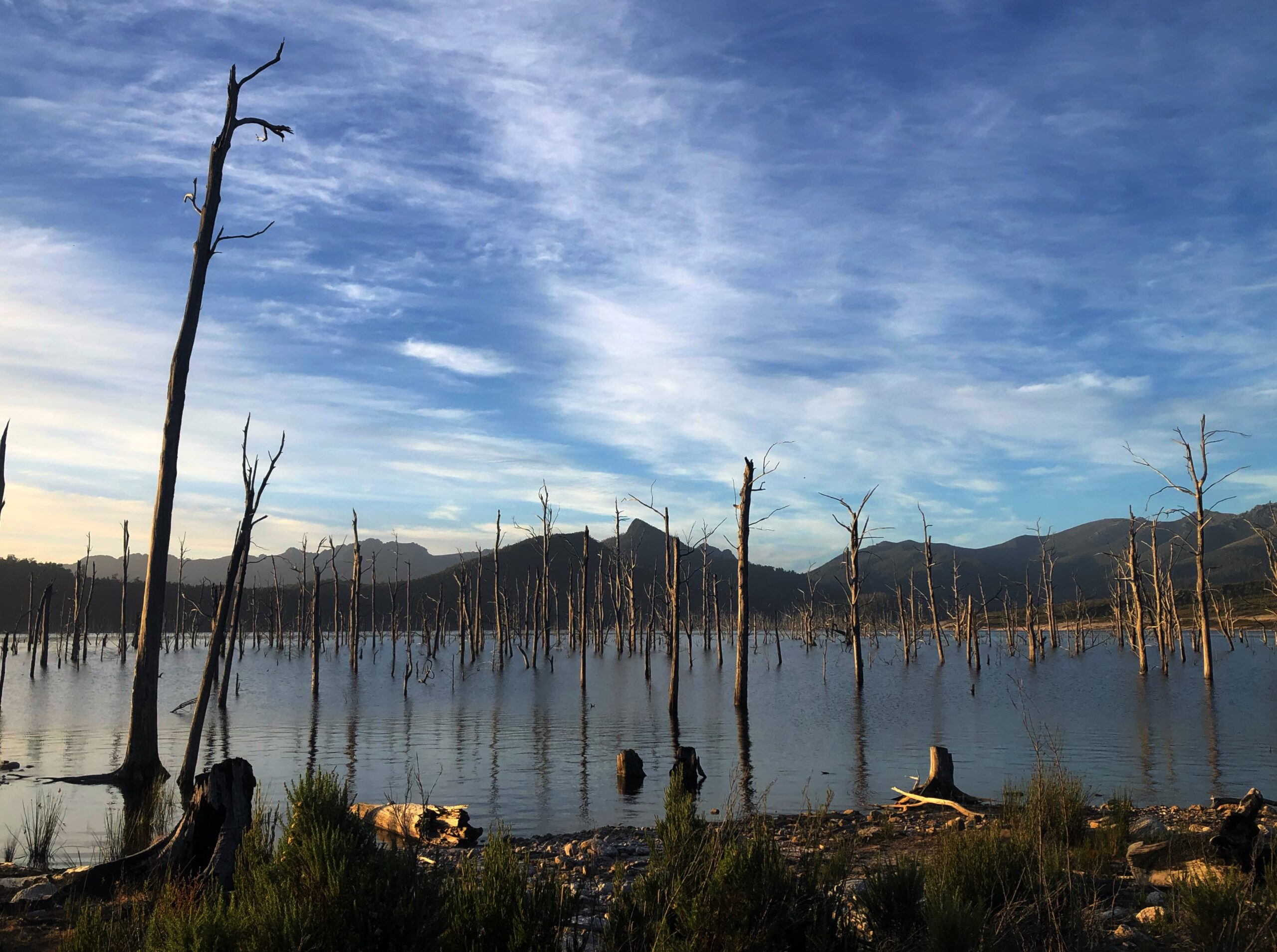
If you meet her late in the story, on Tasmania’s west coast, the Gordon may seem tempered by 172 kilometres of travel, humbled by the dam perhaps. Dark and thoughtful, she exhales her last loosening sigh across Macquarie Harbour to Hell’s Gates, reclaiming and releasing her wild self. There’s no more time for “what ifs”. Only the sound of flowing water.
All that she has called her own isn’t lost, but simply dispersed – sustaining, influencing and changing all who’ve encountered her. As she empties into the Southern Ocean, the countless droplets of her body rejoin the earth’s endless waters. She has become an essential part of something greater, indistinct from the wider world.
She is no longer a river, and she needs no name.
* Not only is there a Gordon River and a Gordon Dam, but also a Gordon Range, Gordon Plains, Gordonvale, Gordon Bend and the Frankin-Gordon Wild Rivers National Park. I’ve probably missed some others. You’d be forgiven for thinking whomever Gordon was, he was kind of a big deal. Turns out he was just a good bloke, having lent explorer James Kelly a whaleboat for his exploratory circumnavigation of Tasmania (then Van Diemen’s Land) in 1815-1816. Questions about whether Gordon is a good name for a river aside, I do like that Kelly was clearly so grateful to the man. His voyage was credited as being the first European entry into Macquarie Harbour, the Gordon River’s last stop.
** In a move driven by Traditional Owners, the Wurundjeri Woi-wurrung, Victoria’s Yarra River has been acknowledged as a single, living, integrated entity under the Yarra River Protection (Wilip-gin Birrarung murron) Act 2017.