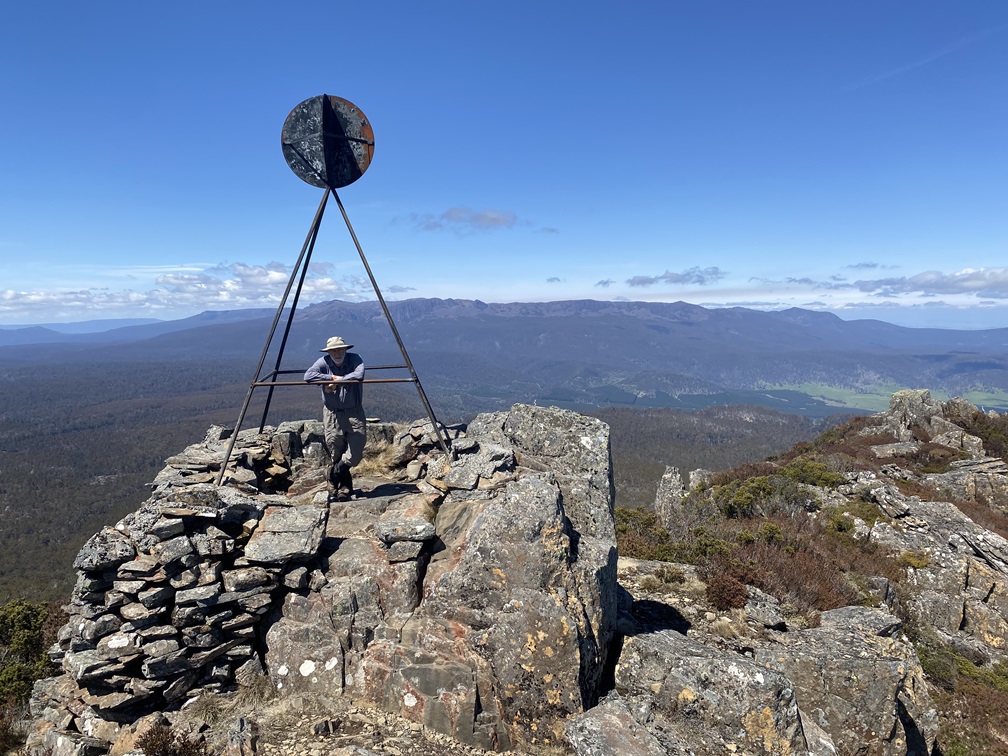
Craig Searle at the summit trig point with Ben Lomond behind. Photo Rob Shaw
“In optimal conditions, this is Tasmania at its just-forget-about-the-rest-of-the-world best.”
writer ROB SHAW
photographers ROB SHAW and CRAIG SEARLE
At 1,345 metres, Ben Nevis is the highest mountain in the British Isles, featuring on countless postcards, tea towels and tourist promotions and something of a poster boy for the Scottish Highlands.
Its Tasmanian namesake is 23 metres higher, only just breaks into its state’s tallest 50 peaks, and receives a fraction of the attention or, indeed, visitation.
This may be because it is surrounded by sparsely populated agricultural land and forestry plantations at least an hour’s drive from anything resembling a township, or because it is somewhat diminished by Tasmania’s biggest (and second-highest) mountain just a few kilometres to the south. Or, with 48 higher-achieving classmates about, perhaps it just tends to get overlooked.
All of this is unfortunate because the Tasmanian Ben Nevis is a wonderful place to visit, offering a textbook Tasmanian alpine experience and, in contrast to its Scottish cousin, company almost certainly limited to the number of people in your particular party.
It is central to the 13 peaks in the north-east section of Bill Wilkinson’s Abels series (Tasmanian mountains above 1,100m with a 150m drop on all sides). As a result, its summit views are unsurpassed, offering a fascinating perspective up Jacob’s Ladder to the ski village on Ben Lomond, with fellow Abels Legges Tor (1,575m), Ragged Jack (1,369m), Mount Barrow (1,420m), Mount Arthur (1,187m), Mount Maurice (1,122m), Mount Victoria (1,215m), Mount Albert (1,125m), Mount Saddleback (1,256m), West Tower (1,110m) and East Tower (1,122m) falling into line in a clockwise direction. Only Mensa Moor (at 1,365m just 3m lower than Ben Nevis) and Stacks Bluff (1,528m) are obscured from view by the formidable dolerite bulk of Ben Lomond.
While committed Abellists will desire to bag all of the above, anyone planning to climb just one north-east mountain should go for Ben Nevis. Being so central means smaller peaks such as Mounts Horror, Young and Cameron are also identifiable along with the more distant Great Western Tiers, Elephant Pass and Strzelecki Peaks on Flinders Island. Having scaled all of these, I cannot make a case for a better view in this corner of the state.
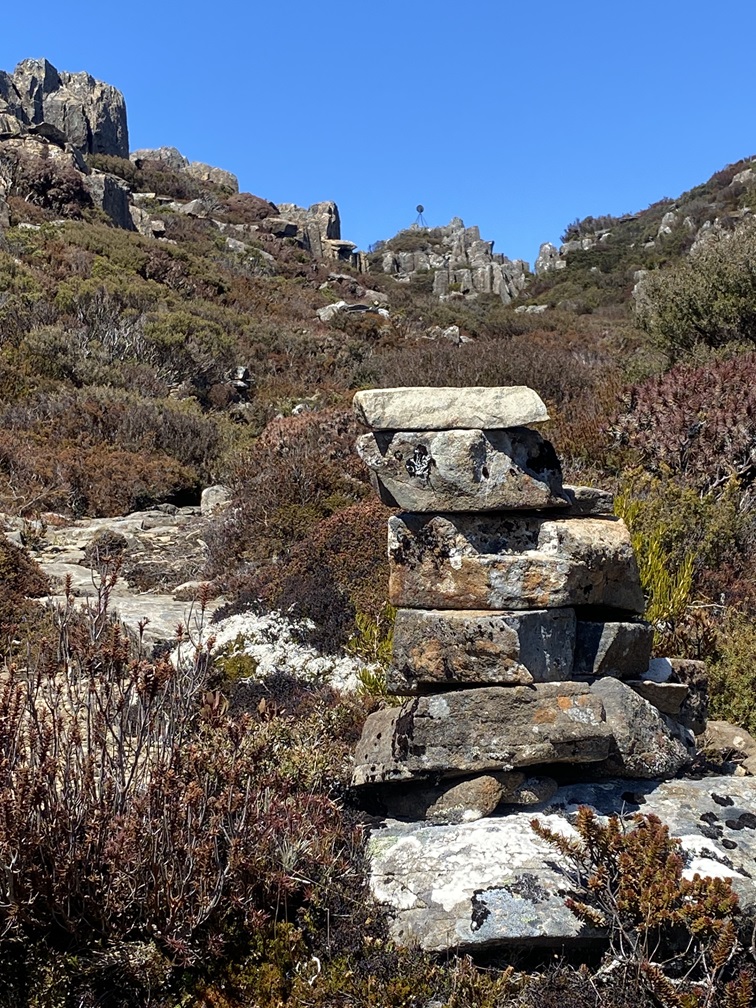
Large cairns signal the way to the well-marked summit. Photo Rob Shaw
Ben Nevis can lay claim to accommodating the source of both the North and South Esk rivers, which set off from the west and east flanks respectively and then take alternative courses around Ben Lomond before finally settling their differences with a reunion in central Launceston. At this point they adopt the name Tamar River and set off for a romantic cruise to George Town.
Accessibility may be another explanation of how this mountain can maintain such a low profile despite a height of 1,368m. Route C401 from Launceston follows the course of the North Esk and Ford rivers before going into zigzag mode beyond the Ben Lomond turnoff and small settlement of Upper Blessington. Tarmac soon becomes gravel and potholes est1ablish a sound presence as Upper Blessington Road feeds into Telopea Road. By the time Schulhofs Road heads west beside the brilliantly-named Big Heathy Plain, you’re into 4WD-only territory and even then may be forced to think twice about the unknown depth of some puddles.
On foot now, an old logging trail heads due south directly into contour central, with the increasing gradient accompanied by several huge trees blocking the way. However, as with life, none of the obstacles are insurmountable, and abundant reward awaits those game enough to tackle them.
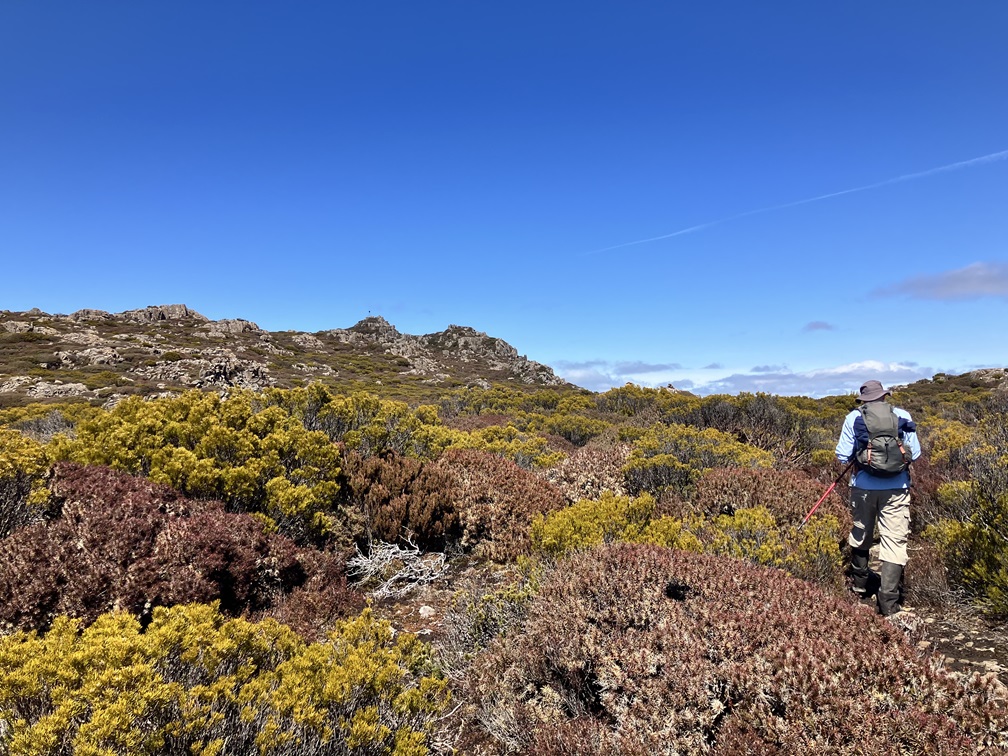
About 400m of elevation is gained in 2km. As the tree cover thins, the impressive cliffs of the mountain’s northern rim loom into view, but the track skirts around them onto a sprawling plateau where a well-cairned route makes for enjoyable hiking. In little time a rocky outcrop and summit trig marker appear on the horizon and, after a short scramble, the idyllic lunch spot is reached.
While blessed with perfect weather, we were well aware this may not always be the case. My hiking companion’s previous encounter with this peak followed heavy rain and produced a conservative estimate of 50 leeches hitching a free ride as he pushed through the dense vegetation on the lower slopes. However, in optimal conditions, this is Tasmania at its just-forget-about-the-rest-of-the-world best.
On the other side of the planet, the Scottish Ben Nevis, situated in the Grampian Mountains in the Highland region of Lochaber, near the town of Fort William, attracts an estimated 150,000 visitors a year. The country’s tourism website calls it “the king of the Munros” – Scotland’s mountains above 3,000 feet (914m). With comparable rewards and about 149,500 fewer annual visitors, its Tasmanian namesake has a solid claim to being a prince of the Abels.
Pleasant hiking across the sprawilng plateau. Photo Craig Searle
"Rob Shaw was born and raised in England where he trained and worked as a journalist. Coming to Australia in 2002 with his young family was supposed to be temporary, but Tasmania had other ideas. He has since spent his time working as a sports reporter, exploring our state’s wilderness and realising that he is staying here for the term of his natural life.
"