For some of the artists steeped in wild Tasmania’s landscapes and iconic endemic flora, this landscape was confronting. “Sadly, for me all the big views contained signs of man, roads and dams so I turned my back on painting them,” Peter Gouldthorpe said. Instead, he discovered closer subjects, such as the yellows and greens of the sphagnum bog.
There’s a grey zone of land, an in-between neither wild nor subdued, in central Tasmania. Pine Tier country has been roaded, worked and burned. Still its contours and rivers, grasslands and forest, shape up to meet creative eyes.
This landscape is the central piece in a jigsaw of land protection by the Tasmanian Land Conservancy that bulwarks the Tasmanian Wilderness World Heritage Area (TWWHA) from farmland, wind turbines and timber country. Holdings now extend for more than 20,000 hectares, across an unbroken 23km-corridor from Top Marshes Conservation Area, through Pine Tier as part of Five Rivers Reserve, which also contains Skullbone Plains, to the Tasmanian Aboriginal Centre’s trawtha makuminya, and then the TWWHA.
Part land of the Big River nation, Pine Tier stands as easily walked hills, plentiful grasslands and reliable streams sloping down to the Derwent system near Bronte Park. From the 1860s, sheep and cattle were grazed there and later it was logged in a familiar extractive succession. Bizarrely, on nearby land an American built a 12-room concrete bunker amid forest in the 1970s as a hedge against nuclear annihilation.
Pine Tier escaped the climate change bomb of lightning-started fire that burned through its nearby namesake, Great Pine Tier, in 2019. Earlier fires and logging mean that most of its 500 hectares of forest and woodland is regrowth. Evidence of the sudden departure of chainsaws is a line of felled trees in one woodland which turned out to be too close to a wedge-tailed eagle’s nest and was never collected. Feral fallow deer are at home in this landscape.
Still there remain botanical prizes on Pine Tier. The cryptic paleoendemic Mount Mawson pine Pherosphaera hookeriana is scattered beside the Nive River, and there are graceful stands of mountain white gum, Eucalyptus darympleana. In one corner of the reserve is a sphagnum bog that, if like another cored at Skullbone Plains, may be of 8,000-year antiquity.
Extensive Poa grasslands thrive at Pine Tier, distinct on these rich basalt soils from the signature Tasmanian buttongrass on quartzite peats of the TWWHA. The threatened Poa labilladieri/P. gunnii vegetation in turn hosts the endangered ptunarra brown butterfly, its ephemeral flying season lasting only a few weeks in autumn.
Hilltops invite a gaze, gnarly trees a closer look or running hand, streams glimmer in the light and the nearer cloud shadows pass faster.
Here the TLC and Allanah Dopson’s Handmark Gallery collaborated in the spring of 2025 to bring nine visual artists and a composer for their responses to Pine Tier. The three-day retreat allowed them to walk across and absorb the country. The range of their works was rich.
Composer Dean Stevenson immediately engaged with the landscape, writing a piece for strings that begins tentatively but moves into warm celebration. “The first three notes were the first things to come to me on the first day. I can’t recall if it was a bird call or just my own brain electricity making connections. But the piece follows my understanding of the place, its interruptions, glory and its simplicity through all manner of weathers.”
For some of the artists steeped in wild Tasmania’s landscapes and iconic endemic flora, this landscape was confronting. “Sadly, for me all the big views contained signs of man, roads and dams so I turned my back on painting them,” Peter Gouldthorpe said. Instead, he discovered closer subjects, such as the yellows and greens of the sphagnum bog.
By contrast, for Max Mueller, Pine Tier’s signs of industry were more considered than he expected. He was drawn to the possibility of regeneration, such as in thick patches of juvenile eucalypts along an old cobble road.
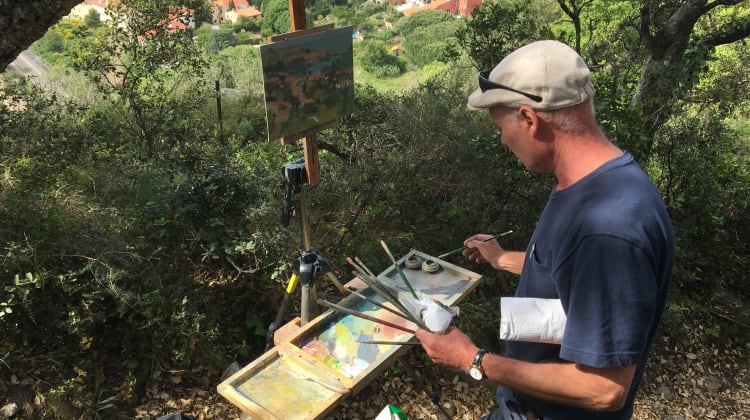
The resurgence of this ecosystem, as explained by the TLC guides, was felt by Melanie McCollin-Walker, who seized the opportunity for plein air drawing as a pathway to her precisely detailed studio landscape paintings.
Julie Payne recorded a landscape mixed with fragility, remoteness and threat. Among her many sketchbook entries, some were shadowed with the presence of the Fallow Deer.
Pine Tier brought a fundamental change for Olivia Moroney, who was prepared to take in larger, expansive landscapes in her drawings, using abstracted marks to bring clarity to her images. “This experience has shifted my art practice completely; I feel I am now experimenting and pushing the way I use charcoal much more than I have in the past.”
There was a new challenge, too, for Adrian Barber, who previously shied away from painting a forest, with all its complexity, in favour of wider landscapes. At Pine Tier, he found himself drawn to the White Gum woodlands’ representation of renewal and painted them in deep perspectives.
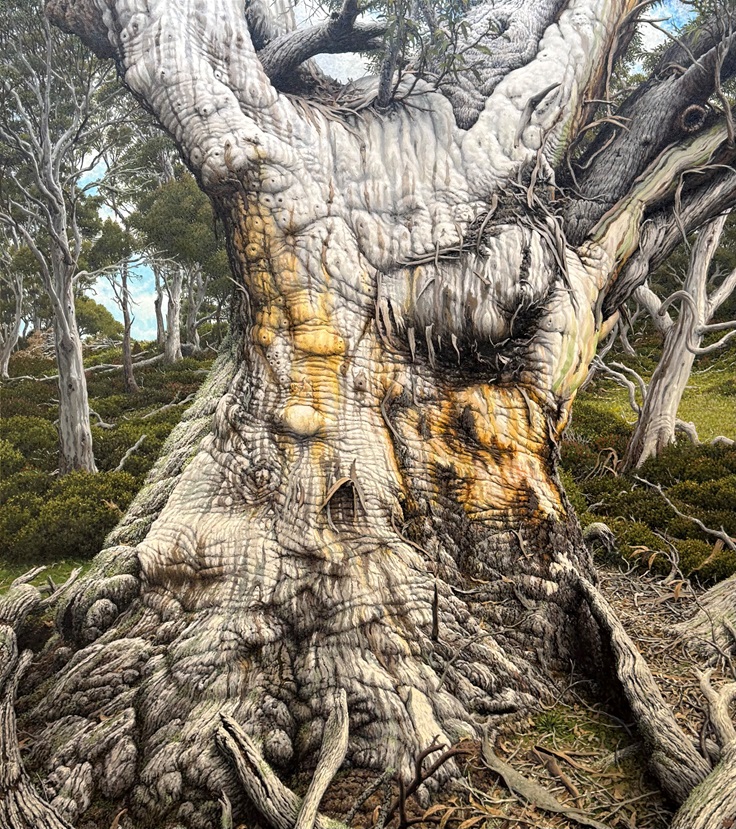
Several of the artists compressed their vision into the tighter landscape: a single tree such as was chosen by David Edgar. His charcoal on paper resonated when he stripped out colour and focussed on tone in diffused sunlight. “The full chaos and complexity of the tree is magnificent and keeps my vision concentrated,” he said.
Printmaker Melissa Smith also centred a solitary White Gum, standing sentinel over the Nive. Accompanied by sound recordings from the field, two of her prints are the ethereal “Listen to My Heartbeat – Dusk”, and “Listen to My Heartbeat – Dawn”.
An even closer view was taken in woodcut prints by Helen Mueller, who carried foraged Pine Tier materials back to the studio to produce the entwined White Gum branches, hanging at dawn light. “A new day, a new beginning.”
Their works are being exhibited at Handmark to mark National Tree Day, July 26, in a collection that TLC’s Jessie Bodor hopes will lead to a better appreciation of a pocket of Tasmania that has not been seen in such richness before. “I think it’s really important in understanding that at Pine Tier the TLC is supporting transition zones,” Bodor said. “There was complexity and beauty in these artists’ work. But it also shows that nature isn’t always beautiful and clean.”
Exhibition details: July 17 to August 3, 2026
Handmark Gallery; 77 Salamanca Place, Hobart
Andrew Darby is a former journalist for Fairfax Media who writes on threatened species from his home on the side of kunanyi/Mt.Wellington. His recent book, The Ancients, surveys Tasmania's paleoendemic tree treasury and its great threat from fire. A previous book, Flight Lines, on long distance migratory shorebirds, won the Tasmanian Premier’s Prize for Non-Fiction.
The Ancients is available here: https://www.booktopia.com.au/the-ancients-andrew-darby/book/9781761069239.html. Flight Lines is available here: https://www.booktopia.com.au/flight-lines-andrew-darby/book/9781760296551.html