

A media release published recently on behalf of Tasmanian Premier Jeremy Rockcliff states there will be no caps imposed on the number of guns an individual can own.
Currently, an individual who acquires a gun ownership licence can register as many guns as they like. I believe the number of guns an individual can own must be limited.
My ex-husband was a perpetrator of gun violence. He held a rifle to my head in front of our children while yelling, “I’m going to blow your head off, right here right now.” He kept many guns, some of which were unregistered.
Below is a drawing done by my traumatised daughter, aged five. She drew this depiction of her mother being shot and killed by her father after he showed her a gun he’d taken from the roof cavity, saying he would “shoot mummy with the gun if she (mummy) is naughty”.
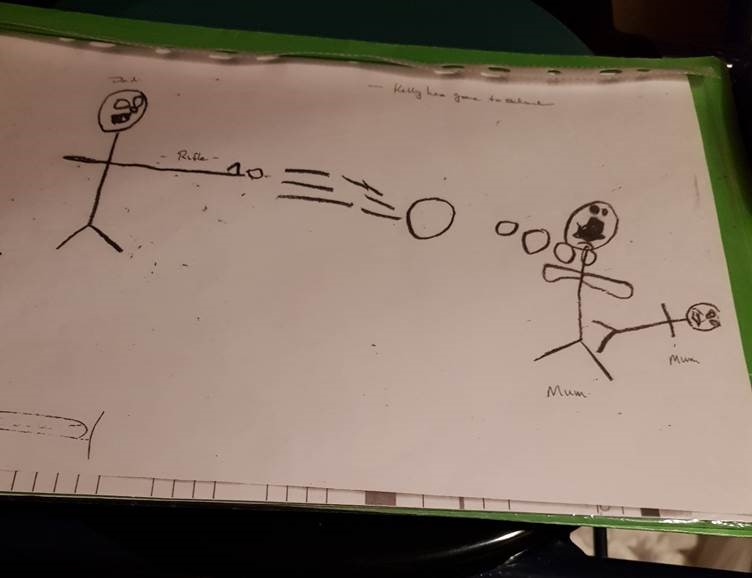
Drawing provided with permission of the artist.
Certain groups say they are law-abiding citizens and will be punished if a cap on the number of guns a person can have is introduced. This argument does not hold water as family violence perpetrators with easy access to firearms through multiple gun ownership use gun violence yet are in public seen as law-abiding citizens.
Abusers cannot have easy access to numerous guns, which currently is legally allowed.
Capping the number of guns per individual reduces an abuser’s access to the availability of weapons to intimidate or kill their partner or family member. Victims are more fearful when there are multiple guns in a house. Fewer guns means fewer opportunities to kill.
As the government considers gun reform, it is imperative to consult with those with lived experience of gun violence to inform gun laws and policy amendment. Rather than just consulting gun owners, those who are terrorised by people with easy access to guns, both legally and illegally, should be consulted. We need fairer representation.
I speak from the perspective of once being a gun owner – albeit unwillingly, with gun licence categories A, B and C – and a victim/survivor threatened by guns.
Criminals (including those who abuse their partner/children) do not use weapons for their trade, competitive shooting or for recreation. Weapons are used for criminal purposes, to intimidate, to injure and to kill. Current loopholes allow those with criminal intent to legitimately own firearms. With caps, these loopholes are even more problematic.
Criminologists state that tougher penalties are less of a deterrent to those with criminal intent than is the prospect of being detected. However, capping the number of firearms in the community makes it harder for criminals to access guns.
Tasmanian not-for-profit Engender Equality advocacy group says, “Fear through gun violence leads to long-term mental health problems such as complex PTSD for hundreds of women in Tasmania.”
In monetary terms, this puts a financial burden on our health system, social services and judicial systems, an unnecessary burden that would be less problematic if the number of guns in the community was capped.
A report by Dr Carmel Hobbs, UTAS Tasmania, states that use of weapons – including firearms, knives and cars – are known risk factors for intimate partner homicide (Matias et al. 2020).
Tasmania has the highest per capita rate of both legal gun ownership (Alpers et al. 2022b) and estimated unregistered and illicit firearms (Alpers et al. 2022a) in Australia. Youth and family violence workers are stretched to extremes trying to cater for the growing number of victims needing priority support because of life-threatening abuse. From one worker, “The level of serious assaults is high … serious physical violence is just absolutely jaw-dropping.”
Teens and young adults have been reported as saying they feels they have no voice.
At most 7 per cent of Tasmanians are licensed gun owners. Domestic violence perpetrators represent more than one in four of the Tasmanian population so it stands to reason that within that 7 per cent, though a small segment of Tasmanian society, will include abusers with access to firearms for purposes of family violence.
. . .
Deborah Thomson is a former holder of a firearms licence, and a survivor of gun violence.