
writer and photographer PEN TAYLER
“Tasmanian oak takes 80 to 100 years to grow. I think the piece I make should last twice if not three times as long.” ~ Laura McCusker
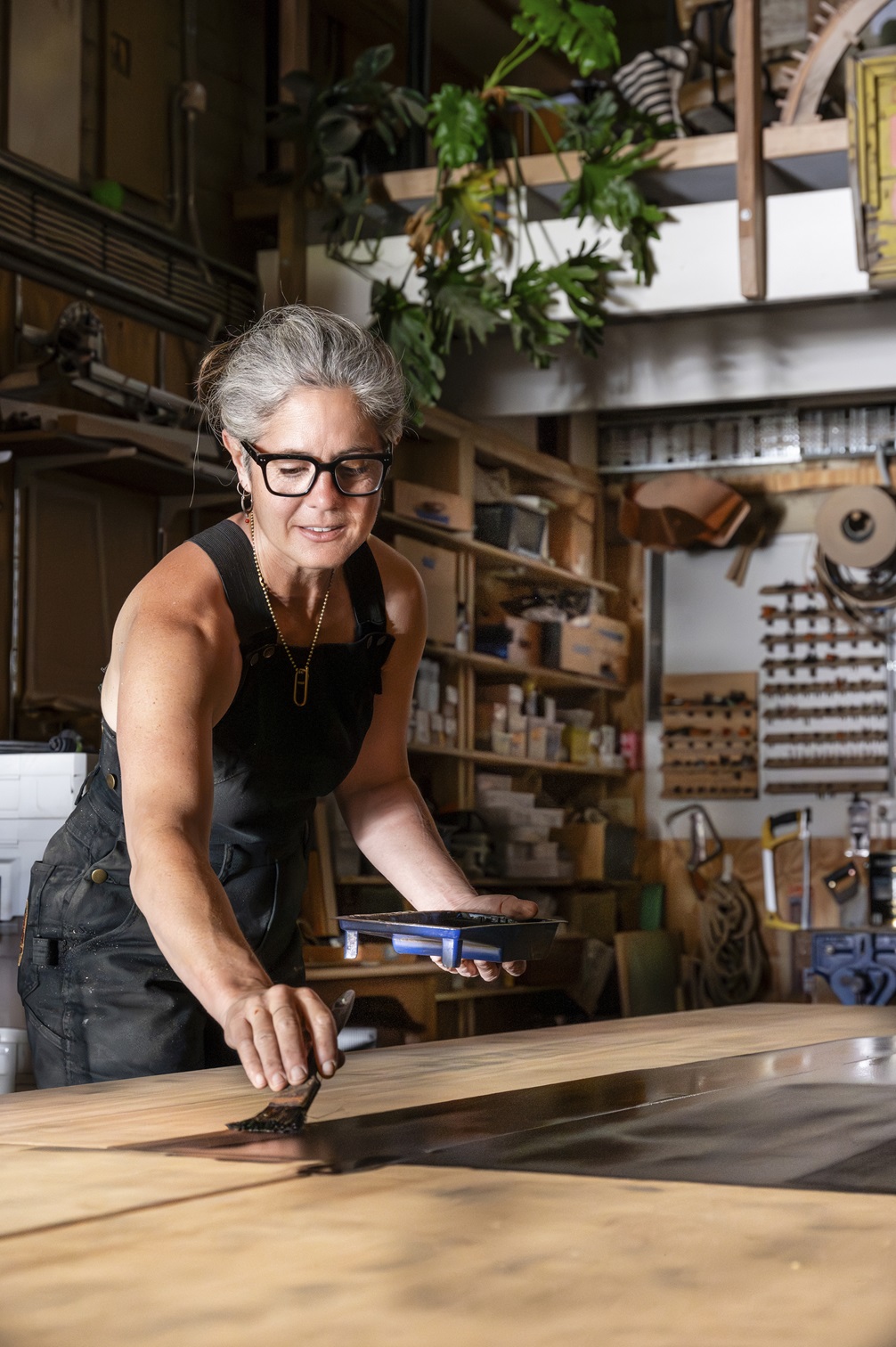
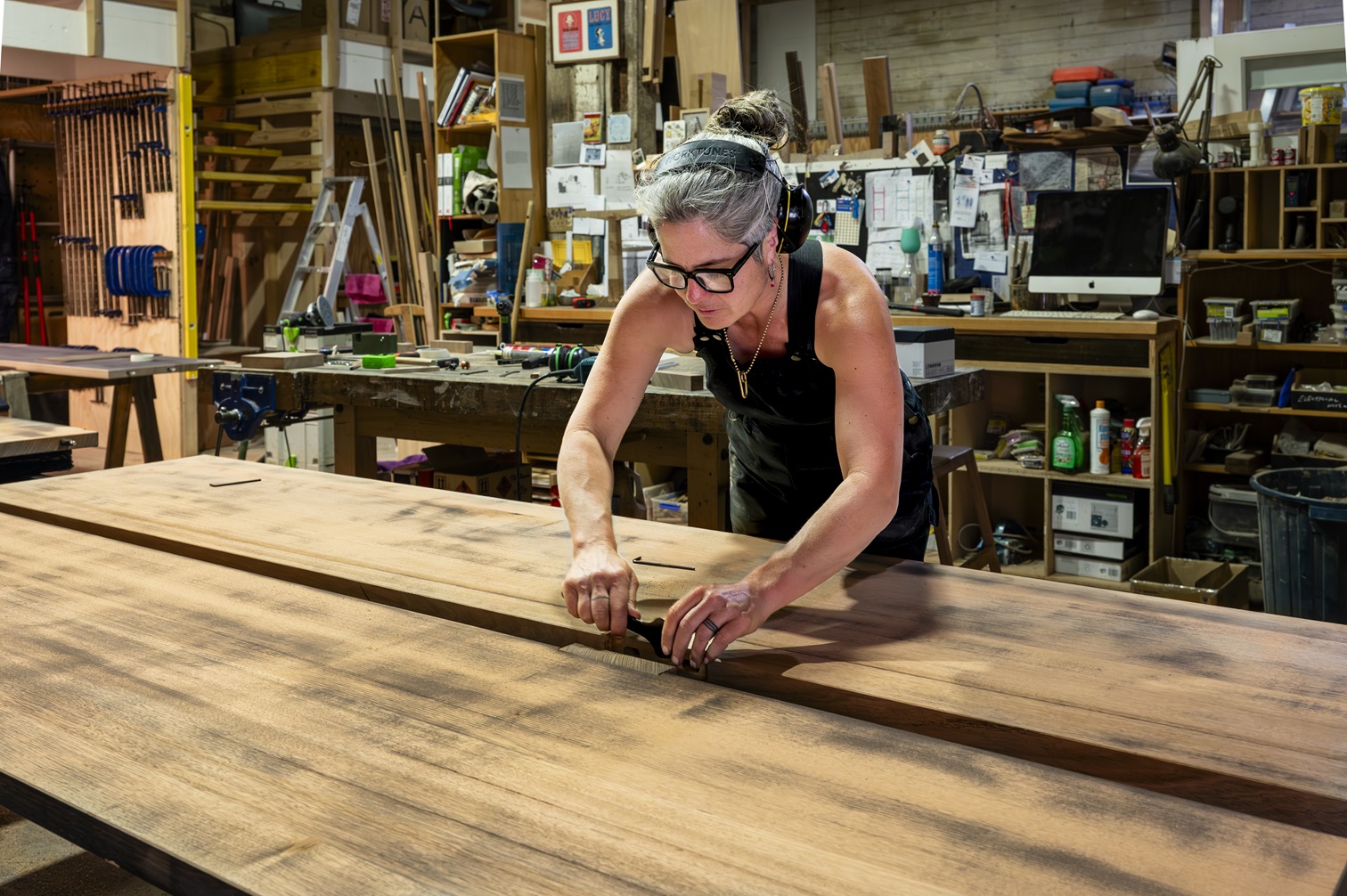
At the bottom of a delightful garden in the Hobart suburb of Moonah sits a relic of the days when the area was covered with apple orchards. Built of brick and insulated with horsehair and sawdust, a large, old apple packing shed turns out to be perfect as a workshop for one of Tasmania’s creative furniture designers and makers, Laura McCusker.
McCusker’s family background includes no furniture makers and “I certainly didn’t know any women who built furniture”, she says. Her family was mostly doctors, lawyers and teachers. The furniture in their homes was either family heirlooms or bought from retailers.
A young Laura chose fine arts, and went to Sydney University to study it, only to find, “I was frustrated because it wasn’t hands on enough.” She transferred to architecture at University of Technology Sydney, because, “I remember hearing that one of the first year projects was to build a table, and I thought that sounds fantastic.” Then someone said that getting an architecture degree because she wanted to build tables was a roundabout route to learning to make them, and that made sense, so she went to TAFE, followed by the Sturt School for Wood at Mittagong.
Now, 27 years later, “I still find great joy in my work, even sanding. Sanding can be like productive yoga where I’m just ready to sand and bliss out.”
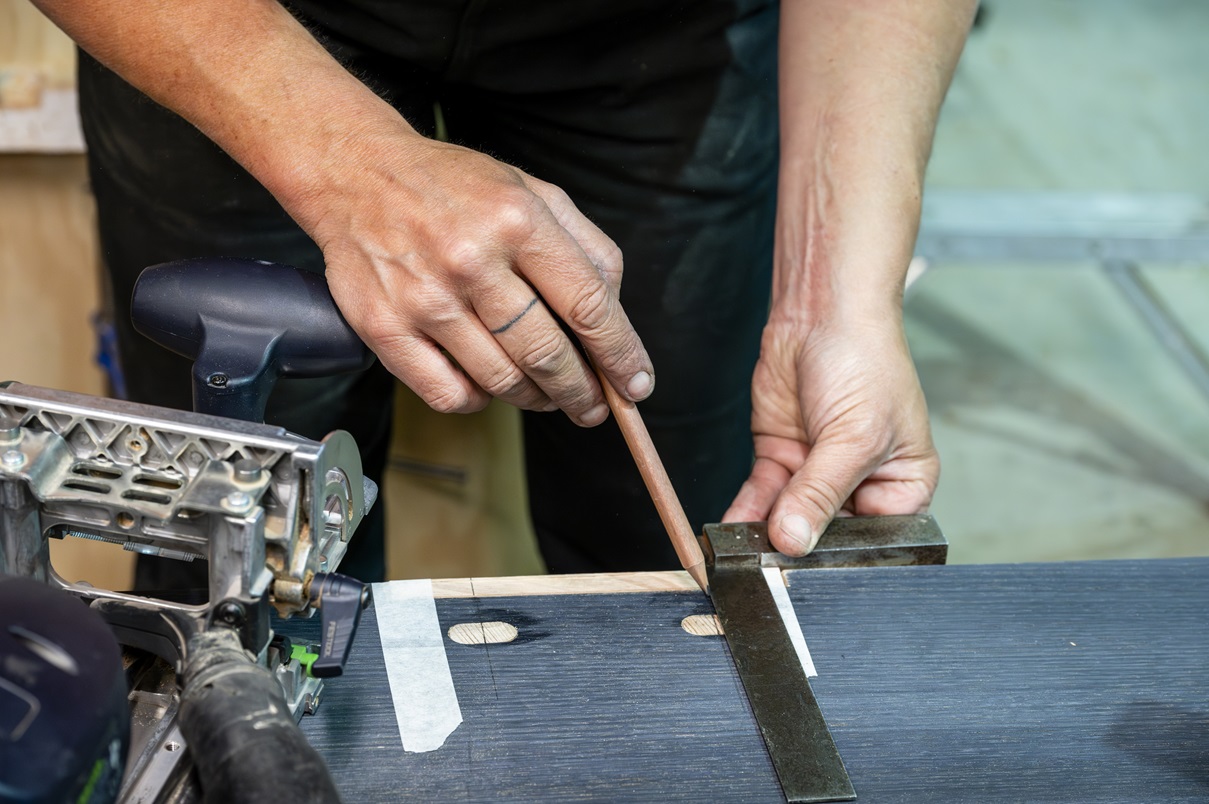
Laura McCusker’s relationship with timber is symbiotic. She might have taken a circuitous route through academia to discover her true vocation, but this fable of a table led to a true goal.
“Timber is my material,” she says. “It’s a very warm material and endlessly fascinating. There are no two pieces of timber that are the same. It lends itself to being used every day. It’s the sort of material that, as you use it over time, that patina adds to it. It’s very accessible; it’s very repairable.”
The repairable nature of wood fits with the movements that influence McCusker’s designs, including the Arts and Crafts movement and the Japanese Mingei movement. “It’s the craft of the people – the belief that everyone should be able to use beautiful things in their everyday life and that the more you use it, the more the marks of wear and tear add to rather than diminish from it.” So when something breaks you repair it. “When someone has taken the time to create something, it’s a respect of the materials and of the person who created it to take care to repair it.”
As a designer and maker, McCusker thinks about more than just the design – about how it will interact with the timber itself. “In the workshop, you learn to read the timber, its grain, its growth, what part of the tree the board has been cut from. How will the grain reveal itself around a generous curve? Which face should face out? Where will I hide imperfections? Is the imperfection actually a feature? How will it move over time, with humidity and the seasons? “
When I visit McCusker’s Moonah workshop, she is working on a boardroom table, made from Tasmanian oak for a Hobart-based software company. Tasmanian oak is McCusker’s preferred wood – her philosophy is to use local. In Tasmania it’s used for everything from fence posts to building homes to furniture making, but despite its ubiquitous use, “I’m working with a material that is very precious. Tas oak is a modest timber in the scheme of Tasmanian timbers, but all timber is precious. Tas oak takes 80 to 100 years to grow. I think the piece I make should last twice if not three times as long.”
Laura McCusker’s journey from TAFE to this perfect workshop in Moonah hasn’t been an easy one, but it’s familiar to many women. McCusker had two children early on and quickly found that trying to balance working in the arts, the rental shuffle of inner city life, childcare and the traffic in Sydney was almost impossible.
So they looked for places to live outside Sydney, until a friend commented on the benefits of Hobart: good coffee, live music, an airport, museum, symphony orchestra and cheap housing (in 2003). Moving to Tasmania enabled them to buy a house and to discover just how nice Tasmanians can be. “To be honest for the first few weeks I was a little shocked by it – that people make eye contact with you in the street, smile and say good morning. If they did that in Sydney I’d think maybe they were going to mug me!”
It’s Tasmania’s gift that McCusker moved her family here. With two young children, she still lived with long days, hard physical work and challenging times until MONA’s David Walsh put out a call for local makers. She threw her hat in the ring hoping to get one or two pieces. In the end she had so much work she was able to commit to designing and making full time.
Despite working for organisations such as MONA and Procreate, McCusker says she enjoys making domestic-scale pieces for people who are going to use them every day. Recently she delivered a desk to a writer in Adelaide who keeps sending her messages saying they’ve never written so well.
Today she has a six- to nine-month month waiting list and, after 27 years of designing and making, she says, “It’s still fun. I’m really lucky to have a job that I’m still in love with after all these years. At the end of the day I’m physically exhausted but my brain is firing. I don’t think there are many jobs these days where you get to fire on all the different facets of what it means to be a complete human being.”