
BIRDWATCHER MEETS APEX PREDATOR
writer and photographer BRONWYN SCANLON
It is too hot for humans today, which is why I’m here. The Tasmanian bush feels more alive in this summer solitude – the crackle of skinks, tiger snakes and wrens in the velvet tussock grass a hair-trigger to my senses.
I follow a wallaby track along the back of a slope toward pools of shade. Pine resin and peppermint are heady in the air. Native cherry, sweet bursaria and feathery silver wattle thicken the under-storey. Butterflies float in dizzy trajectories. A crop of boulders rises from the eucalypt forest floor. Below, water sparkles.
Unnatural quiet alerts me to the likely presence of a raptor. Cuckoos aren’t trilling, robins aren’t ticking, no high-pitched tinkling of fantails. Then I hear it. An insistent piercing cry – the call that threatens to split the eardrums of Raptor Refuge carers at close range. I stop. It does too. The absence of the call deepens the noontime hush.
I take tentative steps along the track. Keek-keek-keek, again. The loud rising call of a goshawk. It is not far away. Probably perched high on a white gum on the top of the ridge. I continue walking, but its call is persistent, magnetic. I pivot and climb the rise.
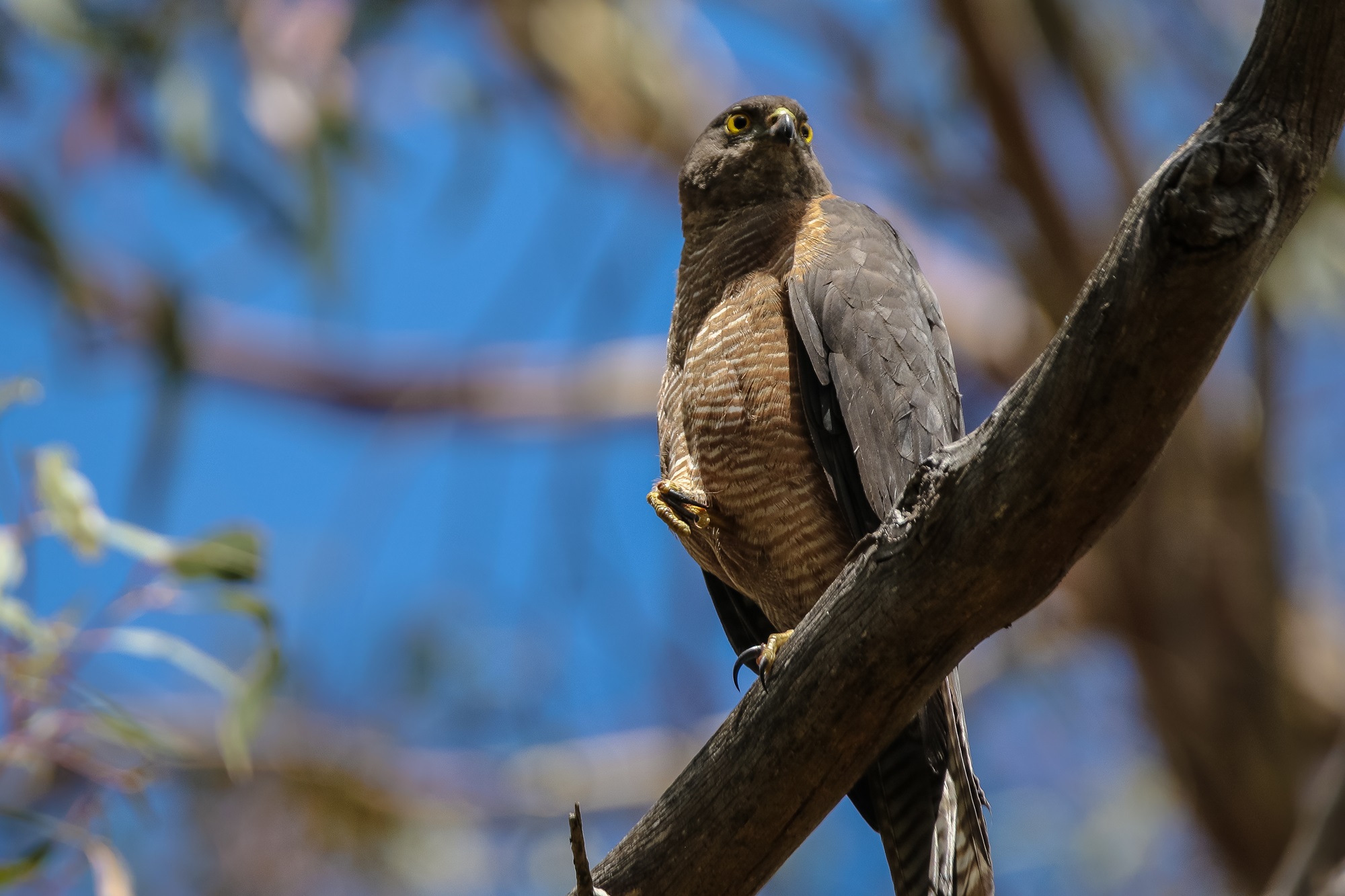
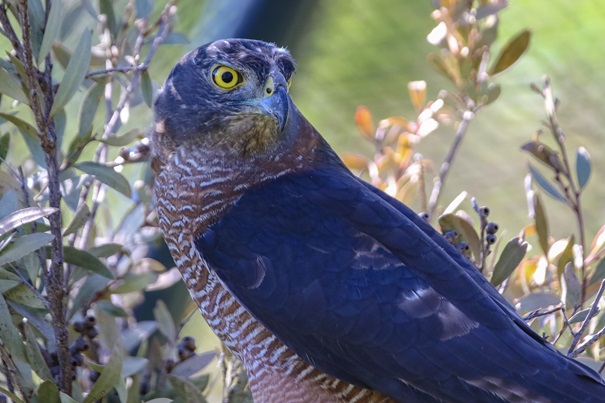
Kangaroos thud off at the snap of a stick underfoot. Then, keek-keek-keek. I look toward where my brain decides the sound originates. And I see it – a beautiful male brown goshawk. Female brown goshawks are larger and heavier than males – a form of reversed sexual dimorphism. He has fine orange barring across his cream breast, denim head and glaring gold eyes, vivid in the bright light. He clutches prey in one foot. It is rare to see a gos in the open – they are known for their habit of hiding in dense foliage to execute ambush attacks.
Another soft step and the goshawk lifts, flaps hard, then glides. Its wings flare, and it brakes to land on a nearby horizontal sheoak. My heart thumps. The hawk’s call ee-you-wick, ee-you-wick, slices the air. Then it launches again, awkward before taking flight, its long legs askew and rounded tail feathers fanned. It hurtles toward the tallest, straightest pine on the hill.
. . .
I brush away spider webs and sink into a pine needle carpet as I move uphill. At the edge of the pines, I aim my camera lens toward the tree’s thick canopy. With my naked eye, I can’t see a thing – the tree is 15-20 metres high – but my lens sees what I crave, the goshawk, perched close to the top.
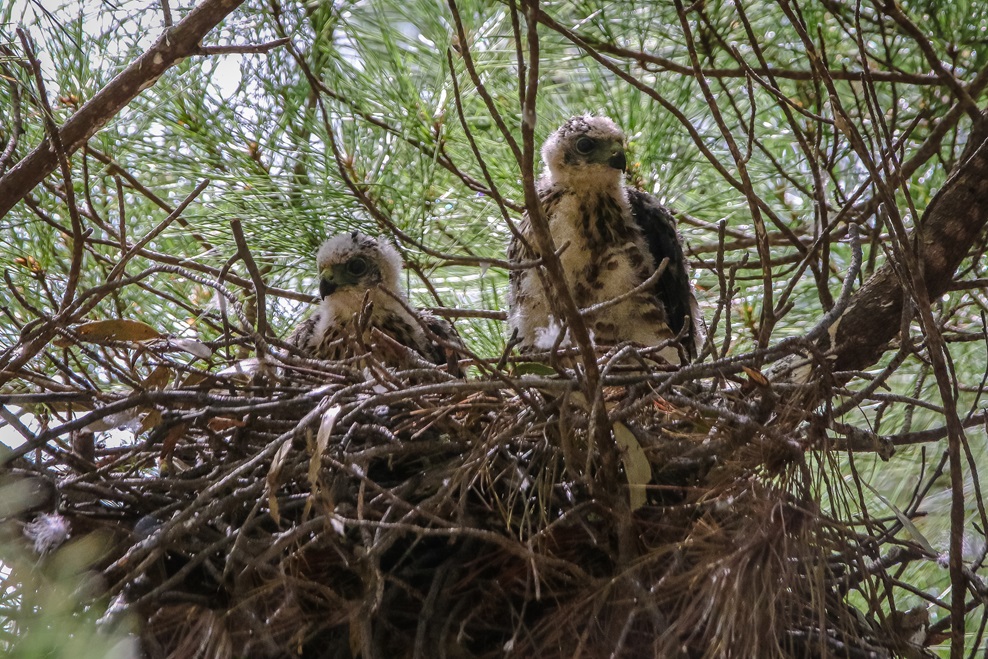
Then I notice the bulky bowl of thick sticks. Above the rim peer three brown-eyed, downy, chocolate-blotched chicks. Awe.
Usually imperceptible to hikers far below, the nest holds a commanding position overlooking the forest and waterways to the south, north and west. I take a quick snap, then return to the track, still wonderstruck. Goshawks can aggressively dive-bomb humans near nests. I think about their talons, long legs, sharp beak and fast flight. But this is not why I walk on. I do not want to disturb goshawks rearing young – every bird matters.
Goshawks are more vocal during courtship and when raising young. Calls near nests could signal an imminent approach, or I have quarry, or weird human here. From late spring to mid-summer, the goshawks are feistier at Kettering Raptor Refuge, according to experienced Ziggy Webb, son of refuge founder, Craig Webb OAM.
More monitoring is required to ensure the birds are not hungry or angry. The monogamous, joint nest builders are primed by the seasons. One season, a wild male brown goshawk visited a resident female. He fed the female goshawk through the aviary slats, proving his hunting prowess – an act of courtship. She built a nest and laid three eggs.
Tasmania is graced by two goshawks, the brown goshawk (Accipiter fasciatus) and the endangered white morph, grey goshawk (Accipiter novaehollandiae). The latter is an exceptionally stunning bird. The only all-white hawk in the world, its pure plumage helps camouflage it against pale-trunked eucalypts and bright ashen skies. A white morph goshawk trailing a sulphur-crested cockatoo flock is a frequent sight; the cockatoos act as cover to aid sudden attacks.
The white goshawk’s beautiful eye colour change – orange-yellow in younger birds and a deep red iris in mature birds – is captivating.
Brown or white, each goshawk has a distinct personality, Webb Jr says. A long-term refuge resident (a brown goshawk unable to be released) knows her carers. When Webb Jnr holds a towel at a certain height to guide her into an aviary corner, she will slip under it and run up the length of his leg. Another bird, a grey goshawk, is relaxed when called upon to display the fixed head-focus adopted when food stimulates the hunting instinct – as if it understands its time-limited, educational role for school groups.
From my human-built eyrie in hills overlooking the River Derwent, I read the spring sky. A male brown goshawk dives, then climbs above a female. The pair then arc high over the forest, their wings in unison like synchronised swimmers. Brown and white goshawks perform reconnaissance laps across suburban roofs, gardens and woodland. Bursting from leafy hides, they head back to their nest, clutching prey in the early evening.
White goshawk females, weighing up to 800g (twice as heavy as males) with a wingspan up to 110cm, take rabbits, native hens, possums, and small wallabies. Males hunt rodents, small birds and insects. One year, I witnessed two white goshawks become three, the fledgling and its parents soaring across their domain.
“Chicken hawks” is another name given to goshawks, Webb Jnr says. Goshawks don’t always distinguish between domestic and wild prey, especially hungry, inexperienced juveniles. Some farmers don’t like the prospect of losing poultry, so they shoot raptors on sight. “A short-term fix,” Webb Jnr tells me, “as another bird will soon replace it.” Options such as providing hiding shelters or enclosures are more effective. Noise is also a deterrent.
Motor vehicle collisions, barbed wire entanglements, and contact with powerlines all result in goshawks arriving at the Raptor Refuge, but shootings remain the most frequent cause. Goshawks are mainly vulnerable to this heavy persecution and habitat loss. They are protected by law.
As apex predators, goshawks play a vital role in maintaining ecosystem balance by regulating prey populations, including pest species. Goshawks, by preying on unwell or unfit individuals, promote the health of the prey gene pool. The presence of a thriving goshawk population is also an indicator of a robust and intact ecosystem.
The unexpected happens, too. Webb Jnr received a call on the 1800 RAPTOR hotline: “I’ve got a white hawk in a cat carrier,” the caller explained. “It killed a duck. When it did, a group of ducks appeared and ganged up on it.” The goshawk, young and believed to be starving, never actually got a feed. The raptor’s wrist and left-wing elbow were inflamed. Following the duck attack, the gos spent three months recovering at the refuge.
Another grey goshawk arrived at the refuge with a broken wing. It was a clean break, and the bird consequently had its wing pinned and bandaged. The prognosis – recovery and release. But the next morning, it was found “panting, squatting and drooling a bit”. Upon inspection, white lesions were discovered throughout the bird’s mouth and throat. It had frounce, a disease more commonly found in peregrine falcons when they eat a feral pigeon’s head. It is highly infectious with a high mortality rate. The refuge decided to stick with the hawk, trialling a range of antibiotics to find what worked for this particular bird. It declined for several days. Then one day, “it was up”, and it continued to recover.
“A slow process but worth it,” Webb Jnr says. In less than a year, it returned to the wild.
Caring for goshawks requires an appreciation of their unpredictable nature. Webb Jnr recalls returning from school when he was aged 12 to find his dad with “four or five dots around his eye”. Webb Snr had transferred a brown goshawk in a pet pack between aviaries. Opening the carrier, the bird had positioned itself on its back, long golden legs extended. His father lost focus for half a second, and the raptor “got him”.
“You’ve got to be on the ball because just like that you could lose an eye,” Webb Jnr says.
When a gos is “fanging” around the flight tunnel at the refuge, the feeling could not be more exhilarating for the volunteer carers. From a small aviary, the raptor progresses to flight fitness training, where, at first, the goshawk might do half a lap or a full lap but be flying low. Over a month or two, the goshawk will begin to fly higher and do this consistently — circling when the carers are within range of its keen eyesight, as if it is “showing off”. The bird lets them know it is ready to go.
For Webb Jnr, there are days when things don’t go well with a raptor he has nurtured over long periods. He accepts the grief and loss as part of the circle of life. It fuels his fire to prevent raptors’ lives from being cut short.
. . .
I return to the goshawk nest realm a month later, when the young should be fully fledged. Success. Three juveniles – streaky plumage and grey-brown eyes – perched high on branches, observing my slow passage on the trail.