
On December 23, 1897, five men in Westbury climbed into a cart pulled by two horses and headed to the Great Lake to spend Christmas. Today a sealed highway runs between the two places but in 1897 this was far from the case. The Great Lake area was remote and wild, with few roads and even fewer inhabitants. This was decades before there were any shacks or hotels, and although trout had been introduced to the Great Lake in 1870, the trout fishing industry that we know today was in its infancy. The dams that were built in the early part of the 20th century were years away. The Great Lake was in its original form.
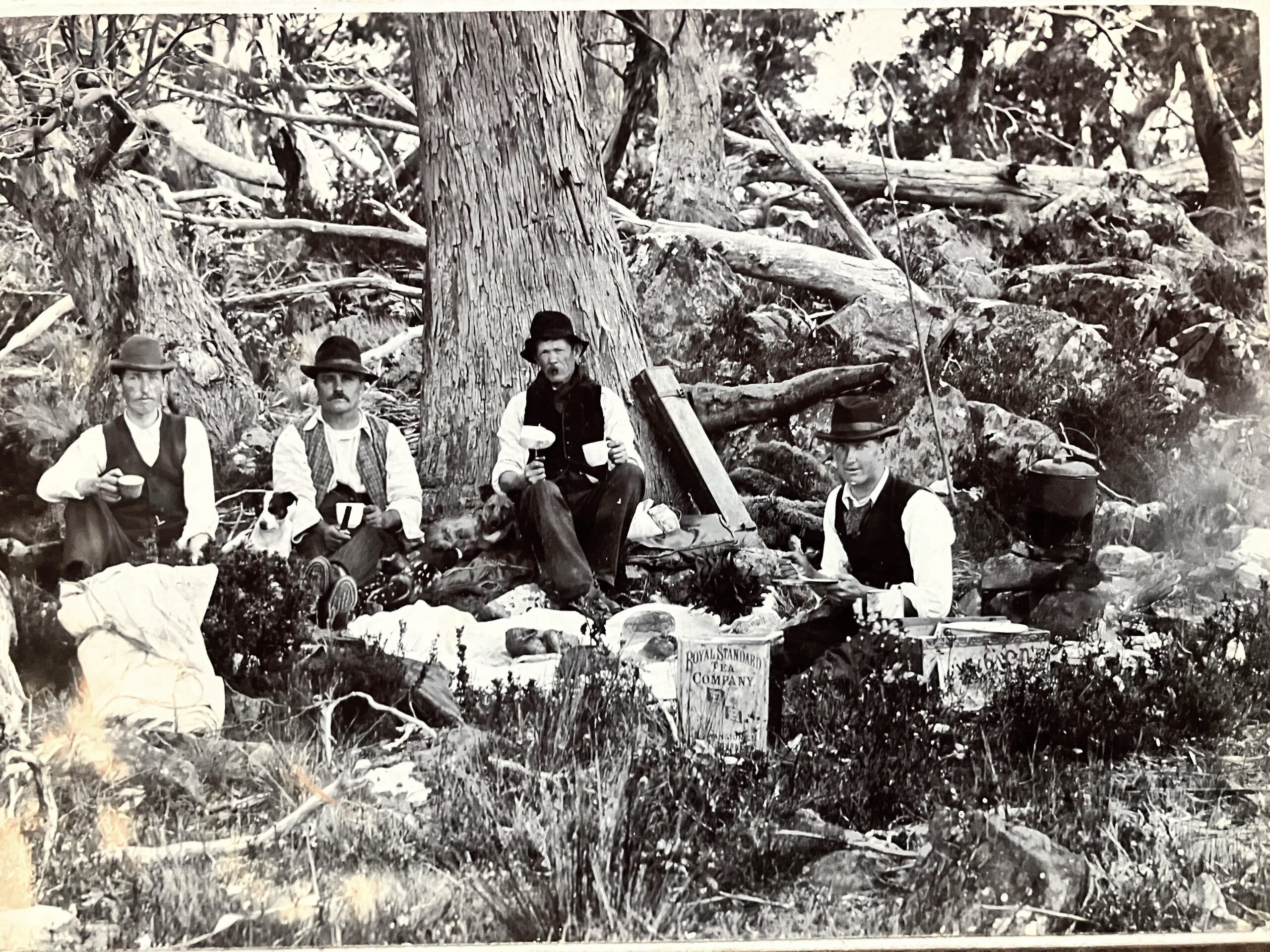
I came across a photograph of the group of five many years ago, with the caption on the back of the picture simply saying, “Christmas Day, 1897, Great Lake”. Initially it was of interest because the gentleman sitting in front of the gum tree, second from right, is my great grandfather, George Searle. Next to him (second from left in the photograph), is his brother-in-law, Frank Dando. The photograph is quite small, only 15cm by 10cm, but very clear. When I really looked, the amount of detail was astonishing.
Hobnails in the soles of the boots are visible. The four men are drinking from china cups – not a tin mug to be seen on this special day. There are two dogs, one each side of Frank Dando, and Frank himself is sitting on the skin of a spotted-tailed quoll. George Searle has a baked potato on his fork and in front of him, on the improvised tablecloth, is a roast chicken and a loaf of damper. Next to George is a gun case and, embedded in the tree above his head, a small axe. Behind the man on the far left, a billy sits over the smoking fire along with what may be a bush fishing pole. The supplies have been packed into the two old tea chests that sit in front of the party, such wooden chests being common in those days.
The landscape the men are sitting amongst is still typical of the Great Lake area today – eucalyptus trees and scrub, amidst large dolerite boulders left behind after glaciers moved across this land during the last Ice Age.
George Searle was born in Tasmania in 1857, the son of convicts George Searle, from England and Barbara Adams, from Ireland. He would have been about 40 years of age when this photograph was taken. George married Elizabeth Annie Dando in 1885 – her brother is sitting next to George in the photograph. The other two men are J Barnard and AS Barnard, but I know nothing more about them. The photograph was taken by the fifth member of the group, J French, and would most likely have been taken using a glass plate, hence its clarity.
. . .
While the photograph is a wonderful snapshot of life for my ancestor, and obviously a special day in a remote part of Tasmania, that’s where the story lay for many years. Just how and why this party of five came to be in the rugged Central Highlands on Christmas Day in 1897 was a mystery. But there was a clue. A small, hand-written note on the back of the photograph said, “3 columns, early Examiner”. Some sleuthing on Trove finally got to the bottom of the story.
The Examiner of Thursday, September 6, 1928, some 31 years after the event, contained the following story on its front page, underneath the photograph of the party sharing Christmas dinner.
The First Party to go by Horse-vehicle from Westbury
Mr. George Searle of Westbury forwards the photograph reproduced above.
He writes: “We left Westbury on December 23rd, 1897, in a spring van drawn by a pair of horses. We camped at Quamby Bluff the first night and started early the next morning for the Great Lake. For about three miles the road was fairly good, but after that there was no road – only a surveyed track, with a peg about every quarter of a mile, over very rough country.
I was the only one to stop in the van, and I had to stand up and drive over logs and big rocks. All the springs of the van were broken, and the pole, and the horses pulled all their shoes off. However, we got to Pine Lake at 2 o’clock, and to the Great Lake at 4 o’clock. We had Christmas Dinner at the lake, and stopped a week.”
It is intriguing as to why George decided to put pen to paper some three decades after the event, but the story does at least give some context to the photograph. And these paragraphs are classics of understatement and brevity. To get some idea of the magnitude of the trip, consider the following. Westbury to Quamby Bluff is about 26km. There was some sort of road to this point but it took the men most of the day to cover the distance.
Quamby Bluff to Great Lake is about 20km and all uphill with some punishing steep sections. This section of the trek would have presented the most challenge. The van (cart) was obviously damaged and the horses had lost their shoes. It sounds like four of the men walked most of the way while George stayed in the van and attempted to drive the van and horses over the “very rough country”. The journey would have been tortuous with frequent stops to repair breakages and move obstacles.
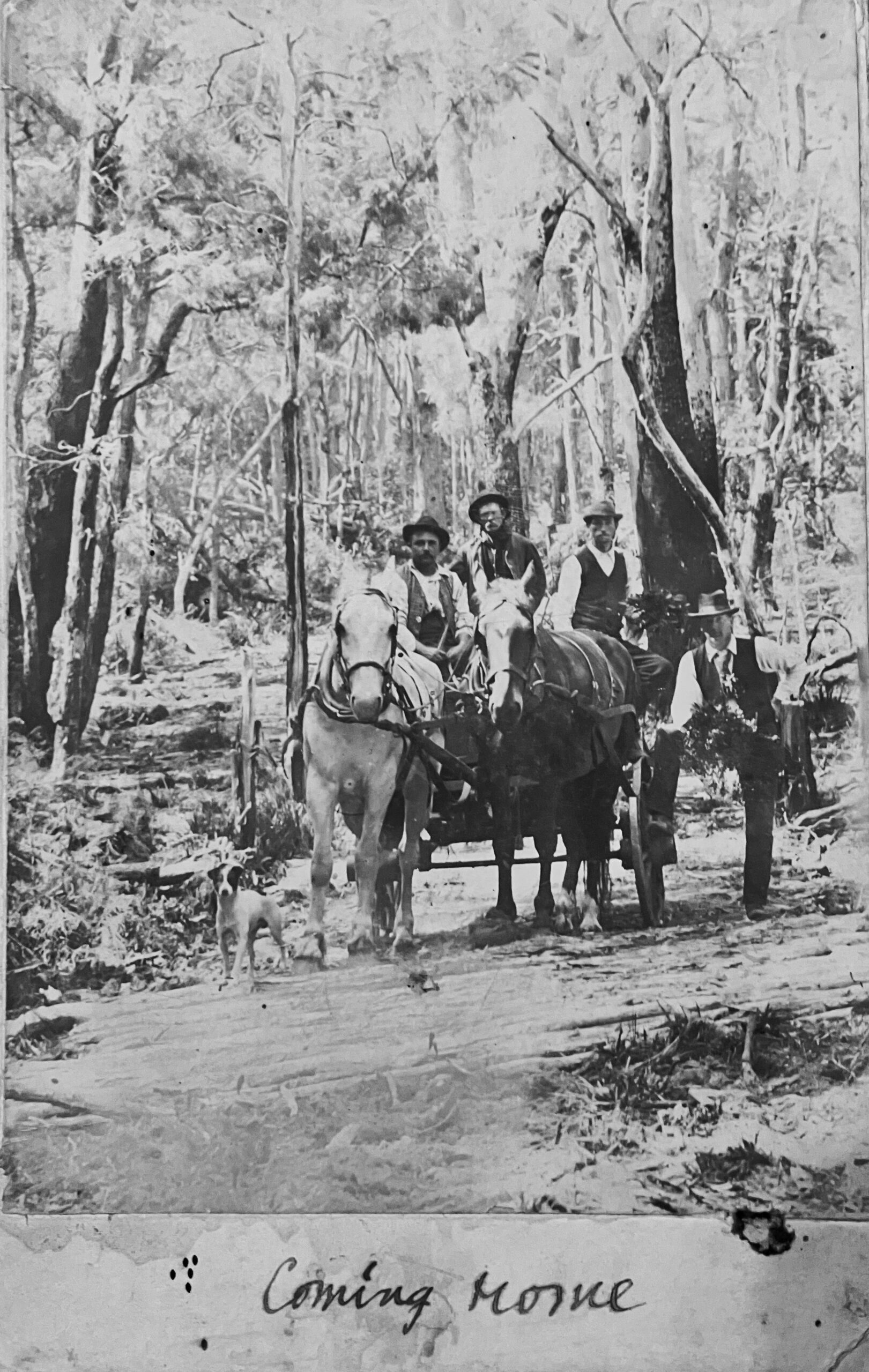
Today, the road is smooth and all bitumen. The steeper sections have been replaced with switchbacks and the total trip from Westbury to the Great Lake would take the average car less than an hour. In 1897 I suspect the surveyed route would have headed straight up the escarpment onto the Great Western Tiers. Indeed, it appears to have taken this party about nine hours to travel the 20km on the second day alone. I suggest a good bushwalker could cover that distance these days in about six hours!
So what started out as just a very interesting family photograph eventually revealed a fascinating story and a quite incredible, intrepid and pioneering adventure.
And I learnt something about myself along the way: it appears that both my desire to spend Christmas away from the madding crowds and my love of adventuring into wild and remote places, may just be hereditary.