
It’s easy to label Smithton as backward, isolated, maybe even inbred, but that would be missing the point. Smithton isn’t trying to be anything. It just is. It doesn’t want to be trendy. It doesn’t want your approval. And, honestly, that kind of self-assured indifference is admirable.
If you ever find yourself in north-western Tasmania and feel like the world is moving a little too fast, then take a drive to Smithton. You’ll know you’ve arrived not by any obvious sign, but by a creeping sense that time itself has packed its bags and buggered off.
Smithton isn’t the kind of town that tries to impress. I’m not entirely sure it knows visitors exist. With a population of about 4,000 people and home to more cows than humans, it’s a rural stronghold nestled in Tasmania’s marshy armpit. It’s the sort of place where the paddocks stretch endlessly, the gates are locked tight, and the “Keep Out” signs seem less like warnings and more like small-town hospitality.
Smithton is often referred to as “Mifton” by outsiders and by some self-deprecating locals, too. The nickname comes with a reputation: a place full of inbreds, Bible-thumping hippies, and homeschooled kids who’ve rarely been past the front gate. It’s the kind of place people love to mock from a distance, a punchline on road trips and a warning whispered down south.
Rolling into town, the atmosphere hits you immediately. You’ll see utes cruising past with someone casually bouncing around in the tray, and no one gives it a second look. Try that in Burnie and you’ll have three squad cars and a helicopter on your tail before you hit the first roundabout. In Smithton, it’s just Bazza giving Gazza a lift home.
The supermarket is small, and everything seems to be in the wrong aisle. Looking for bread and butter? Well, hope you’re going down the meat aisle. Next to it, a Reject Shop so massive it could double as a second town hall. Need a garlic press, a beach umbrella, or a packet of outta date lollies? Smithton’s Reject Shop has your back.
Designer coffee? Not a chance. But you might stumble upon a thriving marijuana plant budding in someone’s front yard or a whole paddock sprouting up, growing with the sort of bold indifference only this town can pull off. Nobody minds. Nobody cares.
There are no fast-food chains in Smithton. Not one golden arch or twirling bucket. So when the craving hits to smash a burger, the locals pile into a car and make the hour-long journey to Burnie. Just for a Happy Meal, a Zinger Box, or whatever cholesterol-inducing fantasy they’ve been dreaming up. Then, chips in lap and Coke sloshing precariously in the cup holder, they turn around and drive the whole hour back as though it’s the most normal thing in the world. Because in Smithton, it is.
. . .
Smithton is home to musical toilets, arguably its main attraction and claim to fame. I walked into one, and suddenly Beethoven’s Fifth was echoing off the slimy cracked tiles as though I’d entered an aggressively cultured urinal-themed opera. Is it charming, disturbing, or both? Who’s to say? But I’m fairly certain I’ve had the most dramatic wee of my life.
Oddly enough, there’s a kind of rugged joy here, especially if you’ve got a thing for four-wheel driving. Locals spend weekends skidding through bushland on quad bikes or mud-slick utes as though it’s a competitive sport, which it probably is. There are no rules out here: just tread depth and bragging rights.
The social dynamics in Smithton are as raw and unfiltered as the landscape. Everyone knows everyone, and privacy is more of an ideal than a reality. You can’t go to Woolies without bumping into someone you went to school with, dated briefly, or heard rumors about through your cousin’s mate’s pet dog. Your business isn’t your business for long – it’s communal property. But there’s a comfort to that too. People show up for each other. When someone’s house floods or catches fire, you won’t have to ask for help – it’ll already be there.
. . .
The people of Smithton fall into rough categories. You’ve got The Lifers born and bred here, and barely interacting with the outside world. Then there are The Escape Dreamers, always talking about leaving but never quite making it past Wynyard. There are The Farmers, who live for early mornings but still find every opportunity to grumble about them with muddy boots and machinery that never quite works right. And then there are The Temporary Settlers – teachers, tradies, or contractors who arrived for a short-term gig and now find themselves captain of the local footy team with a labrador and a 20-year mortgage.
The best swimming spot in Smithton isn’t the beach; far from it. The beach is more swamp than surf, a murky, miserable stretch of water that looks like it gave up sometime in the 1990s and no one had the heart to tell it. There are some rivers and streams, but they are no improvement; even the fish seem to avoid them. Smithton has a small public pool; you just have to pray that it’s open.
The real gem is a dam hidden out in the bush that no one really talks about. It’s a fifteen-minute drive down a gravel road that looks like it leads to nowhere and, technically, it does. What you find at the end is a giant, man-made ravine, maybe 15 metres deep and about the size of a football oval. It’s not much to look at, and so out of place, it feels like it was dropped there by accident. Or like it’s hiding something.
But when it’s full, there’s nowhere better. The water’s flatter than the town pool but without all the chlorine and unspoken risk of swimming through someone’s warm little accident. It takes about 10 minutes to swim from one side to the other – 15 if you’re me.
From above, the water looks like your standard murky brown, the kind of colour that screams tetanus, but get close and you’ll realise it’s surprisingly clean. Cleaner than the ocean, even. And if you’re lucky and it’s been raining, or if you’re just feeling a bit ballsy, there’s a ledge up one side you can jump from. No sign, no handrail, just gravity and questionable decision-making.
You’re boxed in by massive dirt walls on all sides, with rows of plantation trees growing on top like someone tried to hide the whole thing and forgot to finish the job. It makes you wonder what else is out there, what other strange things are hiding in the bush, quietly doing their thing while the rest of the world forgets Smithton exists.
Just half an hour down the coast lies Stanley, a town that feels like it was plucked straight from a travel brochure. It’s polished, pretty, and always ready for a close-up. It hosts quaint cafés with handwritten chalkboard menus, tidy cottages with white picket fences, and a clean waterfront where seagulls pose like extras in a heritage film. But its main attraction is a giant volcanic plug labelled The Nut, and rightly so, a big lump of rock smack in the middle of nowhere with Stanley village wrapped around it as though it was keeping it safe.
Stanley poses and draws a crowd. Smithton stays home in its trackies.
. . .
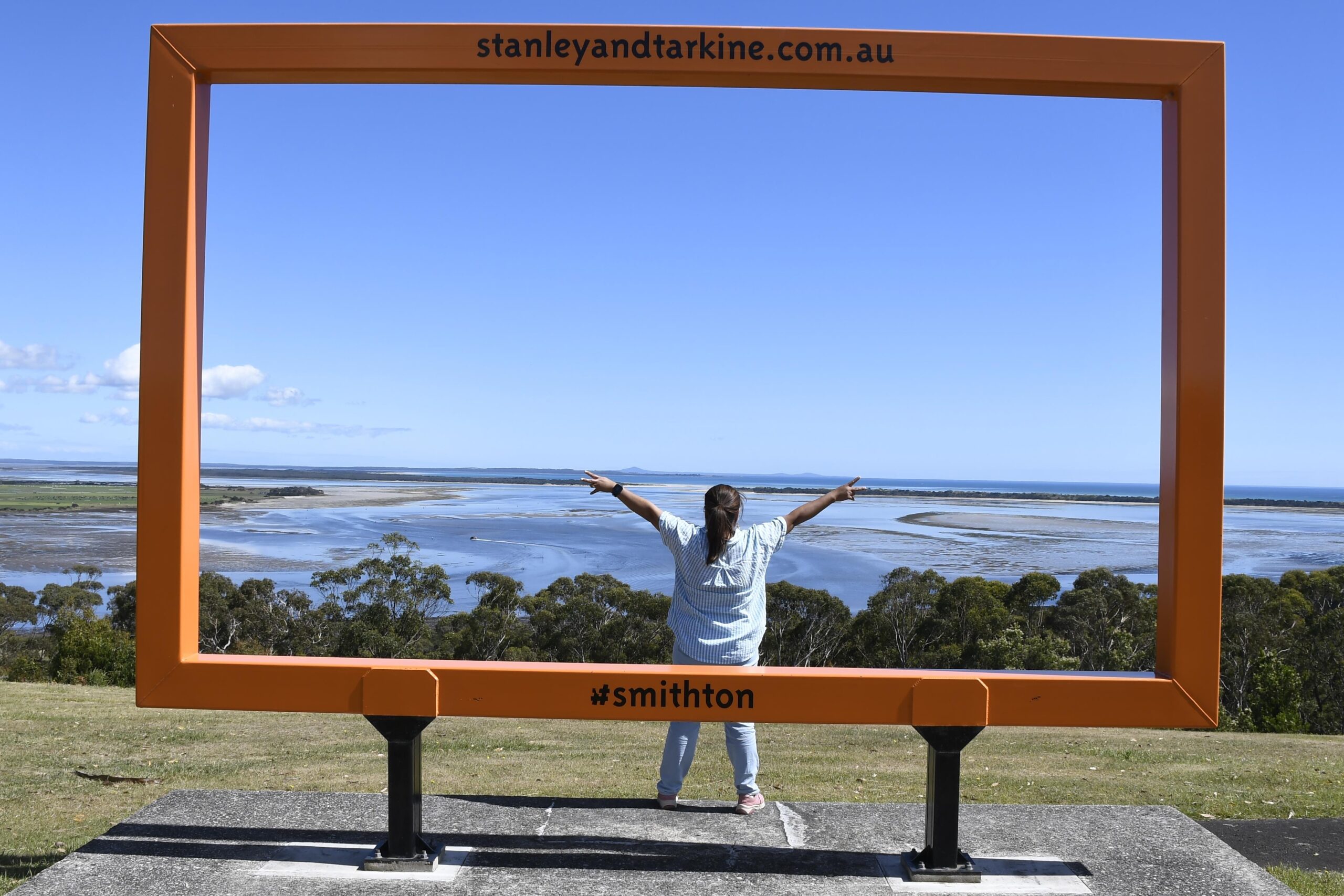
There are town events every now and again, but in Smithton they feel different: real, unpolished, and somehow more genuine. It’s the kind of place where a good chunk of the town will show up just because they can. There are the Christmas carols, held on top of a hill looking down upon Stanley, where families gather on lawn chairs and picnic blankets, sharing home-baked goods from little wicker baskets. Kids run wild, parents sing off-key, and no one cares if the sound system’s fuzzy or the Santa beard’s half falling off. It’s not about perfection. It’s about celebrating together as a town.
It’s easy to label Smithton as backward, isolated, maybe even inbred, but that would be missing the point. Smithton isn’t trying to be anything. It just is. It doesn’t want to be trendy. It doesn’t want your approval. And, honestly, that kind of self-assured indifference is admirable.
But if you hang around and look past the rough exterior, the cracked footpaths, the late-night servo runs, you start to see what makes the place tick. There’s a rhythm here: slow, stubborn, and completely its own. I met people sharp, funny, self-aware who know exactly what kind of place they live in. And they choose it anyway. That’s what stuck with me. Not the town itself, but the people who stay, flaws and all.
Driving away, I find myself oddly fond of the place – its bluntness, its grit, its total refusal to pander or pretend. And the odd bunch of locals I call friends. There’s something refreshing about Smithton. A town that simply is.
So if you’re chasing picturesque scenery, good food, or even just something to do, keep driving. But if you’re after a place where no one gives a damn and toilets burst into song, Smithton’s waiting. Just don’t expect it to notice you’ve arrived.