

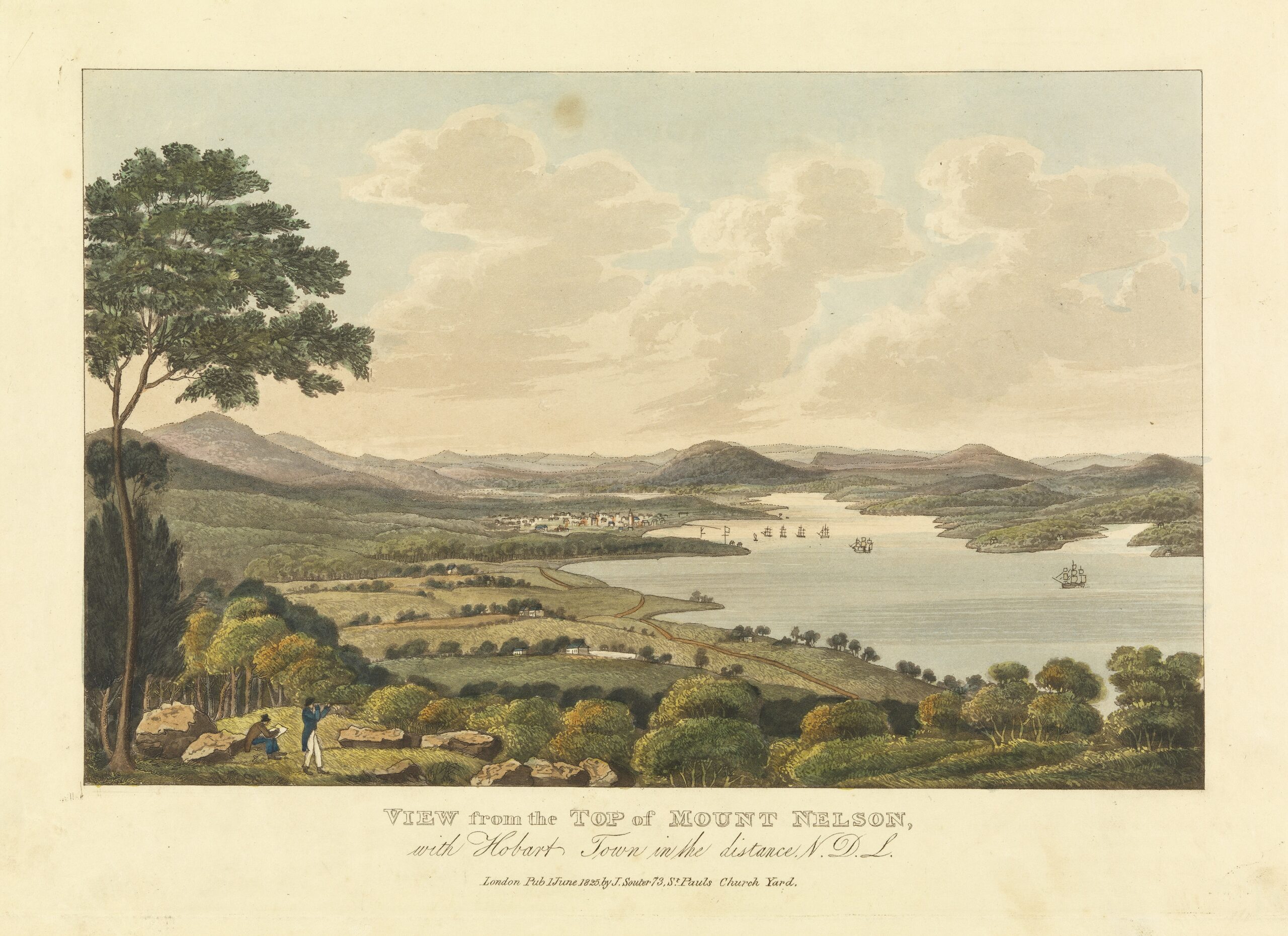
“View from the top of Mount Nelson with Hobart Town, and circumjacent country Van Diemen’s Land”, by Joseph Lycett (c. 1823). Allport Library and Museum of Fine Arts, State Library of Tasmania.
Two hundred years ago – December 3, 1825, to be precise – the verdant island of Van Diemen’s land became a distinct and independent colony within an expanding British Empire. Separation from its parent colony of New South Wales began a new era for the fledgling settlement on the Derwent River. It revived hope, introduced a new system of government and launched Van Diemen’s Land on its bumpy path to responsible government three decades later.
writers ELEANOR ROBIN and TERRY NEWMAN
It is easy to imagine the buoyant atmosphere during the flurry of official events and proclamations leading to independence for Van Diemen’s Land. Lieutenant-General Ralph Darling, the newly appointed governor to New South Wales travelled from England via Hobart Town to personally deliver the Order-in-Council legitimising separation, signed on June 14, 1825, by King George IV.
Darling’s arrival in the Katherine Stewart Forbes on November 24, heralded a fortnight of festivity. Cannons sounded as his ship anchored, and crowds flocked to the wharf to welcome him, his family and his suite. In the evening, he walked informally around town greeting residents. Meanwhile, in deference to Darling’s higher rank as Captain General and Governor-in-Chief of Van Diemen’s Land, Lieutenant-Governor Colonel George Arthur relocated with his family to the government residence at New Norfolk. While on the island Darling was entitled to govern, however, he diplomatically avoided any interference with Arthur’s administration.
On November 25, Darling entertained at a levee ‒ a governor’s reception ‒ causing the Hobart Town Gazette to remark that the immediate presence of a commander was always attended with the happiest effects, giving life and vigour to the community generally. The following week, Darling inspected the jail, penitentiary, army barracks and other government buildings.
Arthur declared a public holiday for the big day, Saturday, December 3, enabling members of the public to attend a series of official ceremonies, culminating in the reading, or in the language of the day, “publishing”, of the King’s Order-in-Council.
That morning the press announced the memberships of the new Legislative Council and the new Executive Council, approved by the Crown. The Executive Council met for the first time.
Apparently, reading of the oaths and swearing in of the commissions became rather long and tedious and many of the spectators Arthur had encouraged had gradually drifted away before the sheriff proclaimed the Order-in-Council in the street in front of Government House. A royal salute from the Mulgrave Battery wrapped up formalities and, in the evening, public-spirited inhabitants illuminated their homes and celebrated.
The Hobart Town Gazette reported that the establishment of Van Diemen’s Land as a separate dependency was “a glorious and important era” in the colony’s history. “Every true colonist feels joy unmixed upon the occasion; and, to the remotest corner of the Island, will contribute his part, to confirm and exalt that rank and character, which His Majesty’s Ministers are ready to allow, we are about to maintain in the eyes of the world.”
After Darling’s departure on December 6, Arthur answered only to the Home Office in London. Anxious to emphasise the change that had occurred, a week later he elevated himself from “His Honour” to “His Excellency”. As Darling never returned to Van Diemen’s Land, the line of executive authority has run from the renowned George Arthur over two centuries to present-day Her Excellency the Honourable Barbara Baker AC.
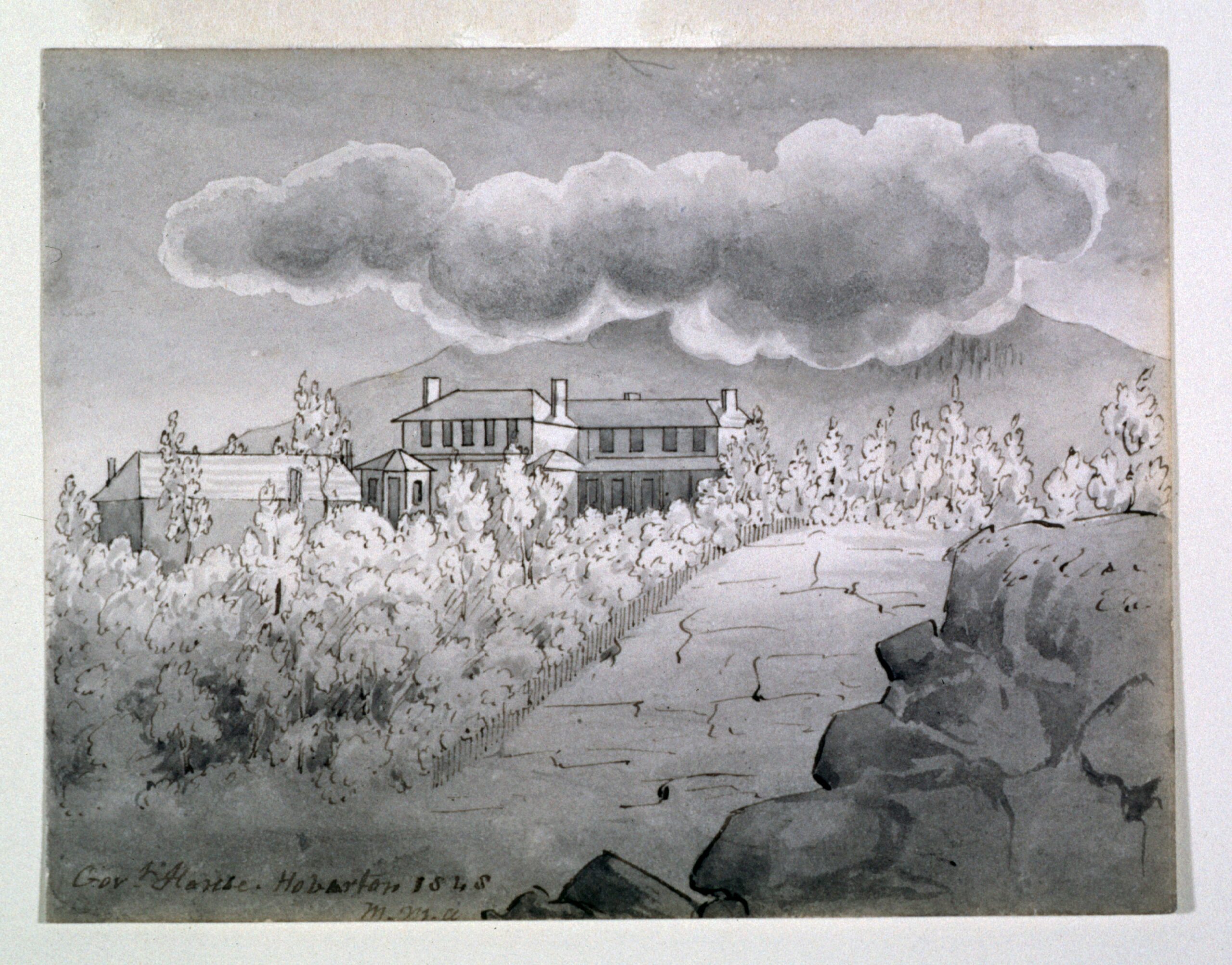
“Government House, Hobarton”, by Mary Morton Allport (1848). Allport Library and Museum of Fine Arts, State Library of Tasmania.
The Chief Justice received the same power and authority in Van Diemen’s Land as the NSW Chief Justice had in relation to New South Wales. Subordination to a Governor in Sydney had ended, along with all the frustrations and delays causing inconvenience and expense to everyone, including litigants and merchants, dealing with a superior power distanced by a long sea voyage.
An important legacy of the separation was the definition of the territory of the new colony, in summary referred to as “the Island of Van Diemen’s Land, its Islands, Territories or places adjacent, including Macquarie Island”, whose exact boundaries Arthur proclaimed on December 12. It is probable that the islands “lying southwards of Wilson’s Promontory”, such as King Island and the Furneaux Group in Bass Strait, would have been claimed already by Victoria had that colony existed at the time. In reality, Port Phillip was grasped by Van Diemen’s Land entrepreneurs in 1835 and not legally separated from NSW until July 1851.
In retrospect, it is true that every step to the island colony’s independence had been hard wrought. The victory was a combined effort of settlers desiring the common rights of British subjects and George Arthur’s stated need for legislative and executive authority to do his job properly.
John Thomas Bigge, the Royal Commissioner who conducted an exhaustive inquiry into the administrations of New South Wales and Van Diemen’s Land between 1819 and 1821, greatly assisted. In gathering his evidence Bigge heard and understood the difficulties and grievances of hundreds of settlers. His formal reports initiated the granting of a charter of justice establishing criminal and superior civil courts in both places. The first Chief Justice for Van Diemen’s Land, John Lewes Peddar, had opened the Supreme Court in Hobart Town on May 10, 1824, among much rejoicing that there was now a court with full civil and criminal jurisdiction. Two days later, Colonel Arthur arrived, replacing Colonel William Sorell as lieutenant-governor.
Bigge also told the Secretary of State for War and the Colonies, Earl Bathurst, that New South Wales and Van Diemen’s Land should be immediately separated and made independent of each other. When the British Parliament considered legislation in 1823 for the better governance of New South Wales (4 Geo. IV C.96 basically providing for an Executive Council and a new Legislative Council), Bigge recommended insertion of a clause into the statute providing for possible future erection of Van Diemen’s Land independent of New South Wales.
On hearing about this proviso, Van Diemen’s Land’s leading merchants, landowners and other free inhabitants petitioned the King to support and hasten separation. They argued that the island, originally a mere penal settlement, had advanced with an increased tide of emigration (the population had more than doubled between 1820 and 1824) accompanied by a considerable influx of capital and an active spirit of agricultural and pastoral improvement and trade. But, because of its differences in moral and physical state to the parent colony, its true interests could only be rightly understood, protected and encouraged by a resident government – not subject to the control of the local government of NSW. Former governor William Sorell, then back in England, and prominent Hobart Town merchant Edward Lord, brother of the British Member of Parliament, Sir John Owen, expeditiously delivered the petition.
The separation was a fillip for the island’s more than 100 of “dutiful and loyal subjects” who had unified and found their feet in the political action of petitioning the King. They had not received all that they had requested but had enjoyed a big boost in morale and a sweet taste of success. There were many actors in the outcome – from rulers, administrators and diligent civil servants to builders and artisans, merchants, landholders, bankers, and arrivals with fresh enthusiasm for their new land – all cognisant of the need for easier access to markets, services and stable livelihoods.
The journalist and publisher Henry Melville described the improvements carried on in all parts of the colony around this period as “truly astonishing” and said Van Diemen’s Land had “arisen from a wilderness to be a populated settlement – from being but a jail on a large scale, to a British colony, highly favoured by the Mother Country as an appendage, and one of the most favored shores for enterprising emigrants”.
Today the long-term significance of separation is barely recognised. Tasmania rejoices in its distinct identity. The opening of the sheep runs and farmlands that Melville applauded resulted in the suffering, dispossession and marginalisation of Tasmania’s indigenous people, a sad history that modern Australia is still coming to terms with.
In April 1826, Arthur’s ambitious nephew, Captain John Montagu, became clerk of both the Executive Council and the Legislative Council and, because of the similarity in memberships, they became known as the “twin councils”. The Legislative Council convened for its first meeting on June 21, 1826 – on George Arthur’s birthday ‒ working to an agenda carefully controlled by His Excellency. This was the single chamber of the colonial Parliament until 1856 with the advent of responsible government, a bi-cameral Parliament and the name Tasmania.
The passage of two centuries has witnessed the fading of the British Empire and its colonial power. The green island on the edge of the earth developed a resilient and attractively gentle character as part of a large independent Australian nation. From the basis of ancient principles, a system of government came into being, evolved and maintained stability, and is, in 2025, still distinctive.