

photographers CRAIG SEARLE and JEFF JENNINGS
If you look at a map of Macquarie Harbour on the west coast of Tasmania you will see, at the very bottom, Birchs Inlet. It is a 10-kilometre long stretch of water that flows out of the Birchs River and feeds into the main harbour. Thew first time my wife and I accepted a position observing orange-bellied parrots at Birchs Inlet, we, in our naivety, assumed that we would be based somewhere on that waterway. The reality was a little different.
. . .
Our arrival in Strahan the day before our departure for Birchs Inlet was typically grey and wet. We had loaded the car with gear and provisions for a two-week stay at what the literature described as a “remote field hut” and left our home in Scottsdale for our first foray into the world of remote area volunteering – two weeks alone in the south-west wilderness. At the time it seemed like the biggest adventure in the world (subsequent six-month winter stays on Maatsuyker Island put that into perspective).
After a briefing on the Strahan docks the morning of our departure, we loaded our possessions onto the Fairway, and placed ourselves into the hands of skipper Mario for the trip down the harbour. The first part of the journey took us about 30km down this mighty waterway (it is bigger than Sydney Harbour).
Birchs Inlet is another 10 kilometres long and as we motored sedately along we looked in vain for our hut. Eventually we entered the Birchs River and travelled a further two kilometres before Mario heaved to at what was referred to in our notes as Big Boat Landing. This was a small, roughly built pontoon to which was tied a three-metre fibreglass dinghy named Pussycat.
There was still no hut to be seen.
All gear was unloaded onto the pontoon and then began the next part of the journey. The Big Boat Landing was as far as Mario could get the Fairway, so we loaded as much as we could get into the dinghy with safety, started its four-horsepower outboard, climbed in and headed further up the Birchs River.
After several hundred metres we came to Little Boat Landing. This pontoon, not surisingly, was smaller than the first but they did share one thing – no hut.
The forest had encroached steadily the further we came up the river and was now quite oppressively thick. Sitting on the Little Boat Landing was a wheelbarrow, and leading off into the dense undergrowth was a track. Mario informed us that the hut was along that track and after unloading the boat, he headed back to get the rest of our gear. We fitted what we could into the wheelbarrow, lifted the rest onto our backs, and headed into the unknown. The adventure had waned slightly by this stage but we were kept going by the sheer mystery of wondering where we were and what we would find.
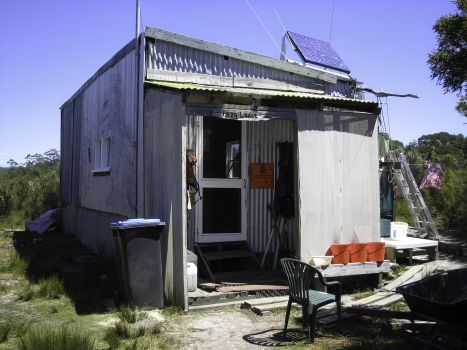
After about five minutes we emerged into a clearing and there it was, the hut!

Starting life as a shed for a vehicle that was used for mineral exploration by BHP, the hut had been adapted for human habitation. It was a small, iron-clad building. It was rough, untidy and cramped – but oddly welcoming.
The sign over the door said “Frog Lodge” and we were soon to learn that never had a building been more aptly named. Frog Lodge sits on a small rise, at the start of the track to Low Rocky Point, a place regularly mentioned, usually unfavourably, in Tasmanian weather reports. Surrounded by button grass, cutting grass, bauera, tea tree and marsh, this area is home to thousands of Tasmanian tree frogs (Litoria burrowsae). Their distinctive, goose-like call could be heard at all times of the day and night.
Over the next two weeks it became clear that such a large population of frogs and tadpoles was a veritable smorgasborg for our other near neighbour. Tiger snakes (Notechis scutatus) seemed to be almost as plentiful as the frogs. A day without seeing a tiger snake was the exception. They lived at the toilet, weather station and around the hut, and wherever we walked the trip would be punctuated with several stops to let one of the reptiles slither across the track.
The hut was a single room into which were crammed four bunks, a small table and chairs, various radios and satellite phones and a makeshift kitchen. Space was at a premium. The structure was clad with corrugated iron and as the original purpose was to house a vehicle and not humans, no attempt had been made to make the building vermin, or snake, proof. The logbook recounted stories of snakes in the hut (and even a sleeping bag) and indeed we had seen a tiger snake trying to get under the roofing iron. The corrugations were stuffed with toilet paper and other materials to make things a little more secure.
Showering was an open air affair, using a solar heated plastic bag hanging from the outside of the hut.
In real estate terms, Frog Lodge would be described as having rustic charm.
As well as the ubiquitous snakes, we shared the hut with a resident water rat. To be fair, he lived under the hut but at times it sounded and smelt as if he was in the hut with us. Anything left outside on the porch was considered his property, a lesson we quickly learned after boots and reef shoes were chewed overnight.
Our duties involved several shifts each day in the canvas bird hide, monitoring and identifying orange-bellied parrots (OBPs). A feed table had been erected and the seed we put down attracted the birds so that we could identify and record them. At that stage of the OBP program, parrots were released at Birchs Inlet into an aviary and then into the wild in an attempt to establish a breeding site. The bird hide and feed table were reached by walking along a board walk across the button grass.
Sitting in the hide on a still morning, the silence was almost palpable. When you are used to living in a city or town, initially that can be quite unnerving.

We also visited the many nest boxes that had been erected around the site to check if they were being used. These expeditions saw us roam far and wide around the area, through Huon Pine stands, thick bauera-infested swamps, and over button grass plains.
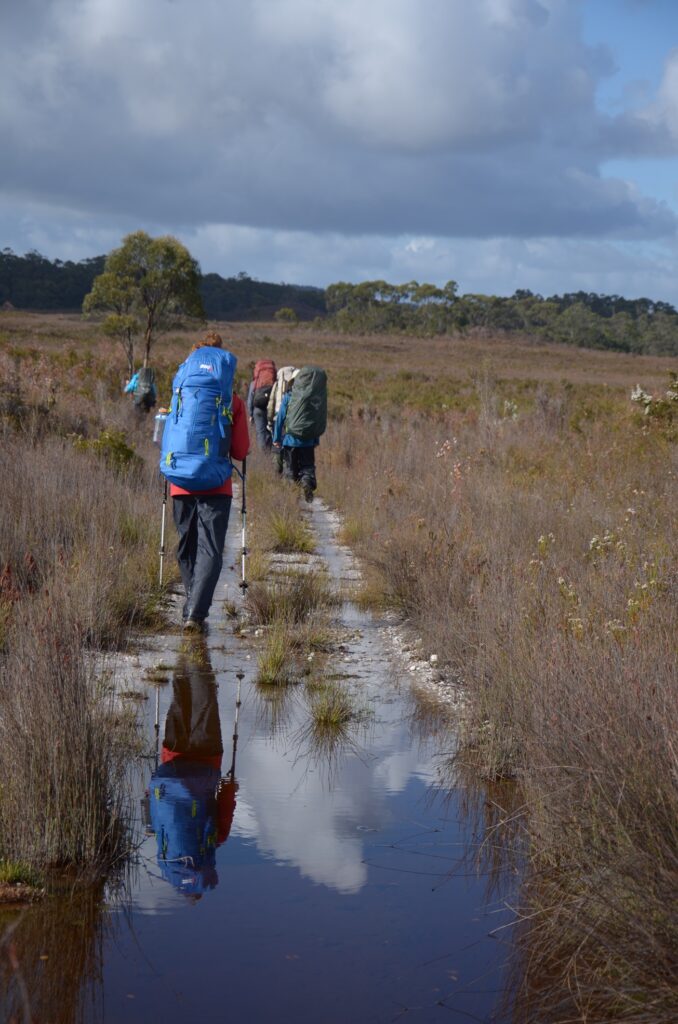
We had brought a double kayak with us and this became integral to our explorations of the waterways. Paddling back up the Birchs River, into Birchs Inlet, and then up the nearby Sorrell River, one could imagine very few people had ever ventured into this part of Tasmania. There was a feeling of remoteness and isolation. Visitors were few – apart from a very occasional bushwalker or sea kayaker, we saw nobody for the duration of our stay.
Towards the end of our trip, food was getting short. As this was our first time volunteering in a remote location, we had not catered as accurately as we could have, so I decided to take the fishing rod and kayak up the river to catch a trout for dinner. Many hours later, after casting until my arms hurt and with nothing to show for it, I took a break and was quietly drifting along the river when a beautiful azure kingfisher landed in a tree near me on the river bank. Just to show me how it was done, and to remind me of his name, he dived into the water and emerged a few seconds later with a small trout in his beak.

Birchs Inlet was used as an orange-bellied parrot release site for several years, but has now been abandoned and most of the infrastructure removed. Frog Lodge remains, quietly sitting amongst the Huon Pines, tree frogs and tiger snakes – a little outpost in south-west Tasmania that most Tasmanians would never have heard of, and even fewer would have visited.