
European romanticism – a defining movement of the late 18th and early 19th centuries – fostered a new and special focus on the “wild” and the “sublime” over “ugly” industry. That kind of romantic thought had been slow to influence Australia during the earliest colonial period, when sheer survival tended to overshadow more poetic sensibilities.
writer and photographer PETER GRANT
One of the mysteries of The Patch, a mere four or five kilometres from Hobart’s CBD, is how it has remained relatively wild.
Does it start with 19th century European expectations? In 1804 Lieutenant Edward Lord was granted 100 acres of South Hobart land (although it was already the home of the Muwinina people). He was disappointed, declaring it “not worth working”.
The next owners agreed, saying there was “not a scrap of good land” on it.
They doubtless sought country that could be cleared, ploughed and used for cropping and livestock. South Hobart’s narrow valley, with its brief, rushing rivulet, steep, wooded slopes and scrawny soils, was never going to meet those criteria.
While it may not have met British agricultural requirements, the settlement beside the Derwent was also about timber and water. Lieutenant-Governor David Collins wanted those resources for building what would become Hobart, and the western shore of the Derwent offered them aplenty.
Sawmilling soon began, but was initially hampered by the shortage of equipment and skilled convict labour. Recognising an opportunity, free settler Peter Degraves and his brother-in-law shipped a sawmill from London in 1824. They set it up on the Hobart Rivulet, near today’s Cascade Brewery. Around the same time, business man Thomas Stace established another water-driven timber mill upstream. As it happens, the two mill sites sit within or near The Patch.
During an 1825 visit to Stace’s mill, George Augustus Robinson observed “a large number of stringybark & gum trees some of them 14ft in diameter”. The extent and size of the trees is evidence that these forests were largely intact at that time. That changed over the next few decades, when many of the taller eucalypts growing along the Rivulet were felled for building, for mill races, and for whaleboats.
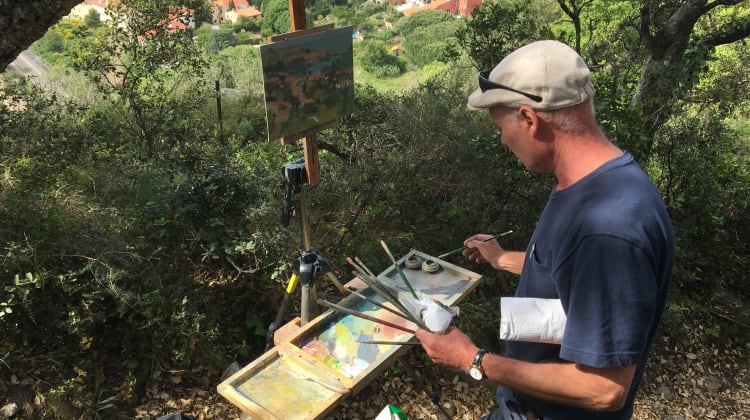
The early 19th century was a time of significant change, both locally and globally. As easily accessible trees became rarer, timber milling on Degraves’ site grew less viable. At the same time, the area along the Hobart Rivulet began to be valued for aesthetic and recreational purposes. European romanticism – a defining movement of the late 18th and early 19th centuries – fostered a new and special focus on the “wild” and the “sublime” over “ugly” industry.
That kind of romantic thought had been slow to influence Australia during the earliest colonial period, when sheer survival tended to overshadow more poetic sensibilities. Nonetheless, by the 1830s it had gained sufficient hold on colonial minds for areas like the forested slopes and waterfalls of the mountain to attract attention and a growing affection.
Amidst this change, Degraves and co. began using their mills for grain and brewing, rather than for timber production. Stace and his successors also eventually pivoted, trialling pyrolignite production on their mill site. This used timber to distil acetic acid for industrial uses. The process was plagued with problems, including a major polluting spill. It closed in the 1860s.
By the end of the 19th century, trams were running up as far as Cascade Brewery, and the citizens of a burgeoning Hobart were picnicking in nearby gardens, sipping and chatting in the tearooms, and wandering the walking tracks to the numerous recreational huts on the mountainside.
Then in the early 20th century, the Boy Scout movement burgeoned. The Scouts found the abandoned pyrolignite works to their liking, and used it as a campsite. They dubbed it Fairy Gorge Camp, borrowing the name from the tearooms just across the rivulet.
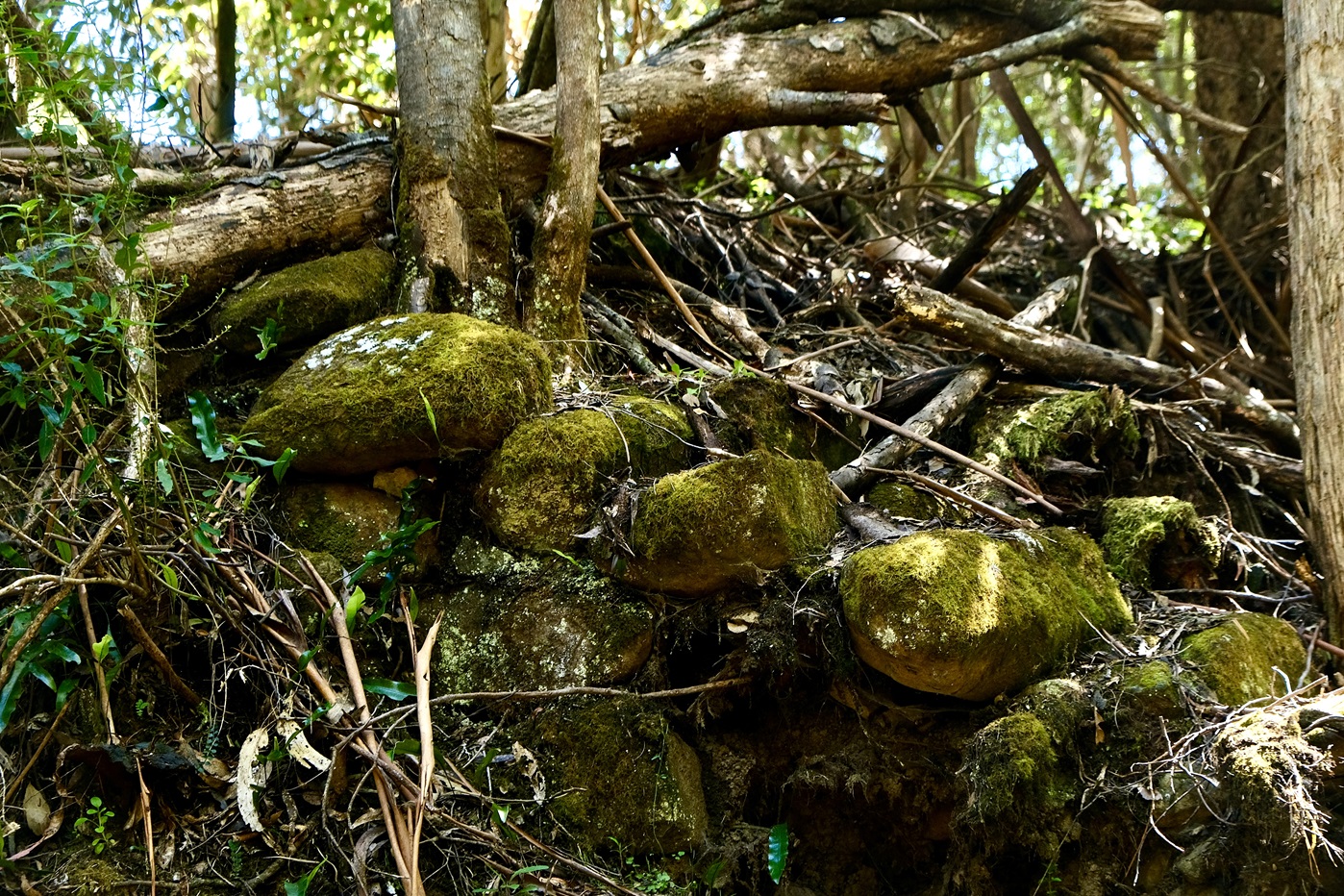
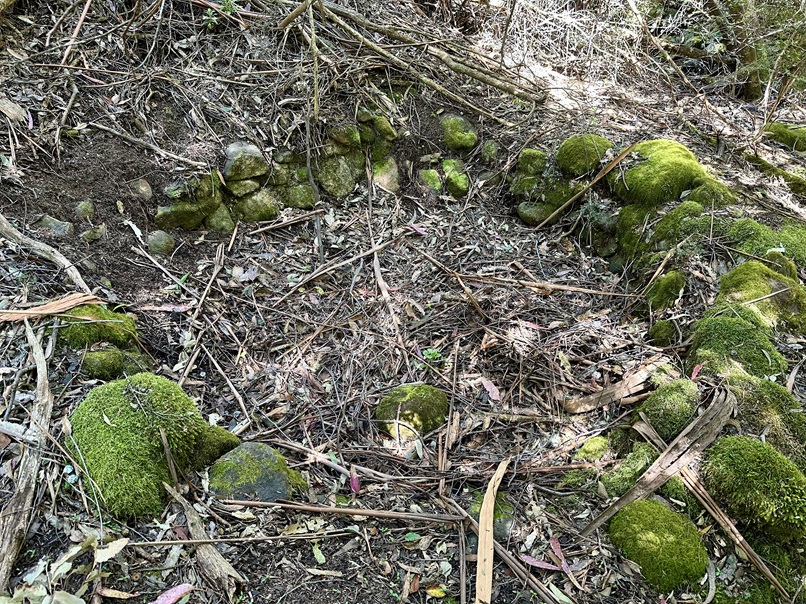
I was curious about how this history had played out on the ground. I asked retired forester and local historian Martin Stone to share his onsite understanding of the Fairy Gorge area. Although it’s only a few hundred metres from my house, I knew little of its story. So, we found ourselves clambering up beside the rushing rivulet, through cool, mossy bush, hurdling numerous fallen logs. We finally paused at what Martin assured me was the old Scout camp. It was a heavily overgrown flattish area next to the rivulet. Numerous exotic plants jostled with native ferns, shrubs and a few tall eucalypts. Nearby we found the suggestion of a formalised stone fire pit, though there was now little open space around it. We also found hints of races, sluiceways and stream diversions, presumably part of the earlier mill works.
Across the rivulet, Martin pointed to what looked like a stone stairway, perhaps part of a formed path once used by the Fairy Gorge tearoom clients. As we explored, I suddenly remembered that our elderly neighbours, now long gone, used to speak of a “Fairy Glen” somewhere up here; surely another name for the place. I also recalled that when our children were small, we had a fairy garden of our own in the backyard. It too was a mossy, dim, enchanted space, shaded by tree ferns. The children used to have their own tea parties there, and they’d write letters to the fairies. Sometimes they would even receive a letter in reply (handwritten by us, though please don’t tell our children!)
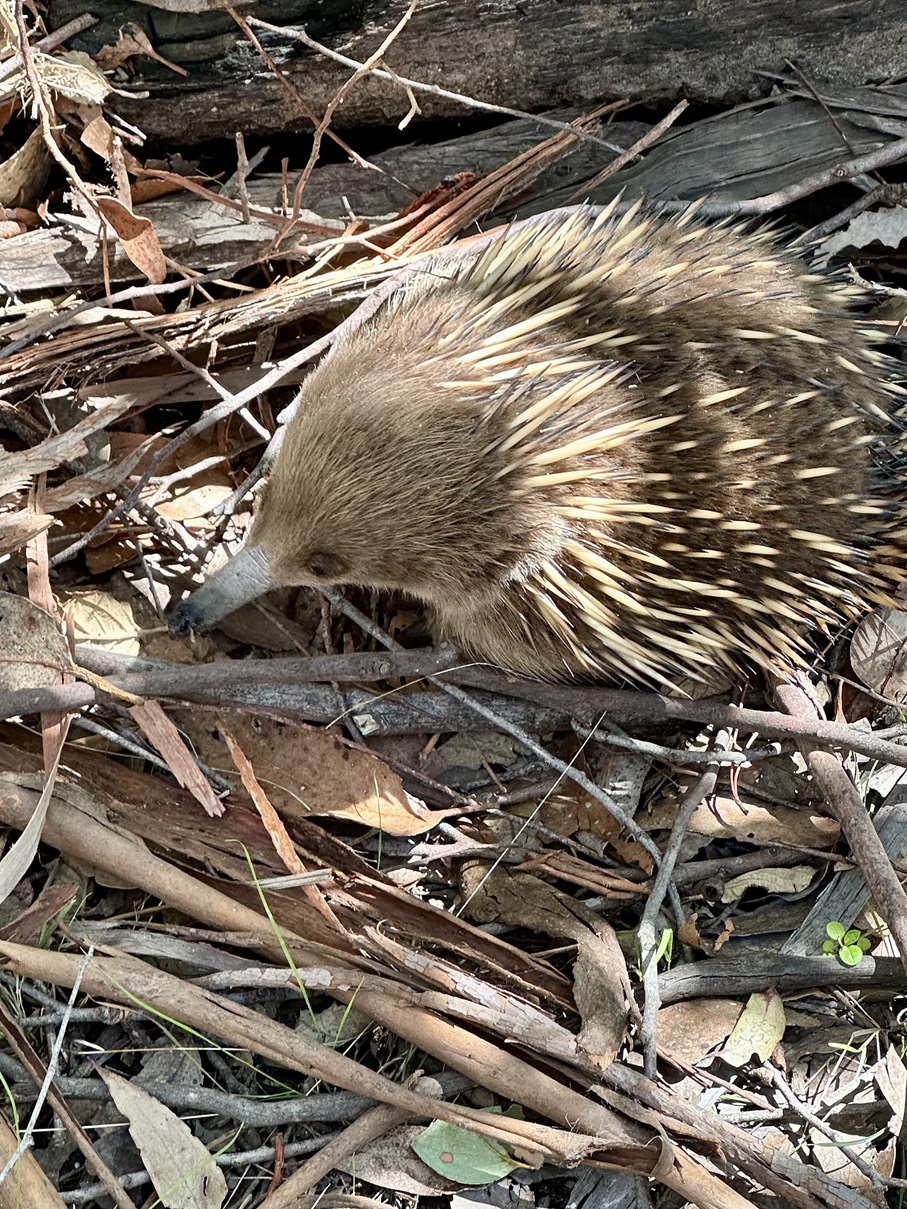
Our heads full of enchanting stories, Martin Stone and I emerged from the bush only to be snapped back to the present by a young echidna waddling nonchalantly across our path. It stopped to snaffle a few ants, then ambled off. And I couldn’t help thinking how full of story and life this “not a scrap of good land” had become.