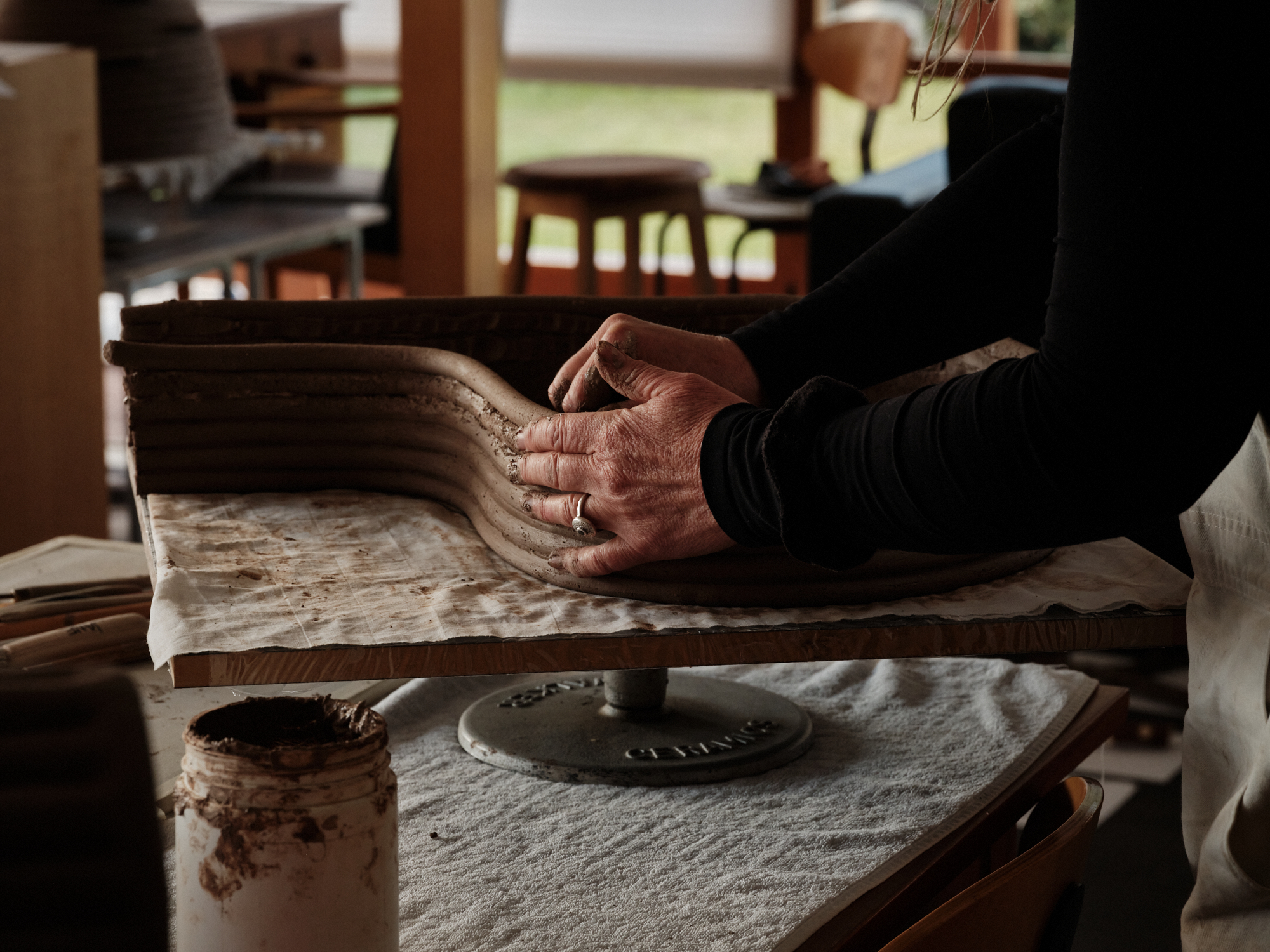
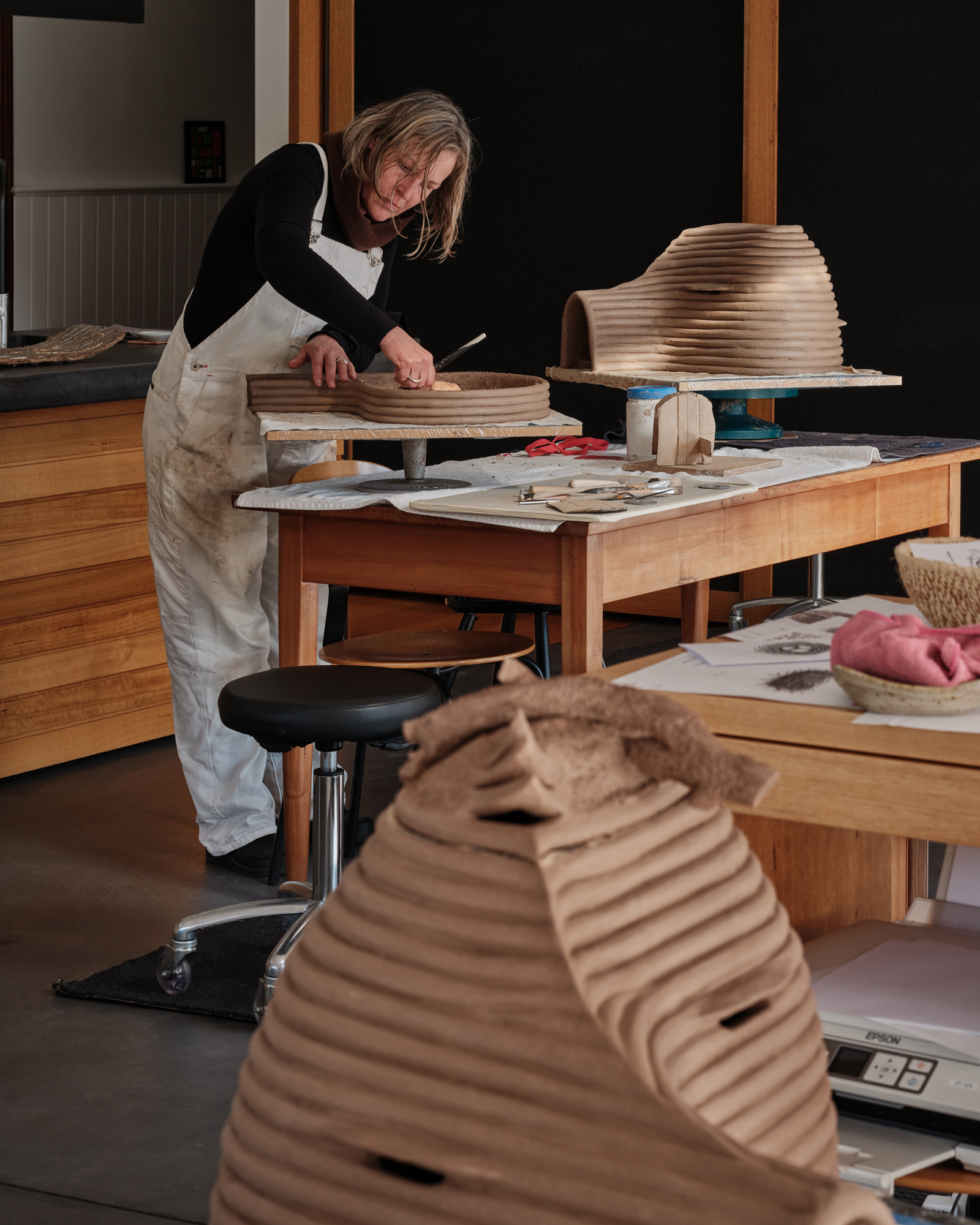
Ceramicist Jane Bamford making little penguin nesting burrows
Some projects are simply beautiful from start to finish, from their quiet intention to the finished product. This is certainly the case for an innovative art-science initiative I’ve had the privilege of being involved in, which brings together a ceramicist, a photographer, an ecologist and a writer to help protect one of Tasmania’s most loved seabirds.
ceramicist JANE BAMFORD photographer PETER WHYTE ecologist ELLIE GREEN writer KATHERINE JOHNSON
Over a few months in early to mid-2026, five beautifully hand-crafted ceramic burrows will be opened to little penguins (Eudyptula minor) in a growing colony on the shores of the Derwent.
Nestled in suburbia, the colony lacks the old, complex vegetation needed for natural nesting sites, although local government is working hard at revegetation. Until the new plants grow older and hollows form, the tiny seabirds here rely on either artificial burrows, or whatever they can find – which isn’t ideal given the potential threats of dogs and cats, and the need for the burrows to stay cool in summer.
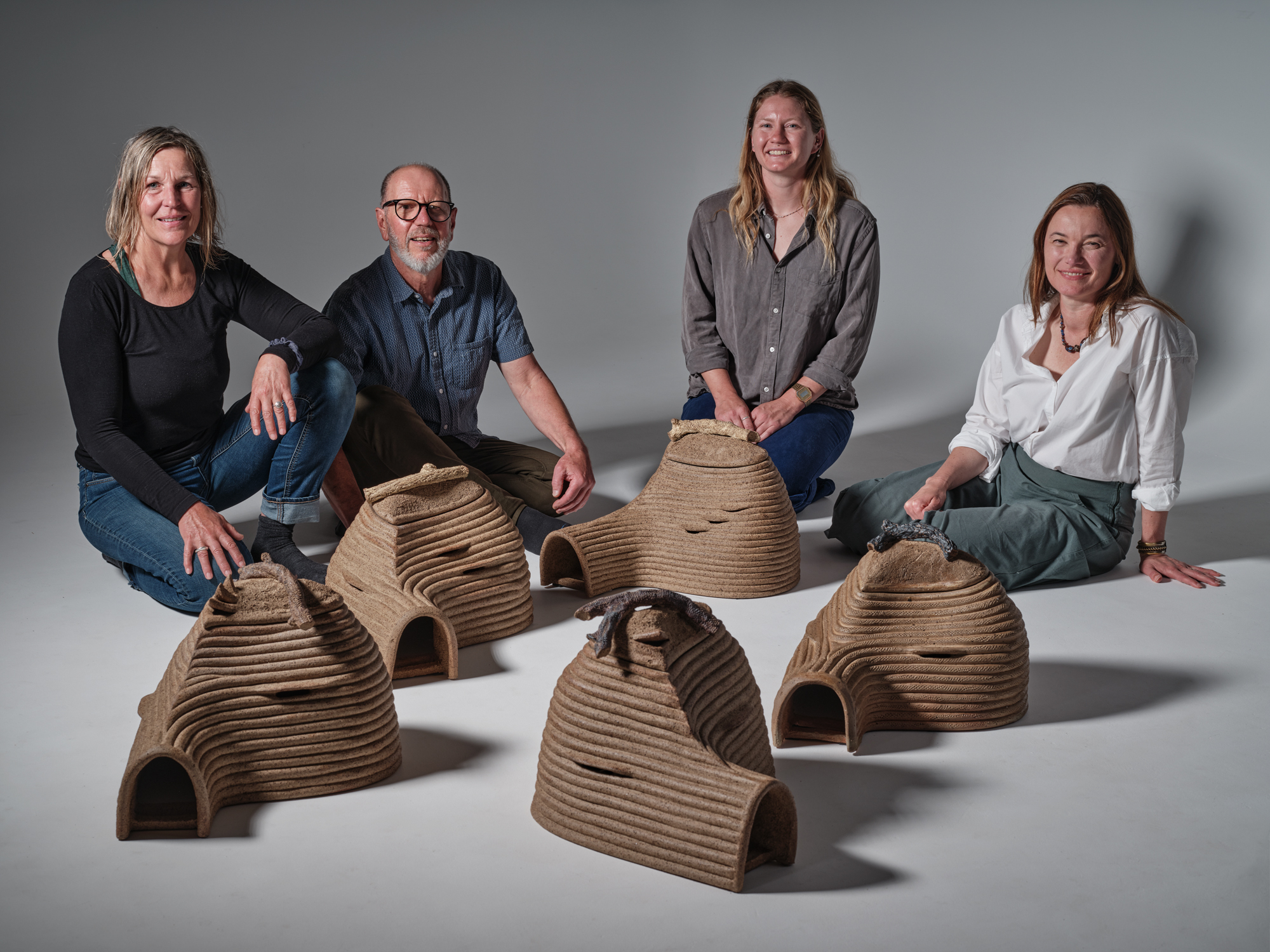
The new burrows have been purpose-built by ceramicist Jane Bamford, in discussion with researchers, including ecologist Ellie Green from the Derwent Estuary Program. They have been designed with ventilation holes to keep the penguins cool and a ceramic lid to allow easy access for researchers during monitoring. The lids have even been fashioned to include a small slot for electronic monitoring “ibuttons” so the scientists can collect data on the temperature and humidity inside the burrows before they are occupied.
“It’s such a cool project, this art-science collaboration,” Green said of the Creative Hobart project, funded by the City of Hobart. “Previously at this colony there were penguins nesting in an apartment bin box next to a busy road, as there were limited other options.” That was a sign the colony was getting crowded and would benefit from more artificial nesting burrows.
. . .
Jane Bamford has been working with scientists to design ceramic burrows for little penguins since 2020. Then, it was for a threatened population on Kangaroo Island in South Australia, where the penguins were experiencing heat stress in the older-style burrows.
“The creation of these new burrows has come about from Jane’s conversations with ecologists. She knows what the penguins need,” Ellie Green said. “You can’t take that knowledge for granted, and it shows in the finished design.”
Creating art for wildlife became the focus of Bamford’s work after ceramic artificial spawning habitats she made for the critically endangered spotted handfish, in collaboration with researchers at CSIRO, won the Design for Impact category in the 2019 Design Tasmania Awards.
“I realised that my piece was the only one not made for humans,” Bamford said. “I started to wonder what else I could do.”
Bamford keeps references, including the International Union for Conservation of Nature Red List for Threatened Species and the list of Threatened Species of Tasmania, currently sitting at more than 650. Another inspiration is the approach of Brian Eno, a musician, artist and activist who calls for a community of creativity.
“All of my projects are collaborations,” Bamford said, and she is quick to point to the work of those who have laid the foundations.
. . .
Little penguin conservation in the Derwent started 20 years ago with volunteers collecting little penguin data in the Derwent Estuary. Now, there is a Derwent Penguin Advisory Group with three councils, the Natural Resources and Environment Marine Conservation Program, BirdLife Tasmania, CSIRO, the Institute for Marine and Antarctic Studies, and the Derwent Estuary Program.
Between 2021 and 2024, Jane Bamford worked with professional and emerging artists, a team of ecologists and a photographer to make a series of penguin nesting modules that were displayed in Kingborough for the community to see and then sold to be gifted into habitat to shelter seabirds in need.
She sees herself as part of a community of creativity. “Often, it’s one person who articulates an idea or a concept but it’s a whole community of making and doing that is behind it,” she said. “This current expansion is such a gift from Creative Hobart – it brings together a photographer, a ceramicist, an ecologist and a writer in the service of little penguins, with talks scheduled for the public.”
International award-winning photographer Peter Whyte has captured every stage of the process – from preparing the recycled clay that was used for one of the modules to placing the finished burrows at the colony. I joined as a science writer, to put the project into words.
Bamford says watching Peter Wyte do his photography is magical, because he looks at the spaces between the forms she is making, and the relationship with light. She is of the view that we often don’t hear about ordinary people coming together to do amazing things and likened it to the way little penguins raft together when out at sea. “They only come ashore to nest and moult,” she said. “I love the idea that these ceramic burrows might be of help by being cooler than existing concrete and wooden artificial burrows and incorporating features such as grids that stop dogs from making the entrance way larger,” she said.
For me, gathering around Jane Bamford’s finished little penguin nesting modules in Peter’s studio felt reverent. Bamford showed us where she had pressed coastal casuarina bark into the clay for the lid handles to make impressions. She used casuarina seed pods in a similar way on the outside of one of the burrows to give it an organic texture, which felt almost like fur to touch. Beneath that are coils of clay that have been carefully extruded from the recycled clay and laid on top of each other – adapting an age-old process. “I love the innovation, the redesigning and revisiting,” she said.
Ellie Green says that the array of special features in Bamford’s burrows also helps the researchers collect important data. “Having the removable lids with handles makes monitoring easier with less disturbance to the penguins. We can lift the lids and peek in versus shining a torch into the nests,” she said. “It also means we have more confidence in what we are observing. “The lugs Jane has fitted for the ibuttons help with stress testing of temperature and humidity, ensuring they are at safe levels for the penguins before they come into the burrows.”
And the results are in. All the burrows have been deemed safe for little penguin occupation, with only one to be repositioned from the current experimental location before they are opened to little penguin use in the colony.
It’s art with a purpose, which is also a win for science, a point that isn’t lost on Bamford. “The ecologists can then share the data, contributing to an ecosystem of people and knowledge about little penguin conservation,” she said.
“Making little penguin modules and imagining the penguins having a family in them is an incredible part of the work.” And there is another advantage – because the burrows are clay, there is no pollution to the environment, not that they will be breaking down any time soon.
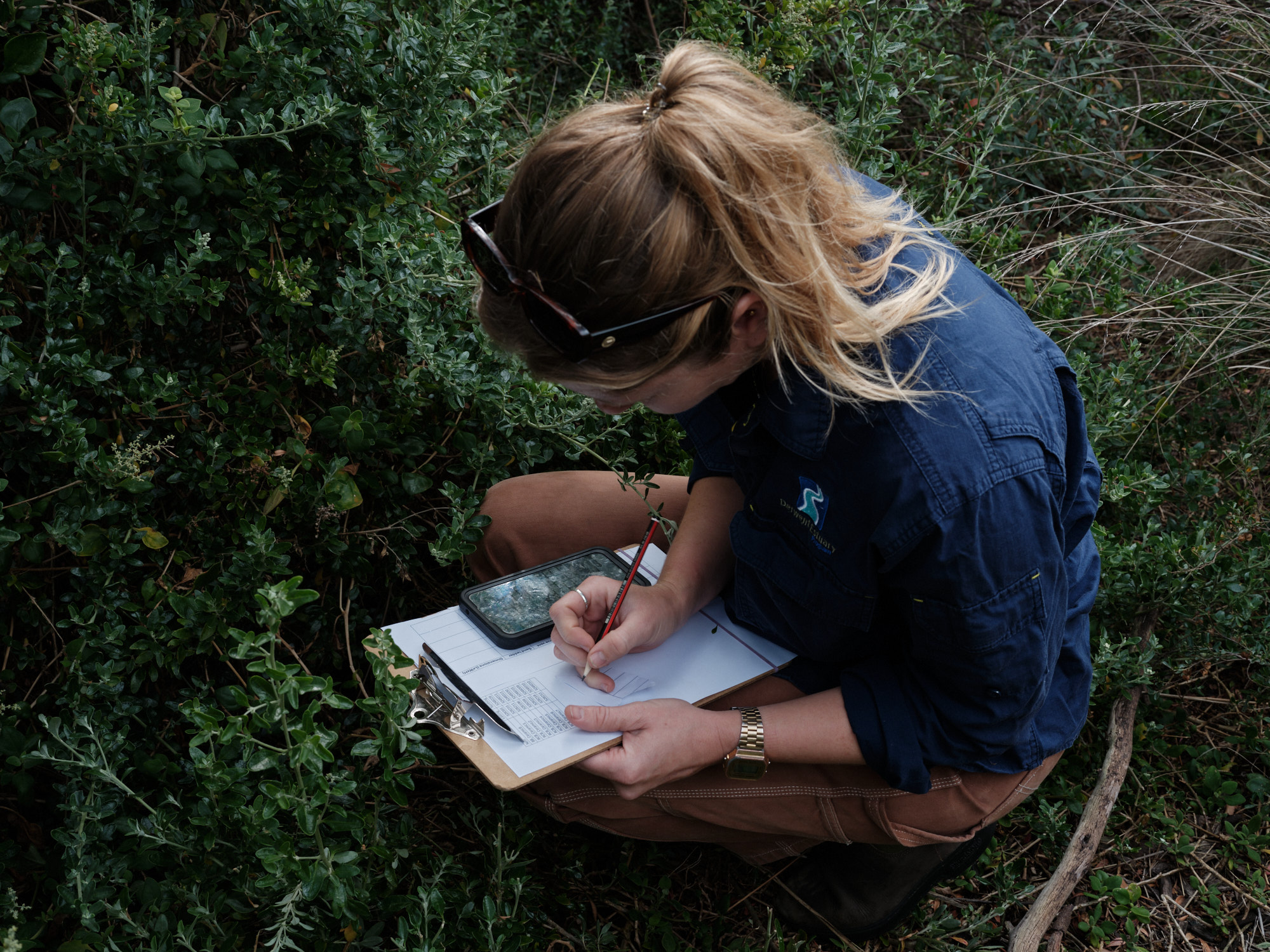
Ellie Green at work near the borrows
The Derwent Estuary Program is monitoring seven colonies in the Derwent where breeding has been observed to occur almost year-round, apart from periods in autumn when the penguins are moulting and can’t go to sea because their new feathers aren’t yet waterproof.
After historic declines, Ellie says there are about 180 breeding penguins in the Derwent, with the five years of early 2020s data showing the population appears stable. Ninety per cent of the little penguin population in Tasmania is on offshore islands.
Ellie Green’s hope, apart from seeing penguins nesting in the new burrows, is that others will be inspired and encouraged to become involved in science-arts projects. “It’s a great way to look at things, to bring new ideas to scientific research projects and seeing different audiences become engaged in science and conservation,” she said. “We need to branch out more, to find new ways of relaying important scientific information to the general public.”
She wants people to ask, can we tell stories better? Can we engage people in a different way?
Peter Whyte agrees. “The way Jane brings into a project people who never would have necessarily worked together – it’s an invitation to be a part of a community,” he said. He notes, too, the privilege of having a window into an ecologist’s world. “Accompanying Ellie to the site and seeing her thoroughness was quite astounding,” he said. “What was very apparent to me was the scientific method, her process and thoroughness. I am an observer of the project, that is my role.”
The location of the colony where Jane’s burrows have been installed has not been made public to protect the penguins from being loved to death. “The irony is that Jane’s beautiful nesting modules need to be hidden from view,” Whyte said.
For Jane Bamford, the best outcome would be that we no longer need to make artistic burrows for little penguins because colonies will have revegetated and be safe from cats, dogs and human intervention. Until then, the little penguins in this Derwent colony will have some beautiful and effective new homes to shelter them.
The team from left, Jane Bamford, Peter Whyte, Ellie Green and Katherine Johnson
An example of one of Jane Bamford’s ceramic burrows will be on display at the Tasmanian Museum and Art Gallery for a public talk on the project on April 23. For more information, and to book, click this link.
Dr Katherine Johnson is a science writer and novelist based in Tasmania. She has published in The Conversation, Good Weekend (Sydney Morning Herald) and CSIRO’s ECOS magazine. Her latest novel, "Every Wild Soul", was released in April, 2026. More about her and her writing can be seen at KatherineJohnsonauthor.com.