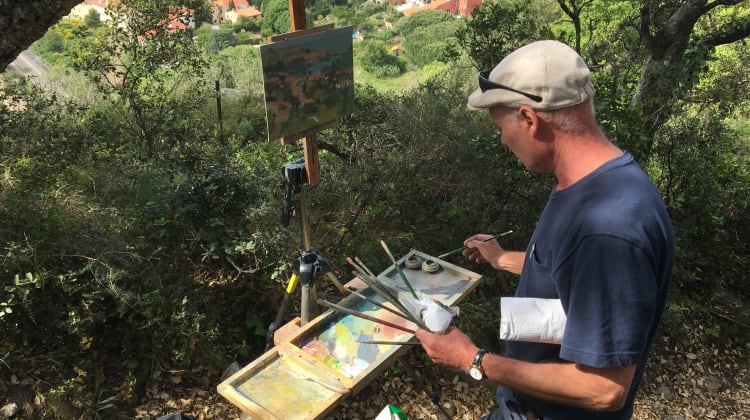

“I prefer poetry to data. I like walking into the woods because it feels like stepping into a different time zone. Trees belong to a different scale to me: they’re not only larger, but they’re have deeper roots in the history of their place.”

writer and photographer BERT SPINKS
I have surely seen more waterfalls this year than at any other time in my life. A loop through this patch of forest alone will convey past me eight of them. Long sheets of rain have unfurled from the low clouds in the past day or so; surplus water spills in all directions, and whatever their height or aspect, each of the falls are at the peak of their powers, frothing and gushing and foaming.
The spray reaches to a wide radius. Watered endlessly, giant lilies sprout at the foot of the cascades, their rubbery leaves reflecting a white sheen, long inflorescences heavily-laden with masses of cream blossom. Vines laden with purple flowers snake a sleazy path across shrubs, through them and up and over them, their routes hard to trace. Another climber – a parasitic species – tosses red tubular flowers, fringed with yellow, on the forest floor, out-of-season Christmas decorations
The mist droops from below the canopy, drenching everything. Fixed above us – relying on the tall trees for architectural support – long ferns in an array of curious forms dangle, dripping. Where one has somehow been knocked from its perch, it looks like a lettuce that has fallen off the back of a grocer’s truck.
A giant ficus tree tilts gently over a creek. I imagine the dramatic moment in which it eventually tumbles. There will be a violent roar. The roots will take soft humus with them as they’re levered out of place; communities of moss and liverworts will be torn asunder, and the high branches will smash through metres of timber, opening up the canopy.
Then calm will return to the rainforest. Seeds will fall into the damp earth; the plants, when germinated, can reach for the sky.
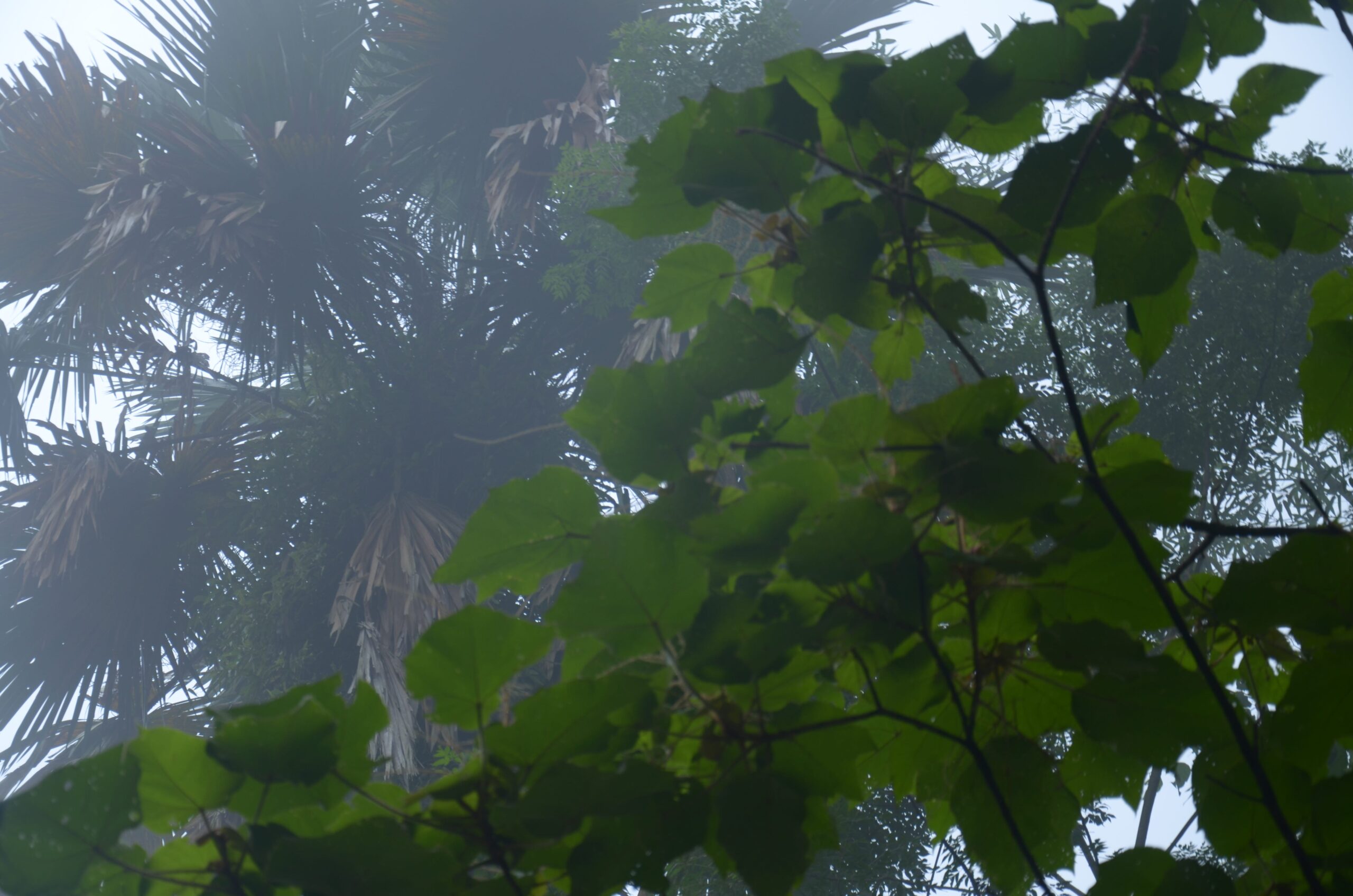
All plants are opportunists, but it’s sometimes more obvious in a rainforest just how tenacious and vigorous certain species are. You never really know what you’ll find. An invasion of lantana chokes the floor around the bottom of these waterfalls. But sprouting from a cleft in one of the basalt shelves that from which the next cascades are built, there is a paper daisy, in bud.
I remember reading a remark made by a well-known European author about forests. Citing fairytales and nursery rhymes, he stated that humans have an instinctive fear of forests. They are dark, damp, cramped places, the author said, and our species evolved for life on the savannah. We are far-seeing animals, vulnerable when we cannot make a plan, defenceless if we don’t first see our predators. In forests we have no hope.
We unconsciously associate all forests, the writer went on, with the threat of getting lost or kidnapped. Instinctively, we distrust or even dislike forest-dwellers. They are outsiders, exiles, menaces or creeps.
I thought: you’re wrong. Because, for as long as I can remember, I have loved wandering through forests. There is a joy that comes from being immersed in places that are so thickly and intricately vegetated. The forest may be where I have most often experienced wonder.
I understood the writer’s premise. There is, I reckon, some truth to what he says about humans and our vision, how the habits of our mind evolved on plains with broad panoramas. I do also love an open moor, where the route ahead can be easily plotted; in contrast, sometimes in an unknown forest, discomfort can set in, as can disorientation, and occasionally a foreboding that around the next corner there will be some threat.
But largely, I suspect the writer who writes of rainforest as a site of gothic horror is in fact just susceptible to that most ordinary of fears – ill-at-ease in places that aren’t entirely dominated by humans yet.
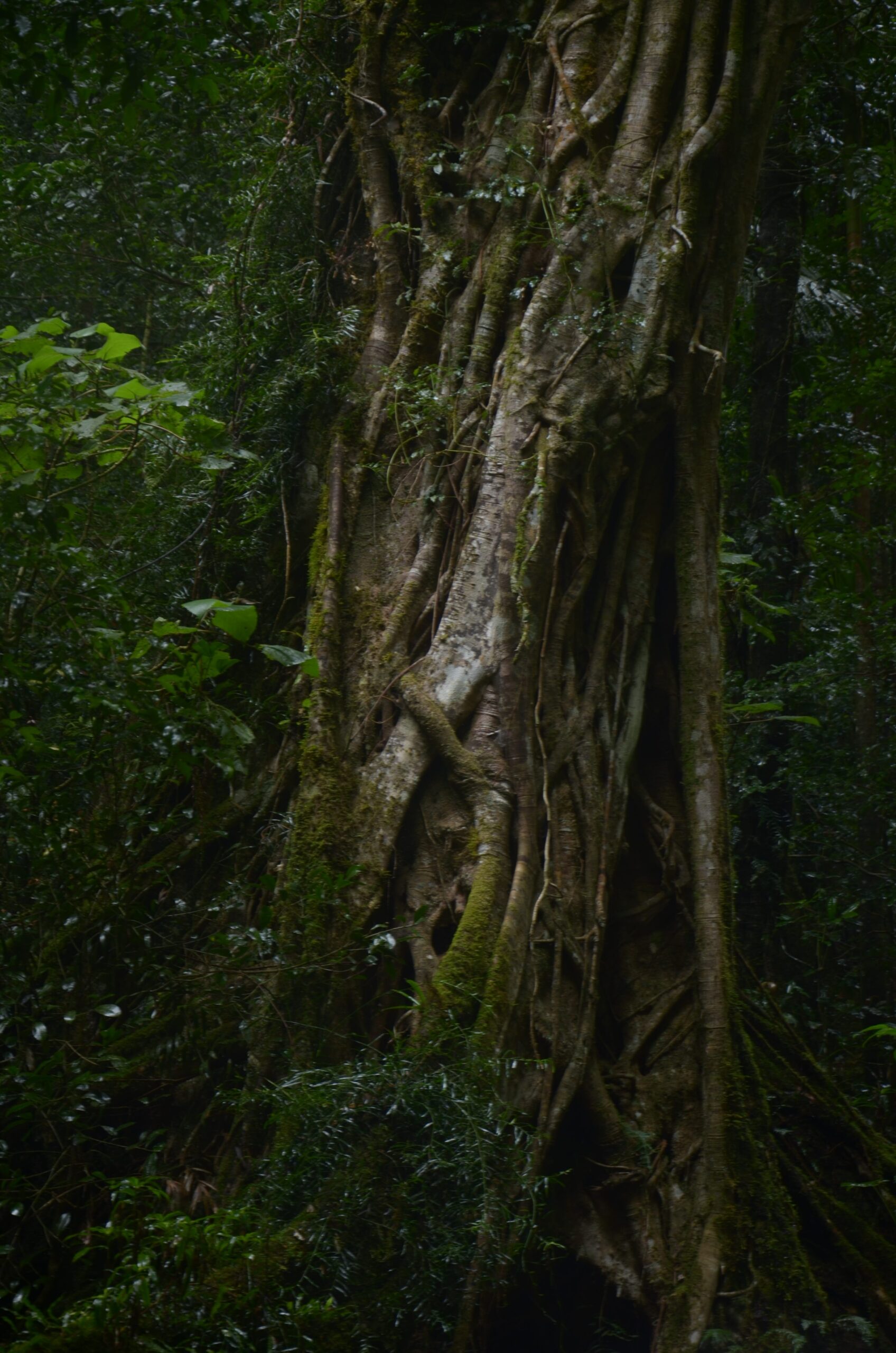
Beneath the soles of my boots, the mud is mobile. It’s like standing on a chocolate cake that’s been pulled out of the oven too early. Roots are laid out like railway steel. Certain plants have spiky leaves; they scratch and claw at my socks as I walk past, pulling loose materials from them, as if riffing on the story of Ariadne, who went into a maze with a ball of string so that she wouldn’t get lost. I could, if I wanted, navigate my way back out of this labyrinthine forest by balls of fluff.
But I don’t need to, for this is my backyard – it’s a mere 10-minute drive to the trailhead from where I wake up most days. I know almost all the species by name; I’m even familiar with individual plants, such as the giant conifer with a soft ruff of moss on the south-facing side of its trunk, or the tall shrub with pungent leaves beneath which I once stood, entranced by the glamorous green butterflies that thronged around its white flowers.
Somewhere in this forest, attached to the underside of leaves, the pupae of these green fairies await the prompts of warmer weather. These will not be anytime too soon; the butterflies of the future are still bunkered down in sleeping-bags. But not me.
I am watched over by sandstone cliffs, with the figures of giants’ shoulders, or else their jutting chins. From these overhangs come a succession of cascades, water sluiced through grooves in the grey-beige stone. They tumble down at different angles, some of them so sheer that it’s as if the rock has been cut for the purpose.
In other places, only stray droplets fall. A few sneak down the back of my raincoat, so severely cold that the immediate sensation is that of having a couple of embers flicked onto my bare skin.
I gaze upon some ferns sprouting from deadwood. I grew up with these; they were my playmates in the bush, when I had few else. Like me they are lovers of the chill air, adapted to cold places. Like me, they would still wear shorts, even in this weather.
I put my hand into the dirt. Unlike soil in other forests, it doesn’t feel like it fizzes with an infinite amount of unseen organisms. Its inhabitants are dormant, hibernating, sterilised, nearly frozen. Nevertheless, life emerges from the darkness. There are still some mushrooms, blooming like brown or white or black wildflowers, manifesting the nutrients in their skinny subterranean tentacles into a form that’s edible to insects or marsupials.
Life is always stirring. It is just not as noisy as it will be soon, the bugs’ drone, the ballads of cicadas. Those who are active now seem remote. I hear birds – lonely call of a black cockatoo, a currawong’s solemn song – but they mostly go unseen. Though when I come upon the threadbare belt of snow just below the tree line, I am surprised to hear a kookaburras’ clamorous laughter billow up towards the mountains.
People will tell you about shinrin-yoku, the Japanese practice of forest bathing. Although it sounds like an ancient art, it was actually part of a public health initiative that began in the 1980s. Nevertheless, it has permeated more generally into the programs that people are using to feel less stressed and more connected to the world.
It has long been said that the colour green is therapeutic. It’s apparently good for our eyes and easy for our visual cortex to process. It has also been proposed that many trees create compounds and oils that have health benefits for humans. According to the German forester and writer, Peter Wohlleben, we react physically to forests,.
I repeat this information only because it chimes what I have felt for a long time. I prefer poetry to data. I like walking into the woods because it feels like stepping into a different time zone. Trees belong to a different scale to me: they’re not only larger, but they’re have deeper roots in the history of their place.
The array of textures, shapes and colours is definitely the largest part of what makes me happy in a forest. There is a sense that there are secrets, not least because intact forests provide habitat for a wide range of species. This is all much simpler and more playful than what’s shown by the psychological studies of forest-bathing, though I’m sure it could be studied and rationalised as well.
I have also walked through felled forests, which has the opposite effect. I don’t know that it’s the sudden absence of mood-enhancing chemicals. Ruined woods are heartbreaking. They’re symbols of death.