
Hogwarts isn’t the only magical place with a special number. If JK Rowling’s school for wizards owes a lot to platform 9¾, our own blue planet can thank the mixed number 23½ for some of its endearing magic.
Rather than a platform number, 23½ degrees is the axial tilt of our home planet. While some other planets, like Mercury and Jupiter, spin boringly close to a vertical axis, ours tilts at a jaunty angle. On our planet’s annual trip around the sun, it’s that angle that gives us our seasons, as we lean variously towards, then away from, our star.
As spring comes to The Patch, we’re more than glad that our part of the Earth is finally, slowly tilting towards the sunny side. It brings a noticeable increase in day length, and a return of warmer weather, albeit gradually and sporadically. But be warned. Although Tasmania may seem like a little England, we should not expect “all the juice and all the joy” of “gentle spring” that English poets like Hopkins and Clare extolled. The conjunction of balmy and brisk here often brings volatile weather. Gales and snow are almost as common in spring as they were in winter.
Still, who can resist the hope of sunlight and warmer days? It brings back not only the human escapees, but also the migratory birds. Those of us who have stuck it out through the dark and cold feel especially rewarded by the sound of our returning birds. Prominent among them in The Patch are silvereyes, striated pardalotes, satin flycatchers and fan tailed cuckoos.
I find the cuckoo’s trilling call somehow thrilling, despite its mournful edge. And I marvel that striated pardalotes (Pardalotus striatus) can fit so much into their tiny frames. After many of them have migrated as far north as Queensland, they herald their return with a quite loud and distinctive call of “pick-it-up, pick-it-up”. For me it’s the perfect spring pick-me-up.
There’s another fascinating seasonal migrant, the Tasmanian boobook (Ninox leucopsis), that we hadn’t recognised as a migrant at all. We hear their haunting two-note “boo-book” call all winter long, and simply assumed they were year-round residents. However, researchers have shown that some are migrants, making them Australia’s only migratory owl. Rather like the state’s human population, a proportion of their species migrates north for the winter, while others remain in Tasmania.
Researchers have tagged and tracked some of the returning boobooks, and found that they made the 250km crossing of Bass Strait, from Victoria to Tasmania, in one overnight flight. Imagine a 200-gram bird matching or beating the crossing time of the 28,000-tonne Spirit of Tasmania ferry.
Researchers have been busy with other aspects of this small, large-eyed owl. Until 2022 it was considered to be the same species as the morepork (Ninox novaeseelandiae), which is found in New Zealand and Lord Howe Island. However, closer analysis has resulted in it being categorised as its own distinct species.
Partial migration works not only latitudinally, but also altitudinally. So, in birds like boobooks and striated pardalotes, only a proportion of the population makes the migration journey to the north, and then back again. But some boobooks, as well as some other local birds, migrate between higher and lower altitudes. Birds we often see in winter in The Patch, including flame robins and crescent honeyeaters, spend warmer months at higher altitudes, chasing the nectar and/or insects that proliferate there at such times. In Spring there’s a little bit of “you say goodbye and I say hello” as birds variously arrive or depart with the warmer days.
Spring also brings changes to our vegetation. Some changes are shy and subtle, while others are bold and landscape wide. The latter includes the golden glow that lights up the slopes of kunanyi when our silver wattles (Acacia dealbata) are in full bloom. Perhaps on the principle that “it’s better to burn out than to rust”, these short-lived trees make up for their brief life span with the fireworks they offer in spring. Of course it’s not just for show – the trees attract pollinators so that they can produce seed for the next generation of trees.
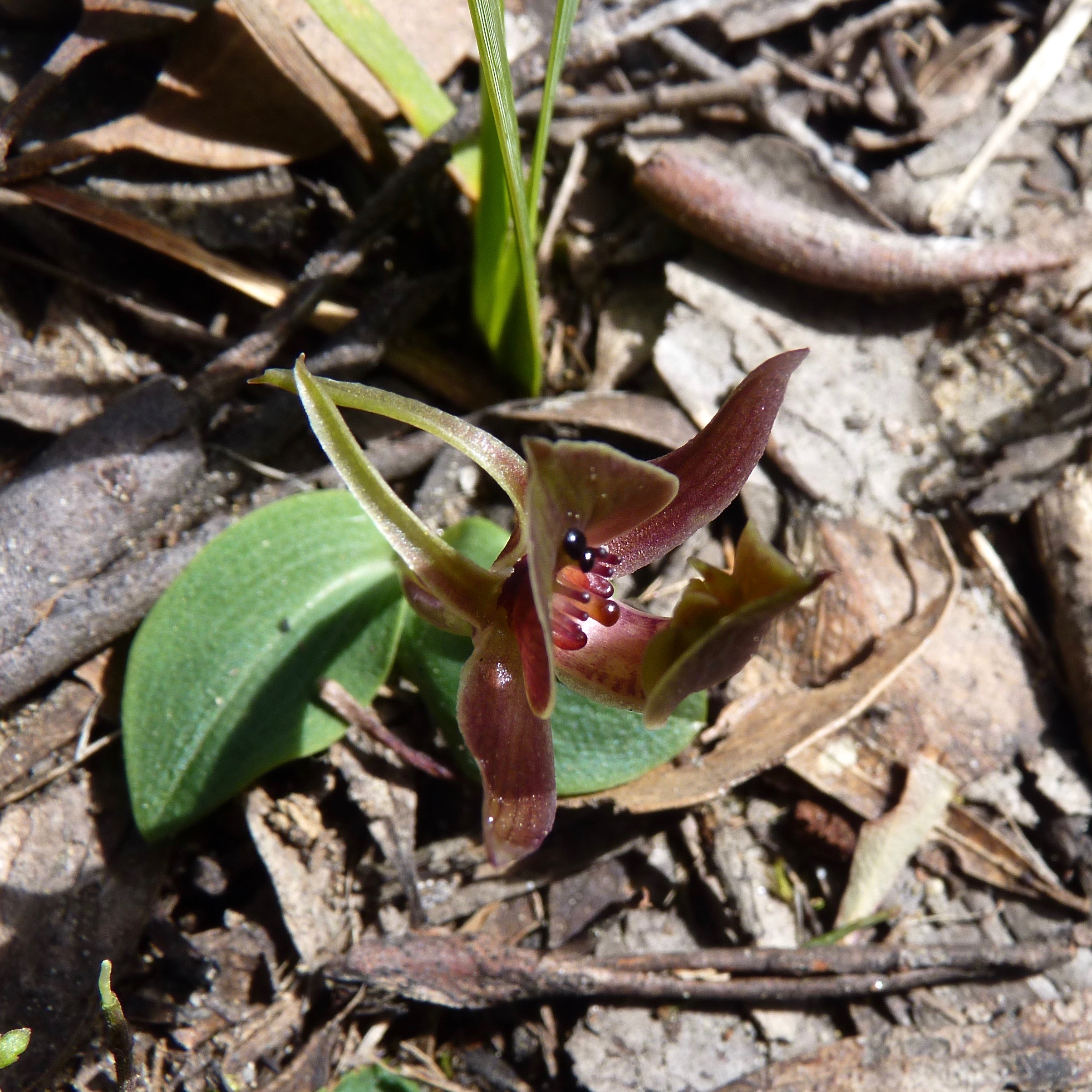
On the shy and subtle end of the spectrum are our orchids. They’re not all spring-flowering, but it’s fair to say that late spring is often the best flowering time for orchids in our bush. We’ve been seeing the petals of the three-horned bird orchid (Chiloglottis triceratops) all winter. Their two-leaf shape, flat on the soil, is reminiscent in miniature of the leaves of zucchini seedlings in our veggie garden. By October, we’re watching for the strange bird-like flowers that rise phoenix-like from between the leaves.
One spring favourite is the felicitously named love creeper (Comesperma volubile). This blue to purple flowering plant twines around other duller looking plants, giving them a blush of spring magic. In return, in the spring gales that can sweep our bush, the less striking plants offer this climber much needed support, helping to lift it skyward. Walking past one particularly windy day, I wonder if I will hear the Hogwarts levitation spell, wingardium leviosa, being spoken over the love creeper. Even if it’s just my fevered imagination, the result is still magical.