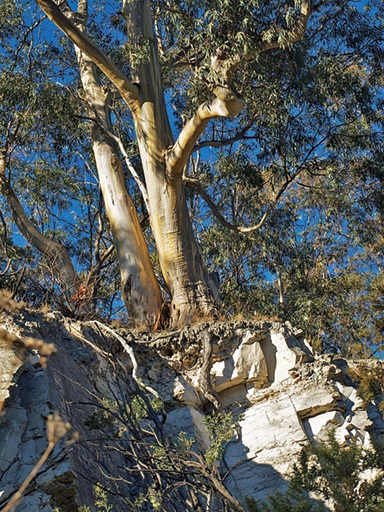

Part of the drama of living near Hobart is the massive daily presence of kunanyi/Mount Wellington. That lion couchant is a solid reminder of powerful geological events that literally tore Tasmania from Antarctica. But drama, whether in the theatre or in geology, needn’t always be obvious. The Patch provides me with a surprising – even unsettling – example of that.
Much of our local bush is underlain by rocks of the Permian era, about 300-250 million years old. These rocks are the ugly ducklings of the geological world, and especially the bland-sounding Permian mudstone. A grey to beige-coloured sedimentary rock, mudstone came from mud and readily returns to the same. It yields poor soils which erode easily and support only a straggling, struggling range of vegetation. In my early wanderings in The Patch, even if I came across the odd fossil in the rock, I was as likely to grumble about the muddy soil as to consider the possibility of any dramatic stories beneath it.
A visit from some of our grandchildren changed all that. They, like many of their peers, have their imaginations fired by dinosaurs and fossils and everything to do with the “annals of the former world”, as American writer John McPhee calls geology. For them it is time travel without a Tardis. So, on a hot summer’s day, we find ourselves on an intergenerational fossil hunt in The Patch. Attention spans are scarcely troubled. Two minutes up our bush track we are literally tripping over fossils. Spoiled for choice, we are picking up dozens of rocks, discarding most, breaking open a few.
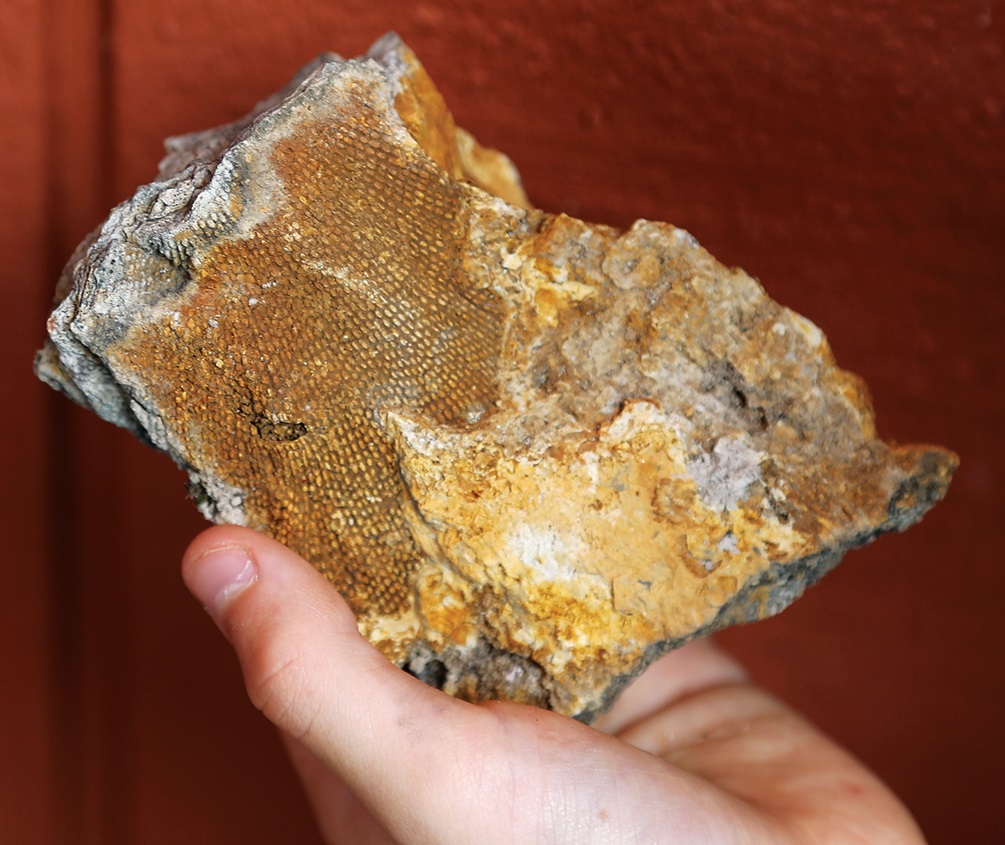
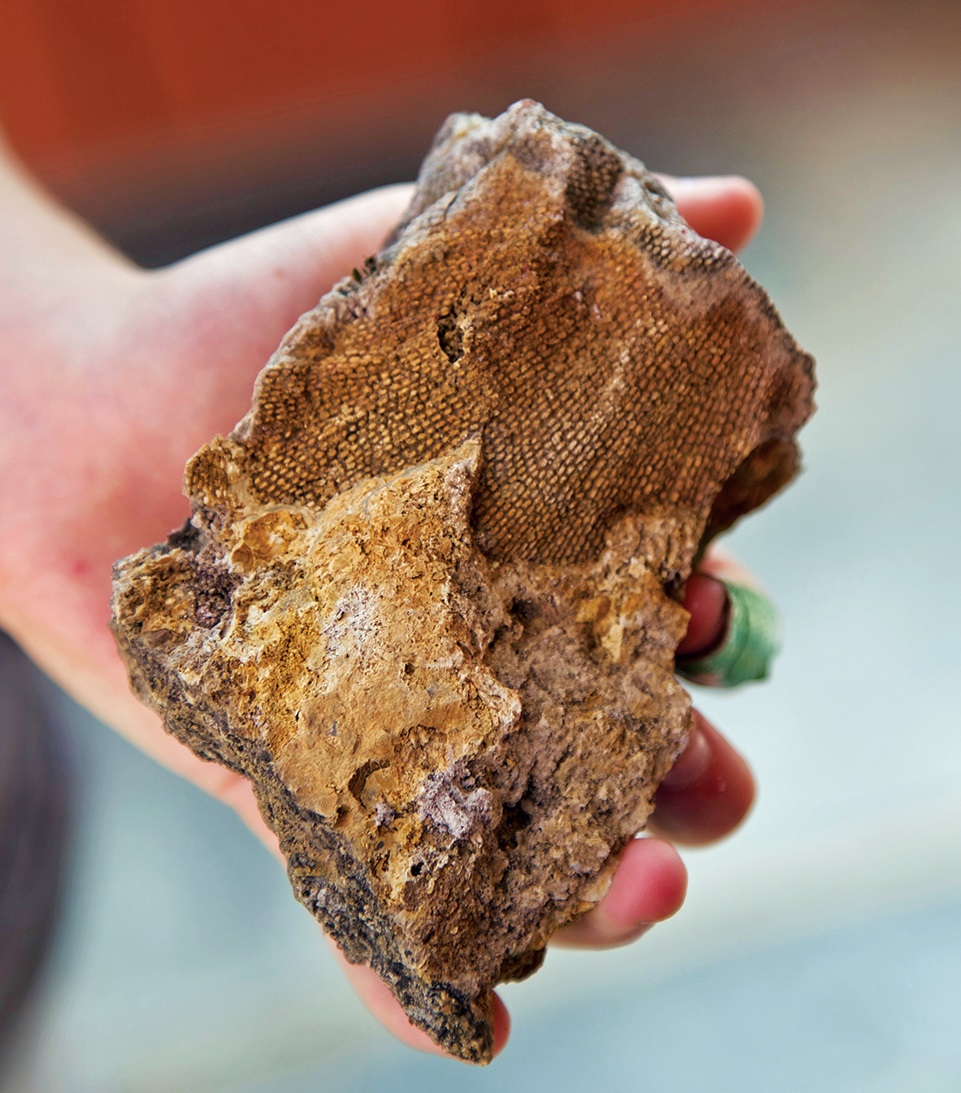
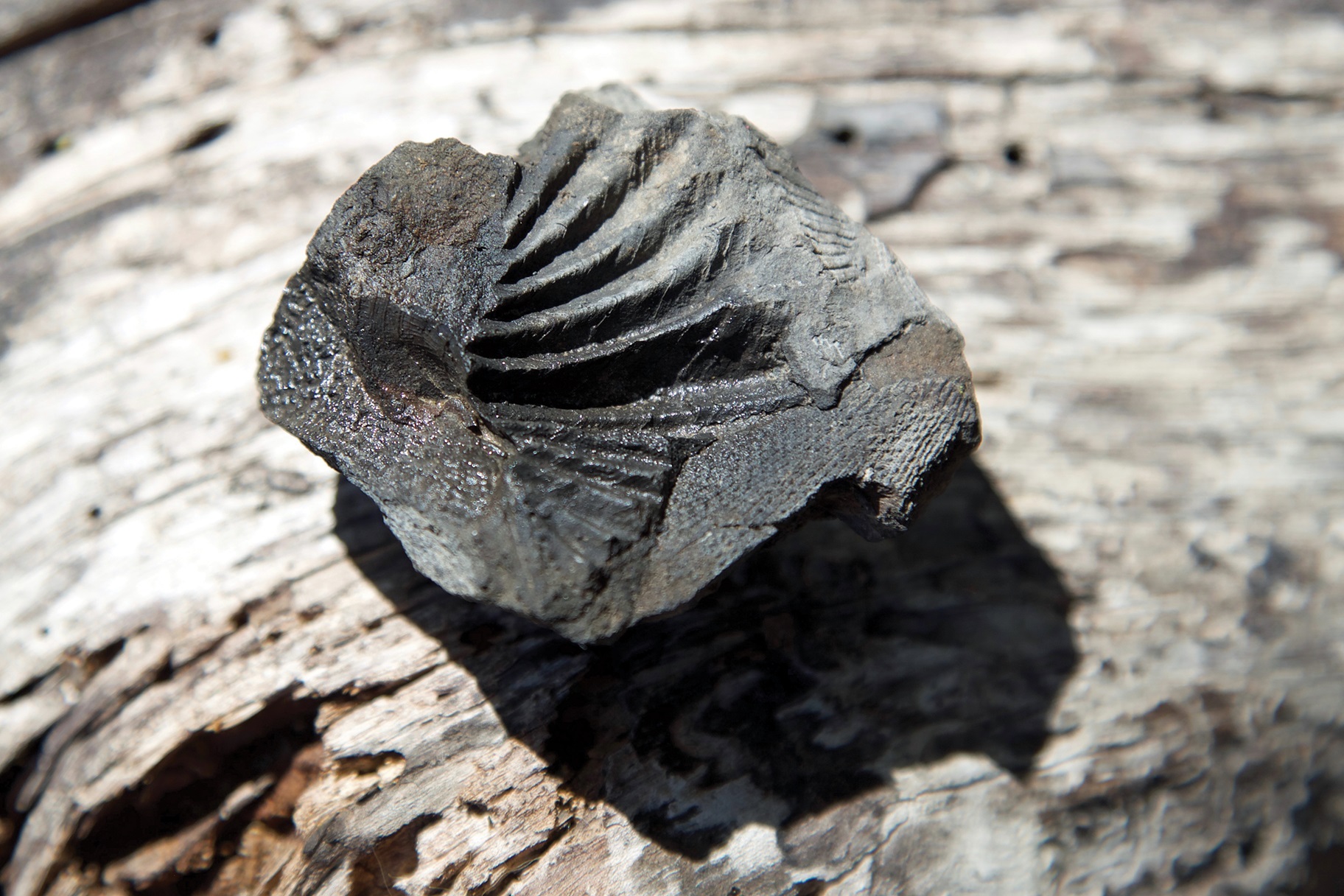
One lump cleaves neatly and the perfect, darkened imprint of a marine bryozoan – its neat lines like a child’s drawing of rain – comes to light for the first time in maybe 270 million years. It is a sunlight brighter than this Fenestella, a moss-like marine plant, would have seen during the Permian. What is now Tasmania was then inside the South Polar Circle. The Patch was part of the Tasmania Basin, a shallow sea – and later lake – into which glacially derived sediments washed, as icebergs floated by.
On a quiet Sunday afternoon, wandering through a sunny summer woodland, it’s difficult imagining the icy world that gave rise to these rocks. I begin to look at them with a new respect, and to ask a few more questions of them. Why, for instance, if fossils are the remains of what once lived, is there such an abundance of them here?
The answers turn out to be more dramatic than I could have imagined. It seems that the Permian era saw one of the worst mass extinction events of all time, more severe than the (later) extinction of the dinosaurs. A staggering 90 per cent of all marine species and 70 per cent of terrestrial species didn’t make it from the Permian into the Triassic.
The reasons for this are still debated, but the collision of tectonic plates and the formation of Pangaea – the all-in-one land mass that preceded supercontinents and continents – was one possible factor. This new land mass greatly disrupted the operation of the currents that moved around and between the oceans and seas. This would have brought about drastic climate change.
Colliding plates would also have led to increased volcanic activity. Large numbers of spewing volcanoes would have spiked CO2 levels, and brought about climate change and ocean acidification. They may also have caused a massive dust cloud around the globe, and that would have disrupted all life forms.
Whatever the global causes, as we sift through The Patch’s mudstone it’s the local victims we’re finding. I crack open one rock and find two sides of a bivalve brachiopod still together, like hands joined in prayer. The shell itself is long gone, but the mud that infiltrated the shell in place of the creature, has preserved the shape of the shell’s interior perfectly. Within an hour we find dozens more bivalve fossils. Right here in our small patch of bush, there’s abundant evidence that shallow-water marine creatures with shells, such as these brachiopods, died in huge numbers during what one geologist has called The Great Dying.
What started as an excuse to get some fresh air with my grandchildren has turned into a mind-expanding journey through time. I will never again consider these rocks ordinary. In fact I’m beginning to wonder whether anything in our world is truly ordinary.
There’s one more twist to this tale. When the children depart, along with their little bag of rocks, I look into the geological backstory a little further. And there, in February 1836, I find Charles Darwin, wandering about our local hills, mountains and shores, collecting the self same fossils, and adding to his long list of mind boggling questions. He may even have passed through The Patch. Whether it’s 182 years, or 270 million years, it seems you don’t need a Tardis to take a mind-expanding wander through time.