
RETURNING RAPTORS TO THE WILD
writer and photographer BRONWYN SCANLON
A farmer, a television crew, Raptor Refuge founder Craig Webb and his assistant, Juliet Harlow, and I gather in Tasmanian bushland on a crisp autumn morning. We bumped along dirt roads to reach this spot in the Huon Valley, more than 50 kilometres from Hobart. Now, emerging from a large plastic transport tube on the ground is the heroine, a majestic Tasmanian wedge-tailed eagle (Aquila audax fleayi).
Webb and Harlow, on their knees, ease the eagle out, taking care not to damage its feathers. Handling a bird of prey takes skill, focus, and raw wit – things can go wrong.
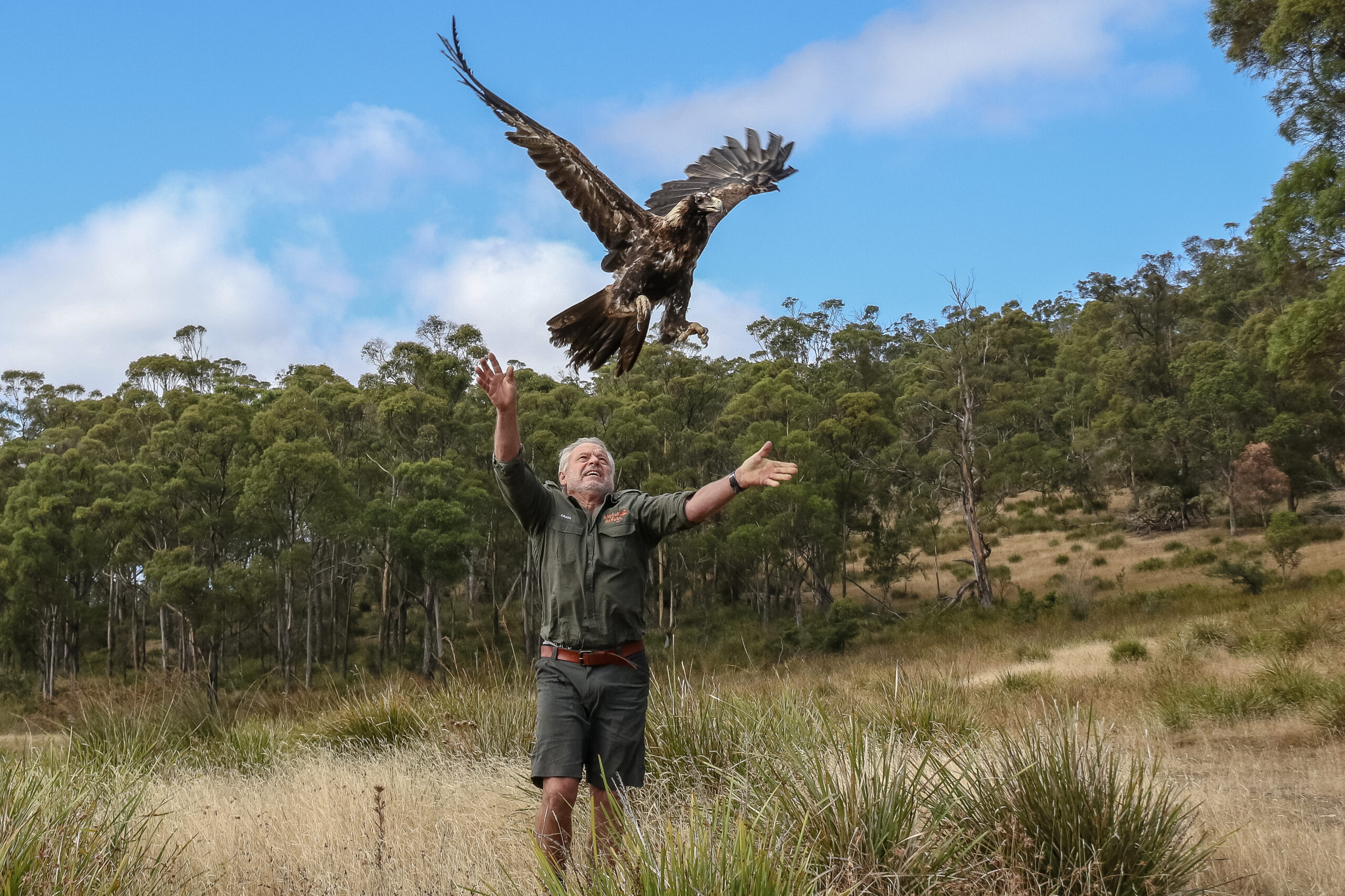
Webb stands in long grass holding the female eagle that weighs about 4.5kg. Webb isn’t feeling in the best of health today, but he knows the raptor is ready to go.
This chocolate-feathered, ferociously-beaked creature is nearly a metre in length. Respect and awe descends. It is a privilege to be here.
Wind gusts. “Ready?” Webb asks. The TV crew and I nod. There is a spine-tingling moment as Webb begins the countdown. “Three, two, one … “
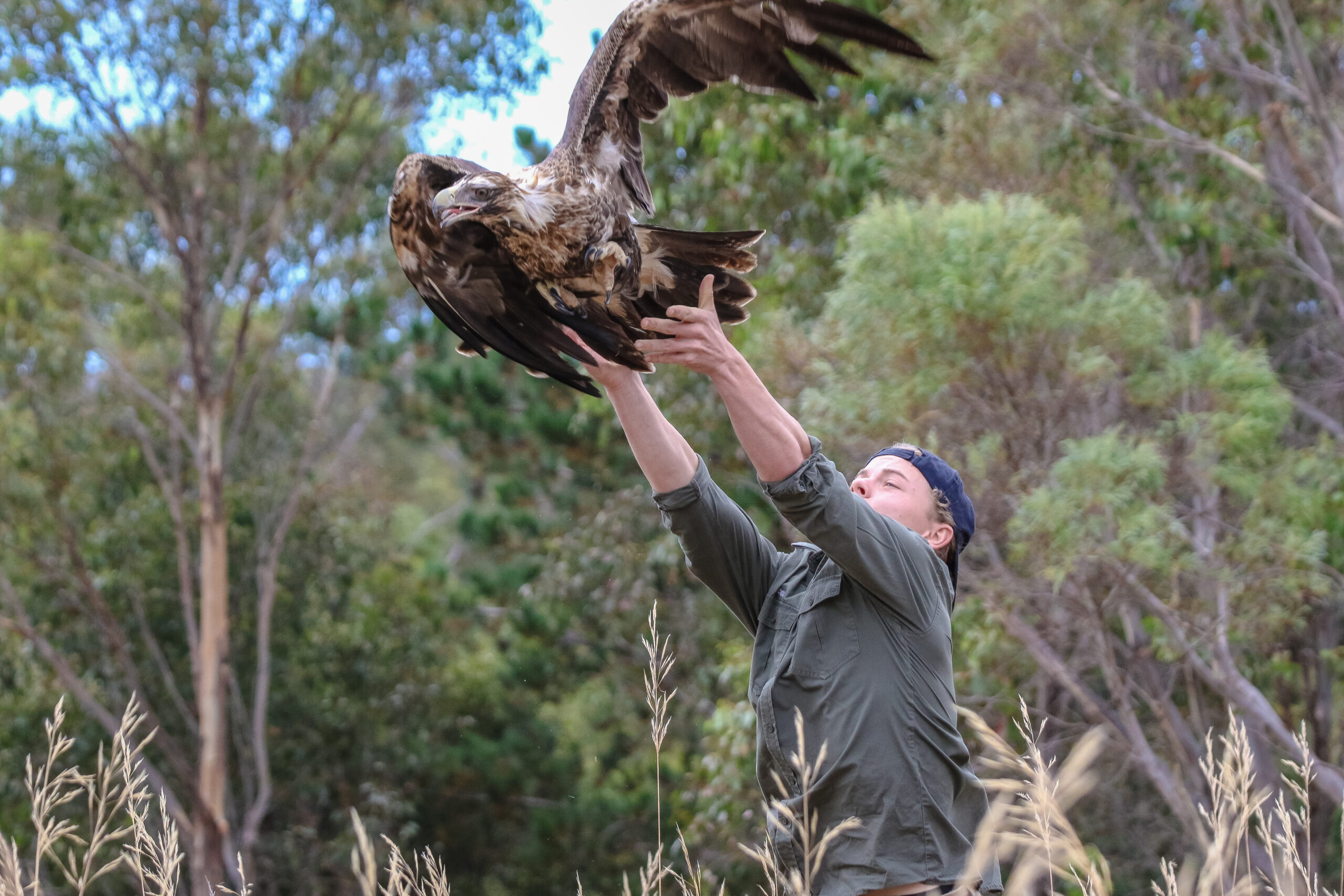
He lifts the massive bird. I focus. Webb thrusts it into the wind. The eagle’s wings flare. Click. Got it. The wingbeat cycle is a circular movement with a dynamic wing shape change as it takes to the sky, unfurling a more than two-metre wingspan.
“Fly free, Wedgie,” Webb says as the eagle flaps across the treetops and vanishes from view. We watch the space long after it has gone, feeling the weight of this release, a rare and beautiful moment that leaves us feeling high, a moment that, if you blinked, you could miss, yet its impact will linger.
After 10 months of rehabilitation, the eagle is now back in its former territory, and Webb feels relieved. The farmer who first found the eagle, under a powerline, is beaming. According to Webb, electrocuted flesh usually causes death. This raptor’s recovery is an exception.
Craig Webb has rehabilitated and released raptors for 23 years – eagles, falcons, goshawks, collared sparrowhawks, swamp harriers and owls. He values sharing celebratory releases, especially eagles, with a broader audience. Elation, wonder and vital messaging around conservation underpin each launch. Raptor Rescue Hotline callers often attend releases, taking an active ongoing interest in the bird’s welfare after discovering them in need of assistance.
Birds are released where rescued unless they’ve been in care for an extended period, as another eagle is likely to have replaced it. The refuge scouts potential release locations to ensure eagles don’t face a territorial attack. Rehabilitated raptors are vulnerable during their first week back in the wild while consolidating their fitness. Sites away from potentially deadly powerlines are mandatory, and storm-free, windy days are preferred to give birds the best odds of a good fresh start.
Webb’s son, Ziggy, now 21, released his first raptor, a brown falcon, at age five. He followed his father’s instruction – hold firm but not tight, the countdown, lift and toss. “I just remember it flying away, and I couldn’t believe it,” he told me. “I loved it. I was addicted.”
Raptors “show off” when they’re ready for release, Ziggy told me. “They fly around in circles in the flight tunnel.”
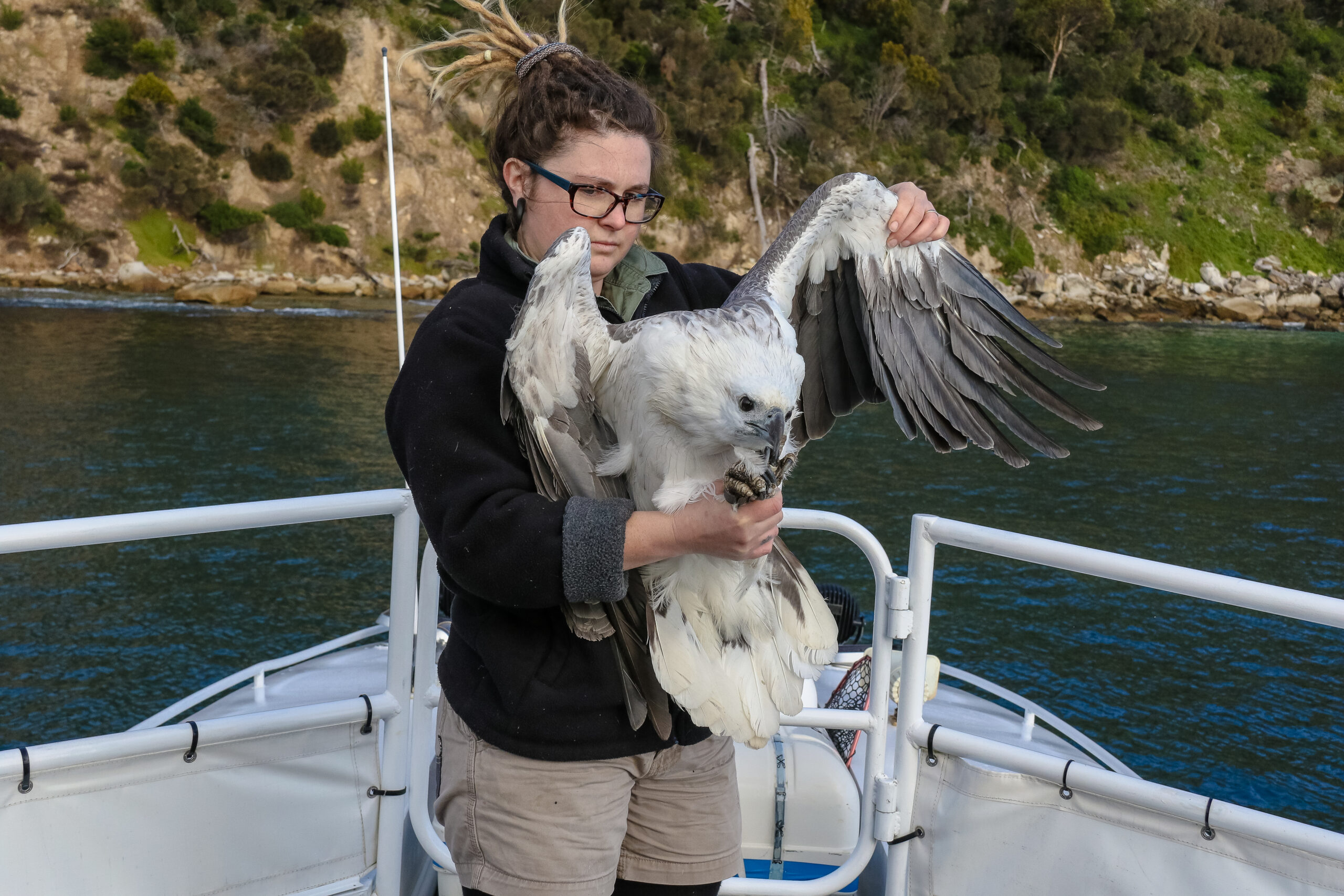
Staged care is tailored to a bird’s injury or illness, the species and the individual. It also involves close monitoring, including via cameras, as birds mask ailments. Webb Snr living on-site enhances the observational capacity. It can be a long process. A white-bellied sea-eagle (Haliaeetus leucogaster) struck by a boat or car at Dolphin Sands lost so many feathers they had to be grown out.
“Big birds use lots of energy to grow these big feathers, which takes two years, or two moults,” Craig Webb explained. That eagle’s recovery took about four years. “It used to do a bit of flying but nothing serious, and then one day this sea-eagle starts doing laps – seven, eight, nine laps. A kilometre a day in laps, which had never happened before. So, it was him saying, ‘Hey guys, I’ve got all my feathers back, I’m getting fitter. I think I’ll be ready to go soon.’ ”
Webb estimated 30 to 35 per cent of all rehabbed birds are successfully released.
Cardio and flight fitness and a clean bill of health over a sufficient timeframe equate to confidence a bird is ready to return to the wild. Then, it’s time for talon sharpening to enhance the bird’s hunting capacity, and other preparations ahead of release.
Despite hiccups – such as, 15 years earlier, when a wedgie escaped inside Webb’s Land Rover during a pitstop en route to a release near the kunanyi summit, or such as the day when Webb was nipped under the chin pre-release by a white-bellied sea-eagle on board a Pennicott boat – most releases go well.
Craig Webb’s educated optimism and passion result in birds receiving a second chance that in other hands, may not. In 2022, Ziggy Webb had stood holding a wedge-tailed eagle before release on northern Bruny. A resident had found the malnourished raptor with a large hole in its chest, the wound likely the result of a territorial fight between wedgies. A future had been uncertain due to extensive muscle damage. But the refuge worked closely with a veterinarian during a two-year recovery until the eagle was flying again in the 16,500 cubic metre aviary.
I was there for that release too. Watching the raptor burst into the sky and fly strongly across dense bushland left us euphoric.
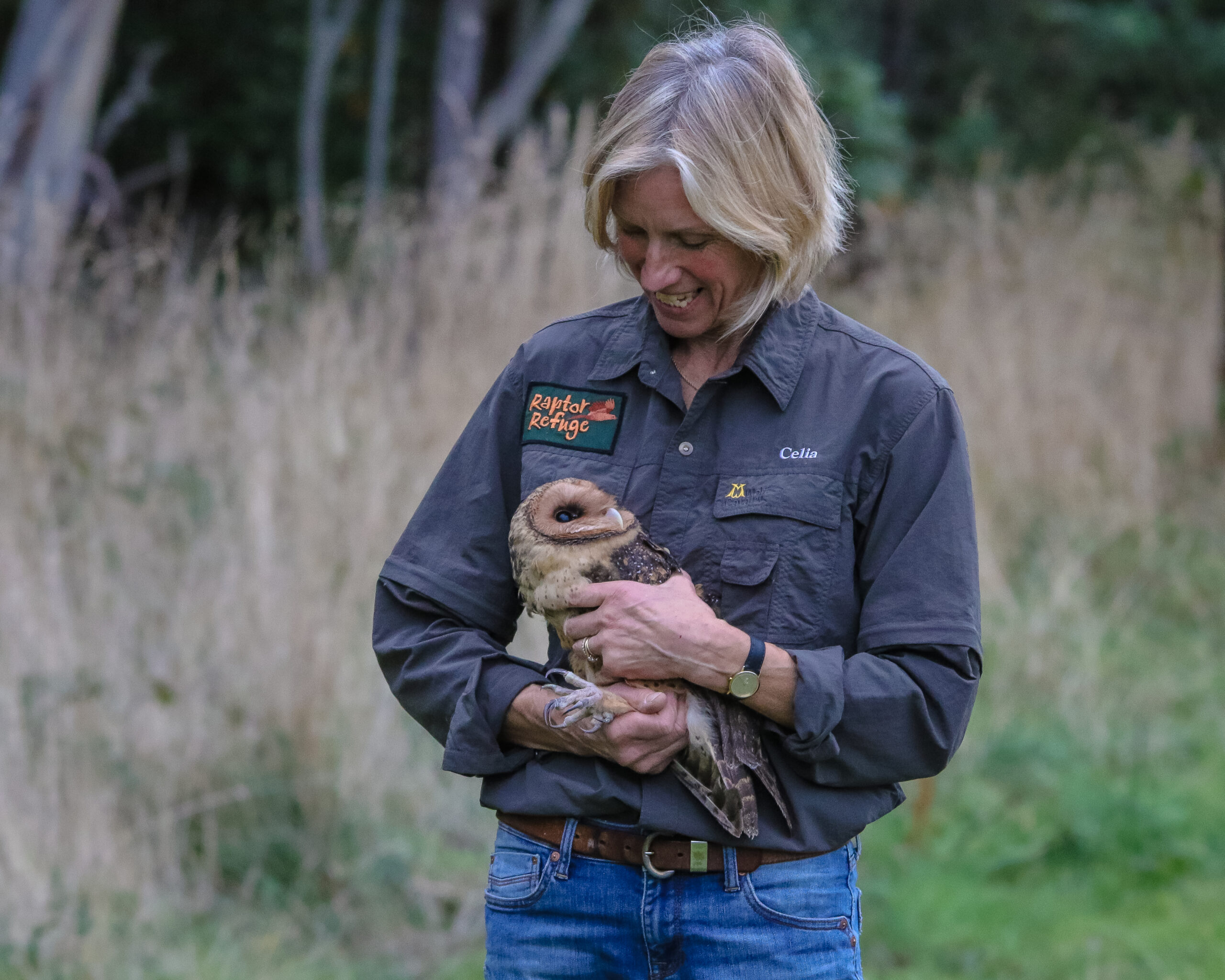
On another day, in 2019, at dusk, rescuers, rehabbers, and recorders gathered beside a creek near Ranelagh. Celia Watchorn, a Raptor Refuge volunteer, was about to release her first bird. Watchorn cradled a Tasmanian masked owl (Tyto novaehollandiae castanops). Veterinarians had pinned and plated its broken wing after it was hit by a vehicle. After the fracture healed and the pin was removed, the Raptor Refuge provided further care as the owl underwent flight fitness training to build sufficient strength to survive in the wild after a three-month hiatus.
It was a beautiful creature, its rufous breast speckled dark brown. Its owl’s head rotated, and its dark, penetrating eyes, set in its buff facial disc, fixed on Watchorn. The owl was ready to go. There was a moment’s silence as the humans invested in the bird’s welfare looked on. “Three, two, one …” The owl spread its wings and flew into the dissolving light. It perched on a tree above the brown-running creek and watched us for a minute, and then disappeared into the night. Celia Watchorn still has a barred feather from that owl, a token recalling a moment of numinous beauty and connection.
Each bird of prey plays a crucial role in the environment, stabilising populations, reducing introduced pest numbers and promoting a healthy bush ecosystem. The Tasmanian wedge-tailed eagle, white-bellied sea-eagle, grey goshawk and Tasmanian masked owl are all threatened species.
The majority of birds at the Raptor Refuge are in care due to collisions with human infrastructure (including power infrastructure) or environmental damage or modification, such as habitat loss and deforestation. A small percentage arrive because they are starved – not all birds successfully hunt and compete.
Birds are banded or toes marked to allow monitoring post-release, but the refuge hopes the raptors never return to care and that they observe humans from a great distance as they continue to live in the wild.
By way of a footnote, Ziggy Webb once released a masked owl on-site at Kettering. The following week, he burned a small fire near his home beside the refuge. At about 10pm, he walked back from the aviaries to check on the fire. Standing in the cold air, he had a sudden feeling. “I just felt this urge to look up with the head torch … and right above me, on a tree’s bare branch, I saw this identical – I’d say 99 per cent sure the same – masked owl. The exact bird I’d released a week before. It was looking straight down at me. I looked away for half a second, and it was gone.”
The younger Webb smiled. The owl’s final farewell visit was deeply satisfying.