
Out here, you notice how everything is in relationship with the other, how we are connected, how we have the same fate. But you know this as much as I do. We are nothing without each other; we are nothing without the wild places.
photographers ANDERS BOWN and KATE BOWN
It’s a woman-against-the-elements kind of day. At 1,100 metres above sea level, in the heart of the Tasmanian Wilderness World Heritage Area, I’m hauling myself and a heavy pack up the shoulder of a mountain. It’s raining, visibility is down to the end of my arm, and the wind is so cold it might as well be Antarctica.
Somewhere above, my husband is fighting his way through the thick scrub — alpine heath, eucalyptus coccifera, richea scoparia. He calls out, and I reply with a string of wicked words because I’m just too wrecked to care – a stick has gone through my waterproof pants, my hands are numb, I’ve lost my water bottle, and I’m bleeding. Just one slip from miserable. Of course, I don’t notice he is taking a video with his phone.
“Can’t show that to the kids,” he yells.
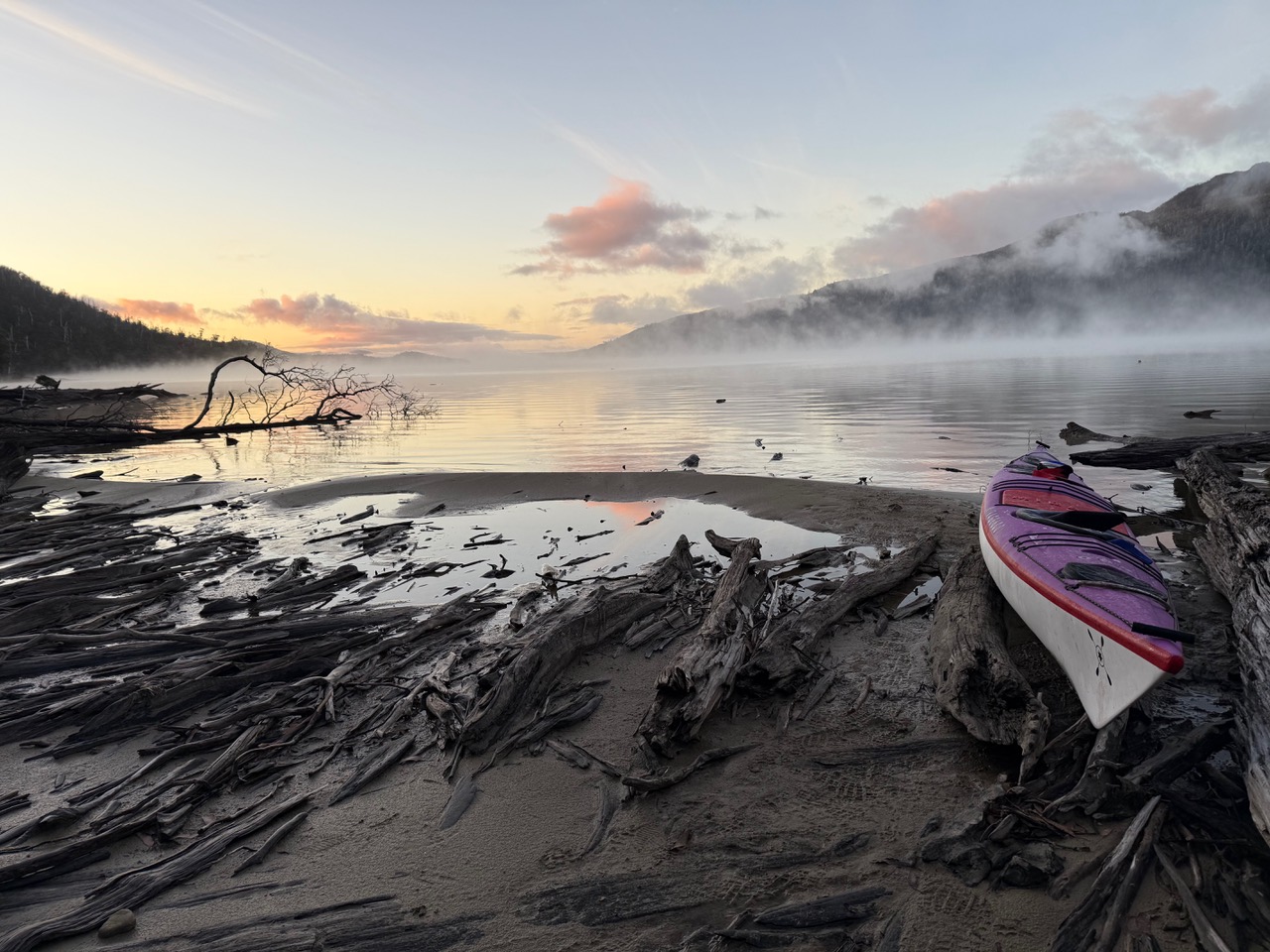
Three days earlier, at leeawuleena/Lake St Clair, we had loaded our double kayak with hiking packs, food, and gear for a week, and paddled to a little beach below the summit of a spectacular mountain named Ida. All afternoon, she had sung to us, her dolerite top rising from the water and pointing like a needle into the sky. I had listened, perhaps a little more than my husband, because Mount Ida was the place where I fell in love with the mountains – my first wild summit at the tender age of 14 – But also because I was anxious that we might capsize in the dark, roiling waters of the lake, and I had wanted to get there fast.
I had longed for the safety of the land, just like I had longed for an adventure like this. It was meant to be an early celebration for my 40th birthday. But now, in the thick of a storm, three days into a challenging traverse of the Du Cane Range, I am beginning to wonder if this was really what I wanted.
At least the inside of our little yellow tent is always sunny. I like her positivity, her slight fabrication of warmth. I unzip the fly and look out, but the sky is grey and pitchforked, and though we are camped beside a pretty tarn ringed with ancient pencil pines, deciduous beech, and magnificent mountains, there is not much beauty to report. I close the fly, find my book, and wait.
But look now — the sun is peeking through the mist and I can hear the birds. Oh, how I’ve missed you. And above the lake, Mount Geryon, rising like a three-headed monster. We set about drying our wet clothes, draping them over the rocks nearby. “Don’t rain,” I plead with the low-hanging clouds as I keep watch. Steam rises from my leather boots. The soggy soil exhales. And all about, there is the heavy tang of humanness. But I no longer care; the day is finally on an upswing.
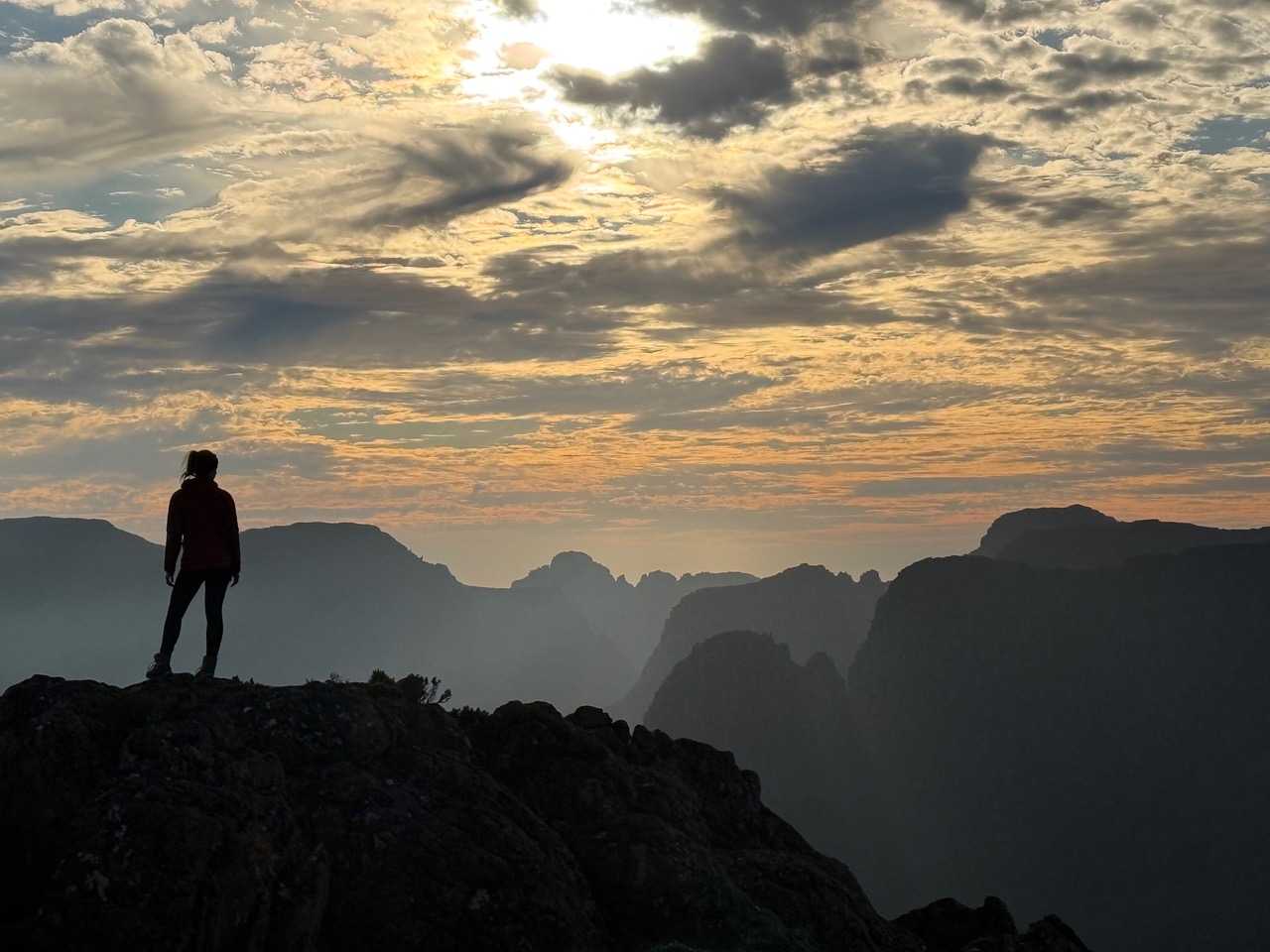
Two days later, on a ridge between two mountains (one named Massif, the other Falling), I am stretched across an abyss. My fingers grip a narrow ledge, and my walking boots smear a sheer wall. I am terrified. But in this moment, I do not think of my children, my life, or anything poignant. I think cat. All instinct and heartbeat — pure sensual grace. Hand by hand, foot by foot, I move until I reach my husband, resting on a gentle ramp. I look down at my red, raw palms and my legs, cut and bruised.
“You must have held on harder than me,” he says.
I exhale. “If we can survive this, we can survive anything.” And I think of the plastic container in the top of my pack containing five perfect poos in compostable bags — the gold standard for bush toileting now. “If we can carry our shit, then what?”
My husband is laughing now and climbing ahead because there is a swarm of ants crawling up his legs. Even here, on top of a mountain range, almost touching the clouds, there is life — insects, water, and flower gardens.
Perhaps you have spent time in the mountains too, and you understand the duality of being here: how it hurts but also how you notice things, and how grateful you are. The way the wind picks up the moment the sun lifts its head above the horizon. The pink scats filled with crushed berries on the track, evidence of elusive mammals. The old boot print in the middle of a mint-green cushion plant, a trespass that takes hundreds of years to recover. The white leatherwood flowers floating on the surface of the Narcissus River, like potpourri, beautiful enough to pull you in. And the black currawong on the edge of the rocks, at the head of the valley, watching the sunrise, surveying her domain.
Out here, you notice how everything is in relationship with the other, how we are connected, how we have the same fate. But you know this as much as I do. We are nothing without each other; we are nothing without the wild places.
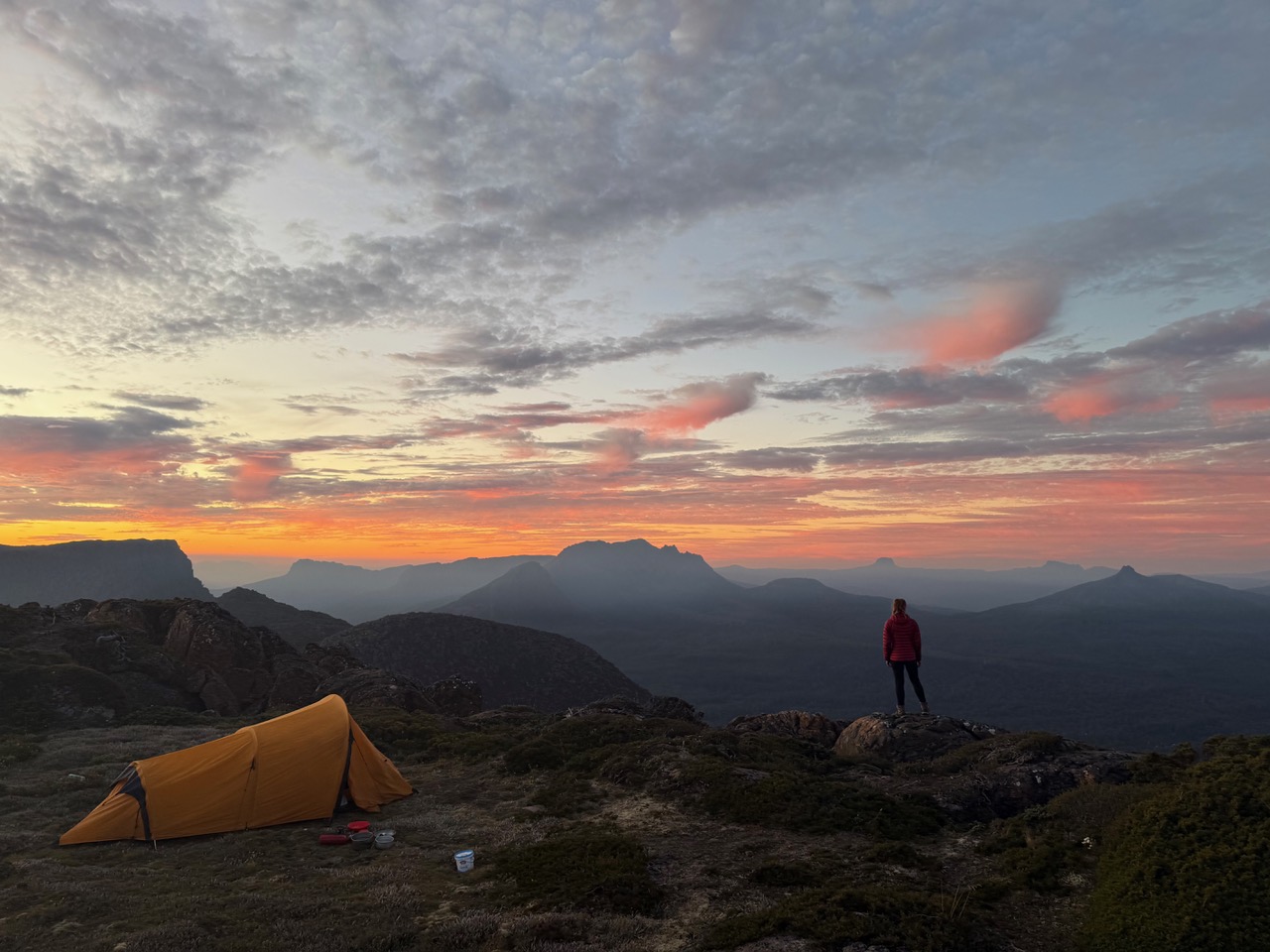
On our last night, we pitch our tent on the summit of Falling Mountain. I walk to the edge and look out at the Du Cane Range — all sheer cliffs, huge boulders and green skirts. I watch the light creep down the range, painting peak after peak in gold, the mist settling into the valleys, and the sky, with clouds infused with wildfire smoke, erupting into flames. I am giddy. It is almost too much. For out here, we are rich in time, and wonder, and some sort of hard-won grace. And there is peace in this simple existence of walking with just your means of survival on your back. Your pack is heavy, but it is lighter than all the things you carry in your life at home.
Home – that place we are heading for now – falling down the side of a mountain, more boulders, shrubbery, thick words, hours of hardened track, and the long kayak across leeawuleena/Lake St Clair to our van.
When we reach the beach, I stagger ashore with my paddle and sit down where the bush meets the sand. There is a woman in a green bikini reading a book, but she does not notice me. I look out across the lake to the mountains, and my eyes water, just a little. I am not broken or wounded. I am blood raging, heart thrumming. For it is here, in the wilderness, that I have learnt what it means to be truly alive.