
Days are warm, evenings bright and long, but we’re happily ignoring all that. Instead we’re keeping a tradition that properly belongs to the cold, dark, northern lands. It’s taken some of our clan up into The Patch.
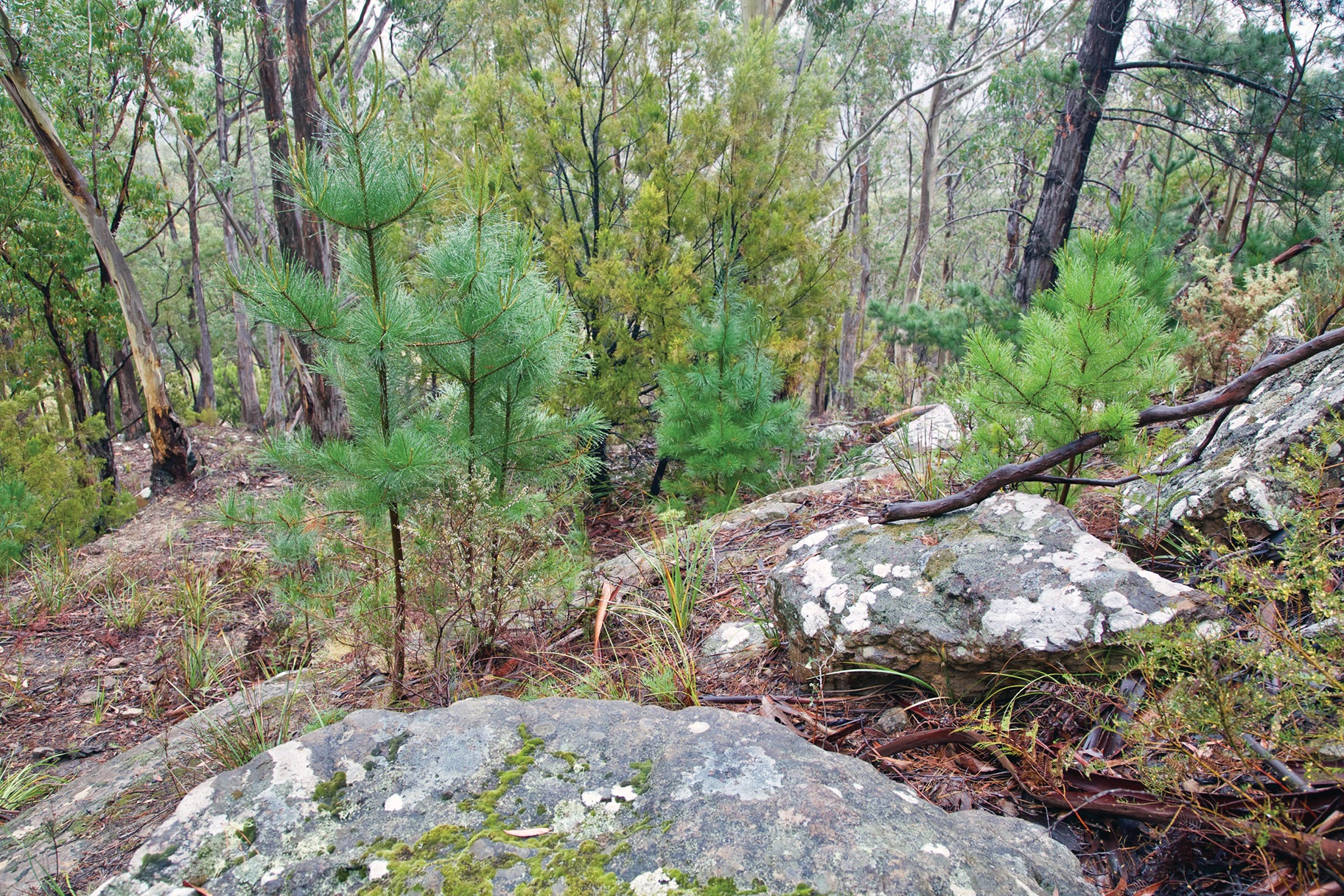
My earworm is Joni Mitchell singing It’s comin’ on Christmas, they’re cuttin’ down trees, they’re puttin’ up reindeer, and singin’ songs of joy and peace. Bow saw in hand, I’m searching for specimens of a particular feral plant that thrives up here. Pinus radiata, or Monterey pine, is surely one of the best Christmas trees money can buy (or an eco-warrior can “liberate”).
It’s been raining, so our 20-month old granddaughter is wearing her rain suit and gumboots. They give her an added degree of determination, as if she needed any. Before long she shakes off guiding hands, stomps along the track – straight through puddles – and stops only when there’s something interesting to pick up and examine. That means about every 10 metres or so. It is a long excursion.
Only for the steepest bit of track does she let her aunty hoist her up for a while. When we reach the feral pines, she’s down again, watching while we work, until some passing cockatoos provide better entertainment. Concepts like Christmas, bow saws and weed trees are probably lost on her, and so too is land tenure. Only we elders feel a tinge of trespass, and the need for plausible excuses, as we cut down something that is not ours to cut.
Bruce Cockburn sang never thought of possession, but all this was mine. And that captures how I feel up here. It’s as though I belong, that this bush is in some sense mine. It’s not actual ownership: according to the Land Titles Register, the owner is a multinational company, and a local subsidiary is the manager. My ownership has more to do with experience, and long connection. It’s recorded on a more natural, less official register.
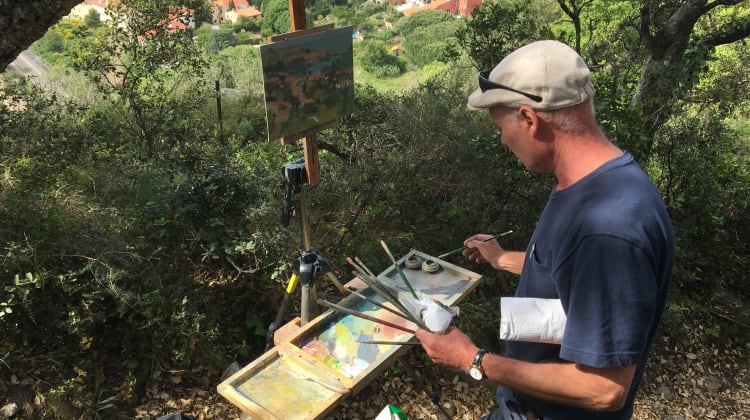
And I’m not the only one. A motley lot of other locals co-own the place, and express it with their feet: joggers, walkers, mountain bikers, artists, bird watchers, dog walkers, wood hookers, even the occasional arsonist. Once I found a tent set up in The Patch. It was sitting oddly on the side of a steep slope, amid thick cutting grass, a daft place to pitch a tent. My head filled with a strange mix of thoughts and concerns. Was the tent’s owner sick, dead even? But I also felt a faint sense of trespass, as though this was an intrusion upon my space.
I called out, walked towards the tent, called again. There was no answer, so I unzipped the tent and looked in. It was empty. I later worked out that it had probably blown here, intact, from someone’s yard in recent gale-force winds.
That odd sense that this was somehow my bush was reinforced a year later when someone actually did set up camp in The Patch. Lynne and I walked near the well-hidden set up a few times. Not only was there a tent, but also a campfire and an old chair. The camper had even cut down some branches and used them to try and disguise the site.
I approached cautiously, calling out my presence before having a closer look. The person was not at home, but the tent had a sleeping bag and some clothing in it, and was obviously in use.
Word soon got to the official land owners, and on my next visit the tent had gone. But in the fireplace I found some hand-written notes. They contained this brief exchange between a company employee and the camper:
(Company) “This is private property. You need to vacate this area immediately, or this area will be pulled down.”
(Camper) “I received the note. So I’m organising transport to leave. Will be gone ASAP.”
The latter was in a neat, possibly feminine hand. We will never know her story, but it pushed me to think further about who belongs in this place, or in any place. Given this was never terra nullius, Tasmanian Aboriginal people were the only ones to belong here for perhaps 40,000 years. I’ve seen a couple of signs of their presence within The Patch, including a spear sharpening groove in a sandstone outcrop and some likely looking overhang shelters.
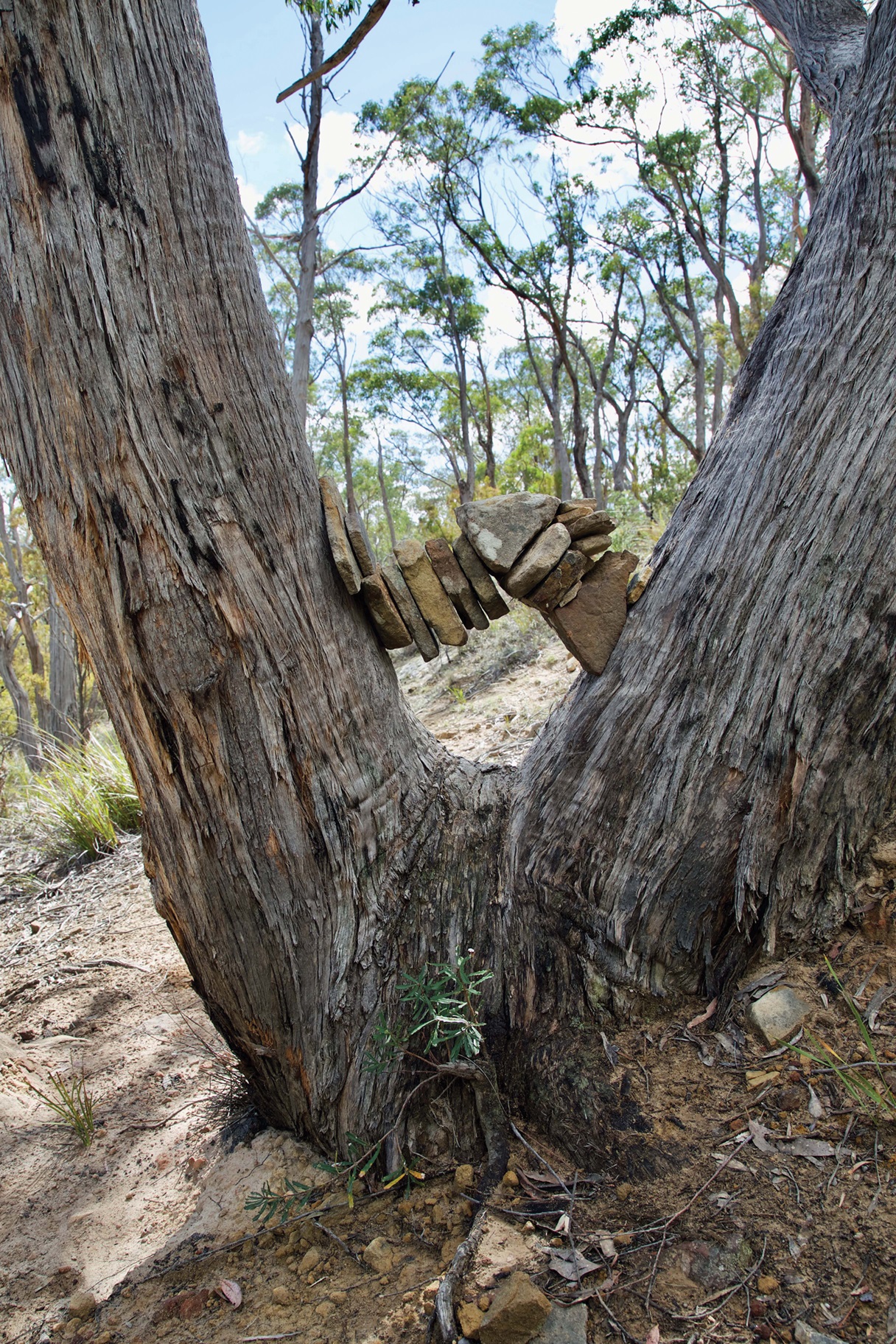
Both sites have indications of more recent use: initials carved on the sandstone slab, words scratched on the rock shelter wall. Old bricks, barbed wire, bits of quarried stone, and crockery and rusty tins tell stories from recent centuries. In my time, neighbours have buried their pets in the bush, and mountain bikers have worn tracks and constructed jumps.
All of these uses reflect some sense of belonging to this place. In that vein I decide to take my tent into The Patch and overnight there. I’m not sure what I’m expecting, but I have long wanted to do it. The night I choose is windy, and I walk just 700m away from home and set up my tent. There’s a waxing moon which peeps through scudding clouds and swaying branches. As I adjust my tent I discover I’m sharing the site with some small ants. They add a faint formic whiff to the new tent smell. But there’s a side scent. I feel slightly dizzy on realising it’s the smell of earth disinterred by the busy ants. They’re doing what they’ve done for maybe 100 million years.
If longevity counts, surely the ants and the many other life forms in The Patch have the greatest claim to ownership. Yet somehow that doesn’t preclude our species from belonging.
Later it rains, and I think of my gumboot-clad granddaughter carrying off her tiny Christmas tree. I wonder if she’ll remember the whiff of freshly cut pine, the soft swish of needles on her face, the feel of warm hands, the shared laughter and sense of occasion, the raucous cockatoos. And will that in turn feed into a sense of belonging to this place?