

writer and photographer KATE BOWN
Winter by the sea in Tasmania is bearable if you’re dressed for it. This Tuesday morning it’s a red woollen bush shirt and a red cable-knit beanie. The cold is not getting in, even if my neck is a little itchy. I give my youngest daughter a squeeze-hug by her classroom door and walk out into the playground. A friend greets me with a wave. “Wow, you’re beaming! You won’t get lost in that,” she says.
I laugh, suddenly aware I must look like a woman on fire or a post box or an emergency beacon. I say, “Safety first!” But what I wanted to say was, there’s a pain sizzling inside me as hot as my sister-in-law’s chilli sauce and all I want is to go down to the river and cool off. My friend smiles and we say goodbye. I drive, 10 long minutes, my thighs clenched to hold my pelvis still and my back straight, to Cornelian Bay, where the timtumili minanya/River Derwent curls its wide blue belly below my home.
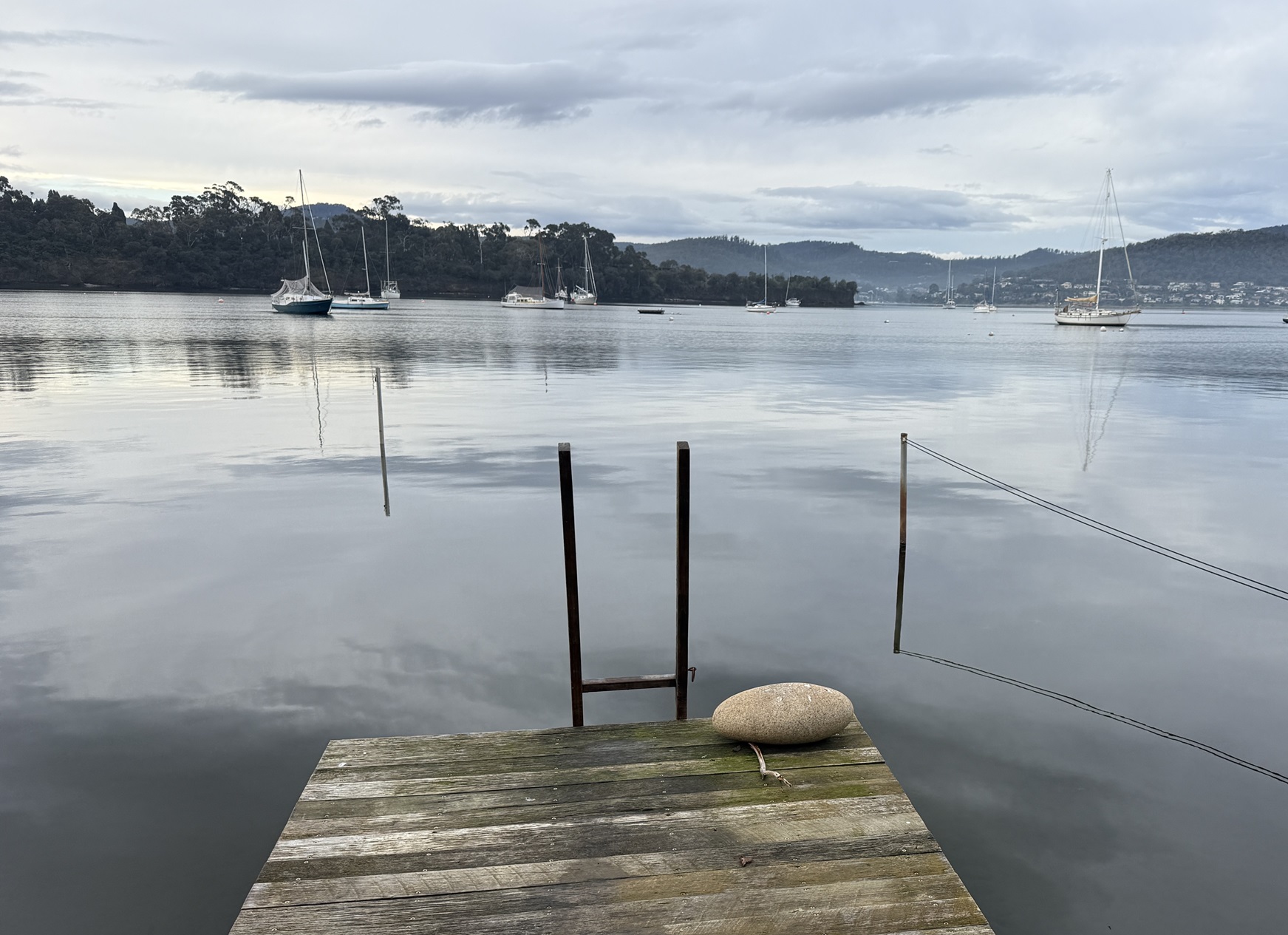
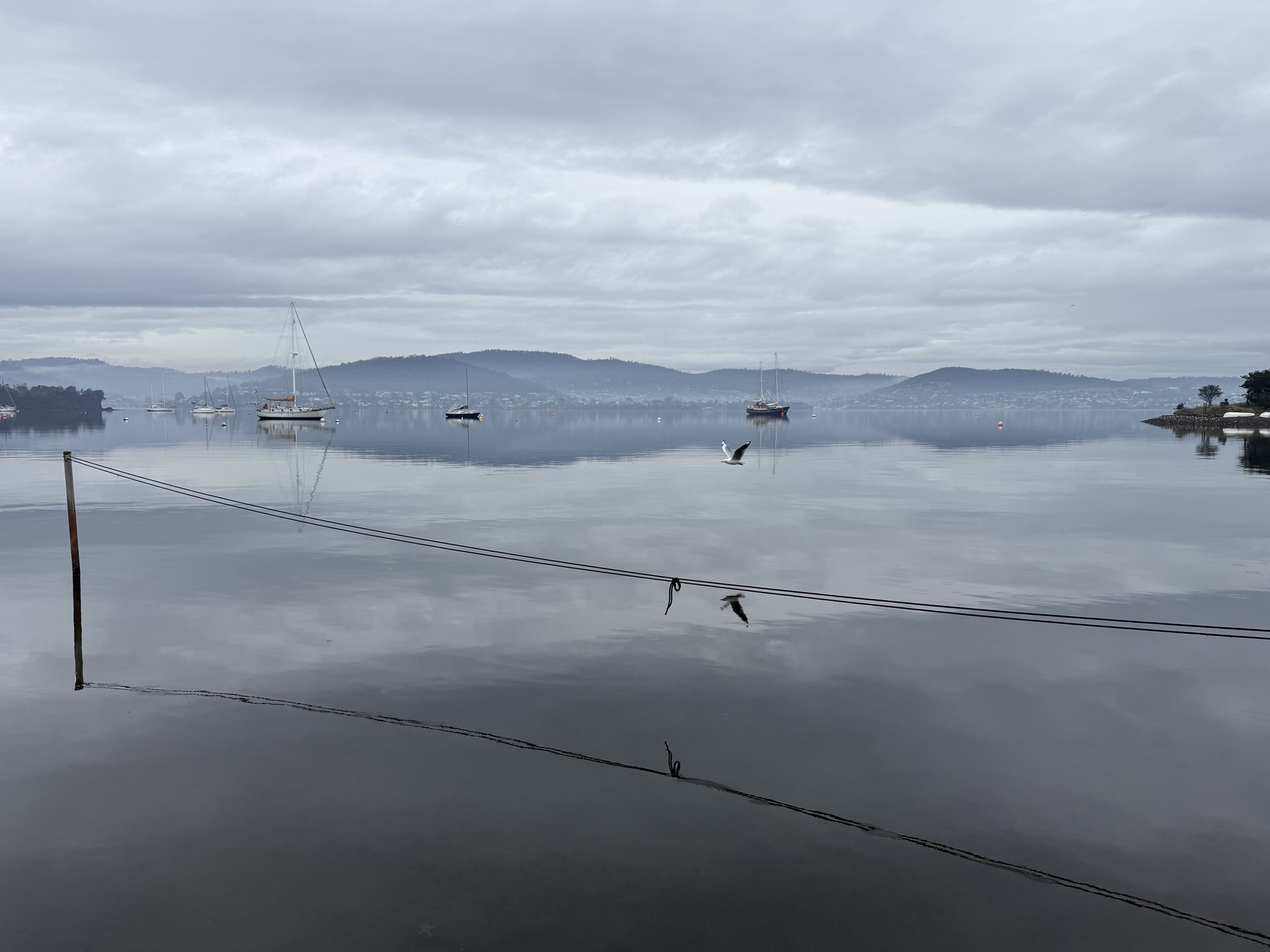
I take the track to the water, past the little boat sheds, nestled like tinned fish, past the sandy beach, and the row boats, to the rocky point at the entrance to the bay. It’s one of those days when the sky blends into the water. Everything is a gorgeous grey-blue. There are clouds in the river and a river flowing into the sky. How magical it looks, the day’s gentle light reflecting in the water.
I want to share it with you. Come and wander by the river with me.
. . .
Out on the water, not a ripple. The wind is playing in the mountains and the tide is midway, going nowhere. Here, at Cornelian Bay, timtumili minanya becomes an estuary; fresh water mingles with the silt-salt of the Tasman Sea, curving into bays and slipping into harbours, rising and falling with the whim of the moon. timtumili minanya is almost home.
Can you hear the river yearning and the sea calling?
There’s a rhythm with rivers: earth’s tug and water’s roll, liquid finding a way to flow. It’s the most beautiful kind of music. The pebbles sing it, exposed at last, on the river bed. And the greening trees, washing their leaves at the water’s edge. The crumbling cliffs, the kissing rocks, the tumbling sediment, and the birds too, as they circle and shrill.
Oh the river and the sea – it’s a love as old as forever ago.
. . .
The rain is making circles the size of coffee cups on the surface of the river. They remind me of the patterns my children make with the Spirograph at home, loops connecting over and around each other. What’s the name for the shape left behind when water falls into water?
A soft sigh fills my ears. I wonder if it is the rain, finally released from the clouds. Or perhaps it is the fish on the sandy bottom: spotted fish with hands, flathead with eyes that point to the sky. The flat fish are free from lines and hooks this winter and the next few, under new fishing laws. But the spotted handfish struggle on, desperately endangered, for our river is not safe, not since the arrival of heavy-metal processing factories and millions of Northern Pacific sea stars.
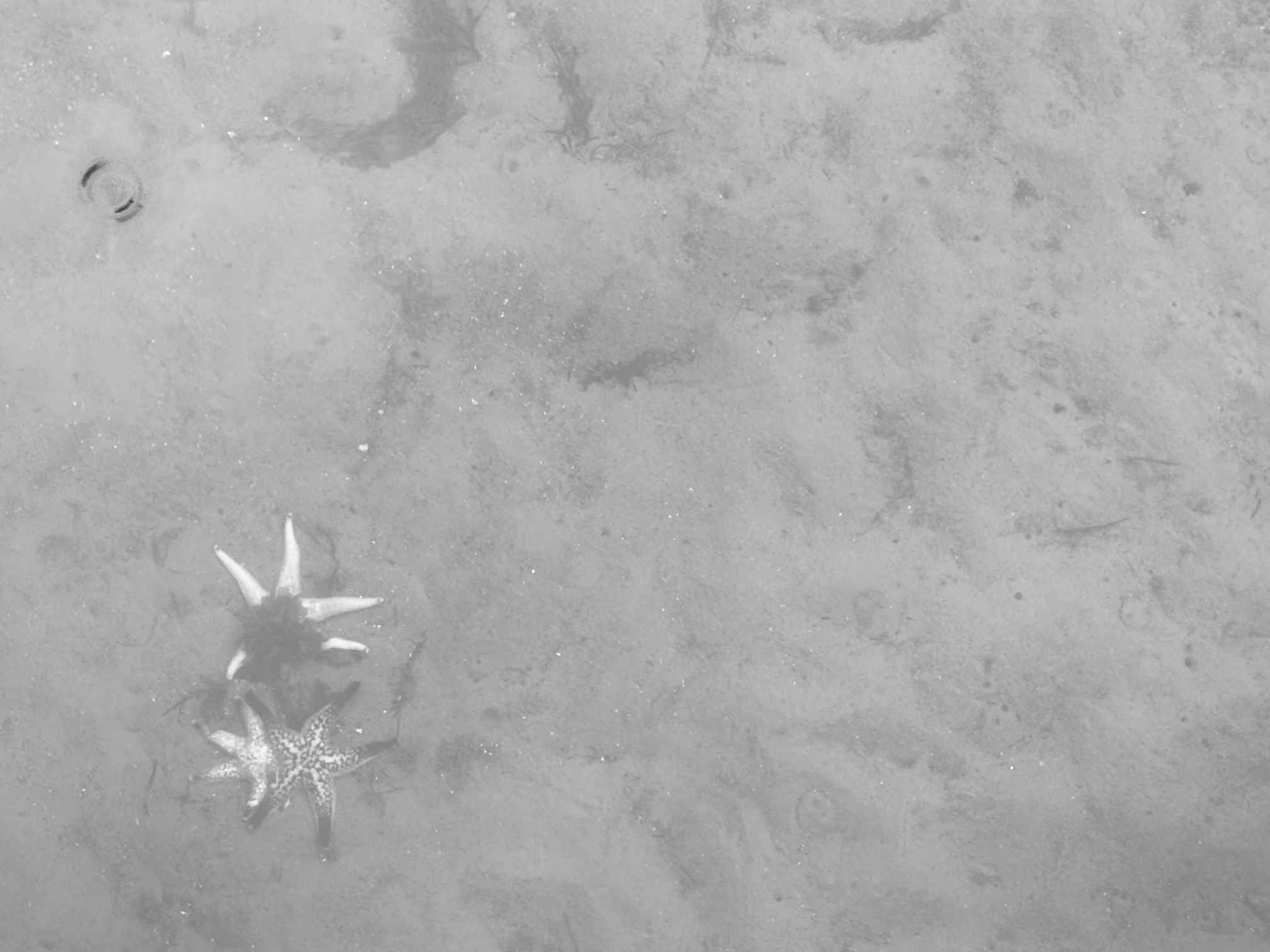
At least the water is clear today. Below the surface, I can see iron-grey mud-silt, snap-shut oyster shells and three orange-armed Pacific sea stars. I watch them for a while, willing them to move, for their hands to touch. But nothing happens.
Do they move at night, or when no one is looking?
A dog rushes past my legs. It’s a German sheperd, muzzle to the ground, sniffing the trunks of the river-bank trees. An elderly man dressed in a navy-blue down jacket, neck warmer and jeans arrives on the point. “She won’t bother you, dear. She’s just catching up on her emails. Friends everywhere,” he calls out.
I smile, remembering the sheperd from my childhood and how she would spin and yip with excitement when we came home for the holidays. I say something about the weather. “So still,” the man nods. The dog sniffs the succulent covered in pink blooms growing by my feet, and then they are gone.
. . .
I think: I’m catching up with the river. I’m filling my pen with blue river-ink because somewhere, across the sea, under a mountain, there is someone in need of a river blessing.
“Water comes from expired air,” my son tells me at his school exhibition. He researched the life cycle of Huon pine, an endemic conifer, curiously resistant to water, and made a diorama with a water cycle and plasticine feral pigs digging at the tree’s roots.
I wonder when I breathe if the water within me is singing because it is returning to the sea.
By now my back is aching and I want to sit down. Will you join me on the bench? There is room enough for two. You ask, “Why a river?” And I say, “I do not come to be cleansed. I do not come to be saved. I come to be rivered. I want to reclaim a rhythm that has always been within me, but that I have forgotten.”
You say nothing at all, but in your lap, your hands open.
. . .
We look out and there are sea-gulls on the metal mooring posts and cormorants drying their wings on the wooden pontoon in the middle of the bay. The old sailing boats point their noses east, resting on their chains, waiting for a change. An ambulance sirens, cars thrum. Smoke rises in gentle puffs from a factory pipe above the pine trees. The mountain shivers with a sprinkling of snow. I notice my fingers, white in the cold air, and decide it’s time to move. I need to get my blood flowing before I enter the water.
I have been coming to the river almost every day since the winter solstice, to swim tiny laps around the mooring poles. I need a challenge, and winter swimming feels adventurous enough. By now the birds must know me as some kind of land-fish, blushing and gulping at the cold air, limbs thrashing, not trusting the river yet to go under.
. . .
I turn and head back along the beach towards the boat sheds. Thousands of white oyster shells lie at the high tide line; odd things, sharp and wonky. I bend under the branches of a sheoak falling towards the water, burnt orange flowers spilling from its thin tubular leaves. I notice the bark peeling on its trunk. It looks parched. I wonder if it feels pain too, if its burls are tender to touch. Does it shake its leaves to release tension? And what of the rocks – does the slow slop of the water feel like bone rubbing against bone?
I think: Sometimes pain is the deepest thing within us. Sometimes love, kindness too. But there is also water, beautiful cool water flowing in our veins.
. . .
The tide begins to climb the wooden legs of the boat sheds. And I know it’s time. The river is calling and I cannot say no. I find the door of the boat shed that’s been in our family for a few years now. I turn my key in the lock, open the door and walk out to the deck. I drop a towel by the edge, take off my clothes, pull on my green crinkle-cut swimmers. I leave my red beanie on. I’ve read its best to keep your head warm when winter swimming.
I descend the ladder, stopping at each rung to breathe until I am waist deep in the river-water. The cold no longer shocks me. The river feels like silk, cool and soft. I push out like a frog, legs kicking, hands slicing, to the mooring poles, past one, then two, and three, where a seagull drops a poo before taking flight. A good sign, perhaps.
My breath is slower now, rising and falling with the sway of the River. The tide climbs higher, licking the deck of the boat shed. I turn around the last pole, gulls circling above as I swim home.