
There’s something about the sea. Growing up in the harbour town of Hobart, how could one not grow to love the sea and her many moods; the call of the gulls; the salty wash of her waves on a morning beach; her fickle embrace as skittish winds blow off kunanyi; the way she scatters the yachts as they tack up and down the Derwent; her dark swells and the mysterious vastness of the Southern Ocean?
Over the years I have become increasingly struck by how the sea and seafarers connect us islanders to the wider world. This is the second of two articles that reflect on that relationship.
In the summer of 1836, Charles Darwin sailed up the Derwent in the Beagle. Although he was initially unimpressed with the straggling frontier town, with its Georgian pretensions and the blood and stink of boiling whale blubber, he stayed for a couple of weeks, and enjoyed some fine dinners, at which he entertained his hosts with tales of his travels in the Americas.
During the days, Darwin rambled, collecting 133 specimens of insects, worms and lizards, and climbed Mount Wellington, intrigued by the dolerite organ pipes, and the curious geology of the area. Darwin was on his way home to England via Mauritius and the Cape of Good Hope. While his initial impressions were not so good, by the time he left, he had decided that the society was probably “ … much pleasanter than that of Sydney”, which he had visited before heading south to Hobart.
Darwin celebrated his 28th birthday with George Frankland, the Surveyor General, in Secheron House. Unfortunately, the young scientist’s pet monkey didn’t take so well to the climate and possibly lies buried somewhere in a Battery Point garden.
Sixty years later, Mark Twain called into Hobart on his world tour. Setting out from Paris, the American novelist, travel writer and social commentator sailed across the Atlantic and toured the United States and Canada before heading on to Hawaii, Fiji, New Zealand, Australia, Sri Lanka, India, Mauritius, South Africa and finally back to England.
He described Hobart in 1895 as follows: “How beautiful is the whole region, for form, and grouping, and opulence, and freshness of foliage, and variety of colour, and grace and shapeliness of the hills, the capes, the promontories; and then, the splendour of the sunlight, the dim, rich distances, the charm of the water-glimpses! And it was in this paradise that the yellow-liveried convicts were landed, and the Corps-bandits quartered, and the wanton slaughter of the kangaroo-chasing black innocents consummated on that autumn day in May, in the brutish old time. It was all out of keeping with the place, a sort of bringing of heaven and hell together.”
He got that right. Tasmania was a prison, a beautiful prison. By the time Twain turned up with his famous moustache and his socialist leanings, the convict system had been dismantled and the indigenous Tasmanian community had been decimated. The old penitentiary of Port Arthur was systematically destroyed, many of the sandstone blocks looted and put to use elsewhere, an effort to erase the convict stain. The name Van Diemen’s Land had been dropped in favour of “Tasmania” in 1856, but the island remained, in one sense, a prison, a beautiful prison walled by oceans and distance.
A few years after Twain’s visit, in March 1912, Roald Amundsen sailed up the Derwent in the Fram. It was several days before the news was out, but the Norwegian explorer had beaten the Englishman, Robert Scott, to the South Pole. By this time, Tasmania was well established as the base for Antarctic expeditions. Mawson, Davis and Scott all sailed out of Hobart.
. . .
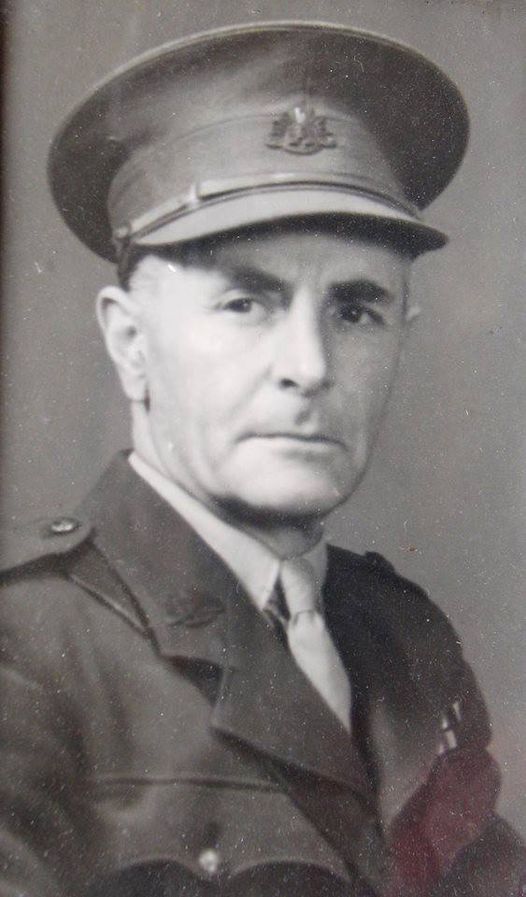
At 22 years of age, my grandfather sailed off to fight in the Great War. It was October 20, 1914. The HMAT A2 Geelong was brimming with eager young men when she cast off from the pier at Sullivans Cove in Hobart, accompanied by streamers and cheers and tears. Two years later Max was back, chastened by the experience of Gallipoli. He and my grandmother were married in South Hobart in December 1917. The groom and best men were in uniform, and the bridesmaids – “all pretty girls” according to The Mercury – were each given a silver bangle with the crest of the Third Light Horse regiment. The young couple honeymooned at Swansea on the east coast. On the journey, the gentlemen were obliged to walk up Bust-Me-Gall Hill and Black Charlie’s Opening, while the coachman took the ladies on ahead and gave the horses a rest at the top of each hill.
According to family lore (and a consideration of the dates), I was conceived aboard a ship. It was probably somewhere in the tropics. My parents, a pair of adventurous young Tasmanians who courted and married in England, were on their way home with a shipload of ten-pound poms and two sons – and another on the way. It was 1956, sixty years after Mark Twain’s visit and forty-odd years since Amundson sailed back from Antarctica and my grandfather sailed off to North Africa and Gallipoli. The six-week trip went via the Suez Canal, Port Aden, Colombo, and Fremantle. Perhaps that’s why the sea is in my blood?
The harbour of my childhood was alive. Wooden-hulled yachts raced on weekends, low-hung Japanese squid boats cruised at nights, their electric lamps glinting off dark water, local fishing boats came and went, oil tankers and freighters from faraway places docked in the harbour, brightly-painted wooden ferries plied their trade during the years after the Tasman Bridge collapse, the occasional visit of a giant US aircraft carrier created a stir in the small town, and the old Anson chugged up and down on her daily run to dump jarosite waste from the zinc works off the continental shelf.
In my early years, the Empress of Australia was a regular visitor to Hobart, sailing to and from Sydney twice a month. Launched in 1964, she was the largest passenger ferry in the world. Her canary yellow hull found its way into my childhood dreams. I realise now that the ship represented something important, an escape, a link to that other world, a world beyond the blue horizon.
. . .
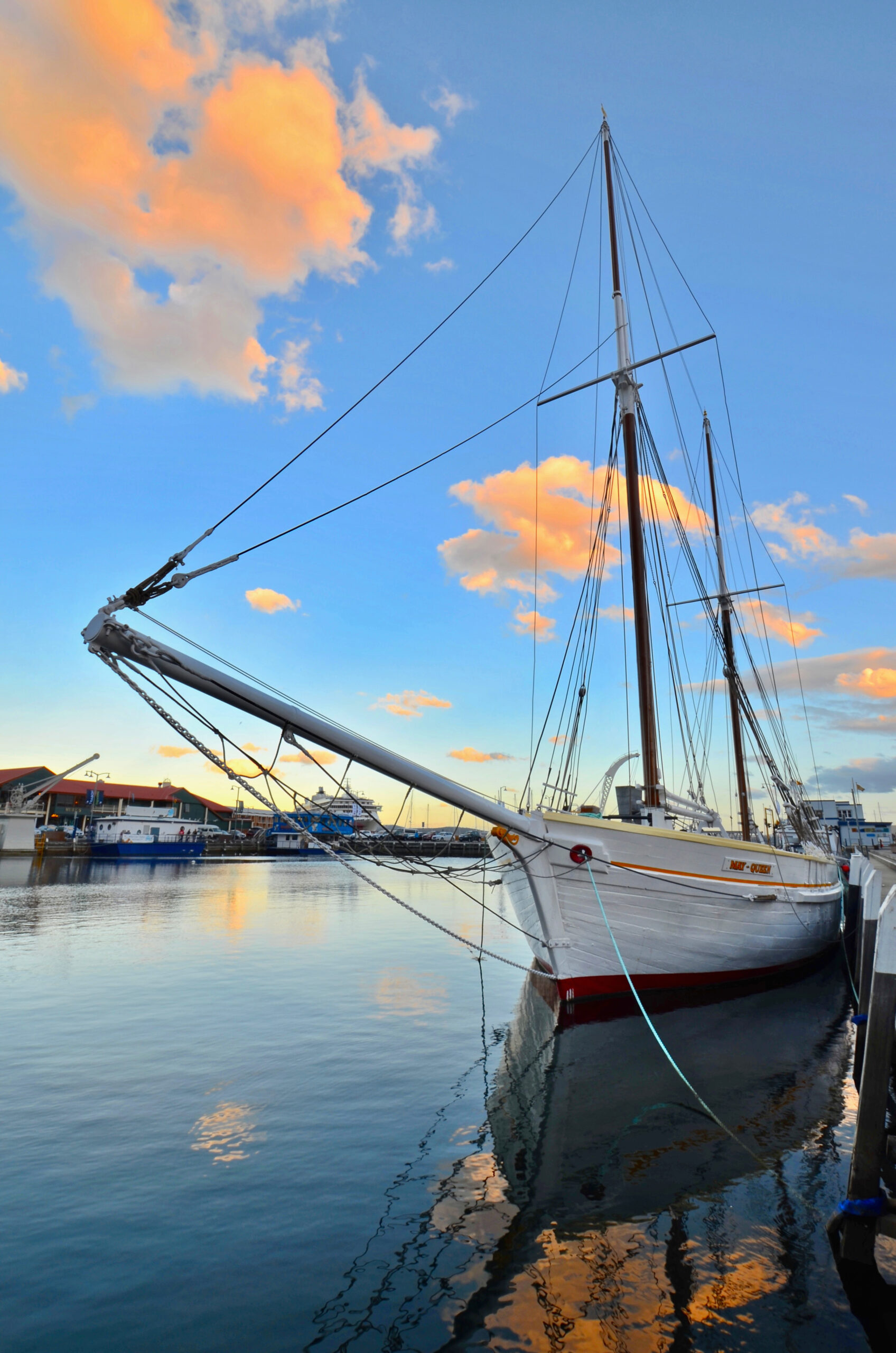
As part of Australia’s centenary celebrations in 1988, tall ships from across the world filled the harbour. Now every two years, the Australian Wooden Boat Festival attracts tall ships and yachts from around the country, a reminder of how Hobart once relied on the wind and the sea.
In those early days, a steady flow of river traffic connected the port town to the wider world. Like the no-doubt-puzzled indigenous people, the early settlers watched the tall ships come and go. Hobart residents looked for the sight of a sail as a ship rounded the Iron Pot, bringing news and supplies from the outside world, perhaps a long-awaited relative, a returning husband or a wife from the old country. Those on board would have felt their spirits lift as the red windmill that my great-great grandfather once owned on the hill in Battery Point came into view: they had survived, and the long journey was finally at an end.
Once a year, the harbour still fills with colour and life, when the Sydney-Hobart yachts arrive a few days after Christmas. Today, there are more yachts than ever, the fishing boats are just as numerous, a southern wright whale recently gave birth in the sheltered waters off Taroona, the first to do so since the mid-1800s, and the world’s biggest cruise liners come and go, towering over the city when they dock in its deep harbour. Gleaming white, multi-storied leviathans, they disgorge a stream of elderly and aspirational tourists for quick shopping and sightseeing excursions, before heading off again with their cargoes of dreams and a long and mournful call.
Perhaps it was the great British novelist, Joseph Conrad, who best captured the spirit of sail and the “sigh of the east”. After a series of voyages to Singapore, Sydney, and various ports in what is now Indonesia and Southeast Asia, Conrad received his first and only command, as captain of the Otago in 1888. The barque he commanded now lies forgotten in the shallow waters of Otago Bay in the River Derwent, her rusting spine a sad memorial to the great age of sail. But Conrad’s books remain to tell the story of that remarkable period. And the names of islands and coastal features around Tasmania tell a story of the great age of European exploration.
In Tasmania, the sea is never far away.