
“We overnighted at Arthur River, sleeping snugly in a storage container that had been converted into a cozy cabin. We were the only people staying at this cabin park on this cold rainy June night and I felt completely content. The quiet, romantic get-away-from-it-all Tasmania that I first discovered more than four decades ago is still here, still authentic. And it is still raining.”
A TASTE OF THE TARKINE
One of the most wonderful things about visiting the Tarkine is that it’s still underdeveloped for tourism. It looks and feels like it’s the far corner of a wild and remote island far from civilisation. It is on the way to nowhere. The type of wild place that I always seek.
Where the Tarkine begins and where it ends is open to interpretation. Locals, activists, miners, foresters, farmers, fisherman, the indigenous community, they all have their own idea of what the Tarkine area is (or isn’t), what it means and where its identity extends. However, if you are visitor, you are free to discover its diversity and wander around without a preconceived idea of what others think about its geographic boundaries and values.
I loathe boundaries – anything that pens me in or prescribes a definition of reality is anathema to me. As an outsider to the area, I felt free to wander, to see what I wanted with only my own biases to see the landscape. Who sees the land most truly or clearly? We all have our own paradigms. Only the eagles soaring above see everything without judgement.
The north-west Tarkine encompasses a globally important blend of ancient cool-temperate rainforests (the second largest such region in the world and the largest in Australia), windswept dunes and coastlines, sacred Aboriginal heritage sites, wetland habitats, swathes of productive farmlands, clearfelled and regrowth forests, mining operations, buttongrass plains and natural history dating back 100 million years to Gondwana.
. . .
This winter we decided to have a broad look around, to get a feel for the place, and then vowed to come back in summer, to camp and hike and focus on one area of tall trees rainforest to get to know it better, to feel the moods of the natural world there and if lucky, to feel its distinct sense of place and spirit.
Our first destination was Corinna, on the far south-western edge of what we broadly defined as the Tarkine area. On the way there, several rainy hours from Launceston, we stopped at Waratah (on the eastern edge of the Tarkine) and found a good lunch spot on this wet June day. We met friends and sat in the local park under an awning, bundled up in woollen hats and parkas, and listened to the rain sheet overhead and around us. Here was the beginning of the west coast experience in winter: raincoats, hot tea from a thermos, fog in the trees, rain sheeting across the horizon and no other tourists. This is why I live here. The rain and cold keep one sane and the tourist riffraff away.
Waratah (established in the 1870s for tin mining at Mt Bischoff and developed as one of the richest tin mines in the Southern Hemisphere) on this wet Friday seemed abandoned. The mine closed in the 1940s and the town has never really recovered. The population, once over 5,000, is now fewer than 250 people (and probably much less in winter), and the only sign of life we saw today was lights emanating from inside the pub at midday – very tempting …
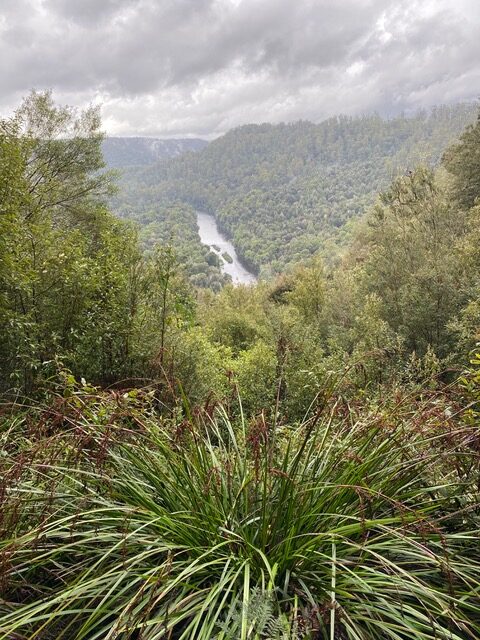
Wandering around the town under umbrellas, we focused on seeing Waratah Falls, which gushes out from the Waratah River that flows through the town centre into a gully and canyon below. The falls are part of the headwaters for one of the Tarkine’s wildest waterways, the Arthur River. Water was once diverted from the river for sluicing at the mine and it was also diverted to a power station to produce hydro-electricity (in 1886, Waratah became the first town in Australia to have electric streetlights). There are good walking tracks around the canyon and falls and through the historic village (and to nearby Philosopher Falls), but we decided to save exploring them (and the local platypus viewing areas) for another day when we had more time and it wasn’t teeming with rain.
We pushed on to Corinna, down a winding road through thick forests towards the coast, and we didn’t pass another car for over an hour.
. . .
Isolated historical Corinna (originally a gold mining village from the 1880s) and its welcoming lodge and old mining cottages has a wilderness 19th century feel about it. Corinna’s quiet camping area and pristine-feeling coastal rainforests, its misty, brooding heart of darkness Pieman River where the Fatman Barge takes two cars at a time to cross (the only cable-driven barge remaining in Tasmania), the choice of several enchanting walks through Huon Pine, sassafras and myrtle beech forests, its boat cruise on the Pieman River that we took out to Pieman Heads; all of this a complete destination and experience in itself. We could have stayed for a week – there is so much to explore. But we were scooting around on this Tarkine trip, just getting a taste, and after a couple of nights we headed north.
We drove up Road to Nowhere – ironically named, as this wilderness road is in fact the road to everywhere: everywhere north and south on the west coast). The isolated dirt road (now officially named as the Western Explorer) is well worth the trip as you drive through dense forests, then up to a plateau of mountain views, through buttongrass plains and heathlands, and then down to the coast. The area feels remote – we passed no towns along the way and only saw two utes during the two-hour trip. My kind of place.
We headed up to Marrawah, the north-western tip of the Tarkine region. We had a walk on the beach and watched a silvery-gold wintry sunset. We stood on the shore and gazed north up the coast to Cape Grim, the far north-west corner of Tasmania, and we decided that here was another area deserving its own dedicated visit. I took photos of the evening light fading beneath the dark clouds that hovered over the ocean, and I wanted to walk further, but the rain began again and so we retreated to the car and made notes about when to return and the many camping options that are nearby.
We overnighted at Arthur River, sleeping snugly in a storage container that had been converted into a cozy cabin. We were the only people staying at this cabin park on this cold rainy June night and I felt completely content. The quiet, romantic get-away-from-it-all Tasmania that I first discovered more than four decades ago is still here, still authentic. And it is still raining.
. . .
On a windy, pewter-coloured morning with scattered showers, we walked around Arthur River, exploring the driftwood strewn coastline (monstrously huge logs scattered around like a pile of toothpicks on the sand) and then walked to the nearby Edge of the World Lookout. The lookout is a perfect spot to gaze up and down the wild Tarkine coastline and watch the powerful waves sweeping in. Here we stared mindfully out at the vast Southern Ocean, the widest expanse of open ocean in the world.
We drove further south, seeing the empty weatherworn fishing shacks around Couta Rocks and then walking along the sandy tracks at Sandy Cape, seeking out Aboriginal middens and rock engravings. No sites were found today as the rains came down heavily and high tides limited our hike. So we headed inland, into the forests, the Tarkine area that one hears so much about and that I really wanted to explore. As we left the coast I vowed to return, to spend quality time exploring the rich Aboriginal heritage that can be found there. The list of future trips was growing longer by the hour.
We headed onto the Tarkine Drive, climbing east up into the dark woods, and within minutes the coast suddenly seemed distant as a tangle of blackwood and eucalypt forests engulfed us.
We walked around the single-laned Kanunnah Bridge which crosses the Arthur River, and it was pulsing with water, joyfully galloping out of the mountains, seeking its final destination in the sea.
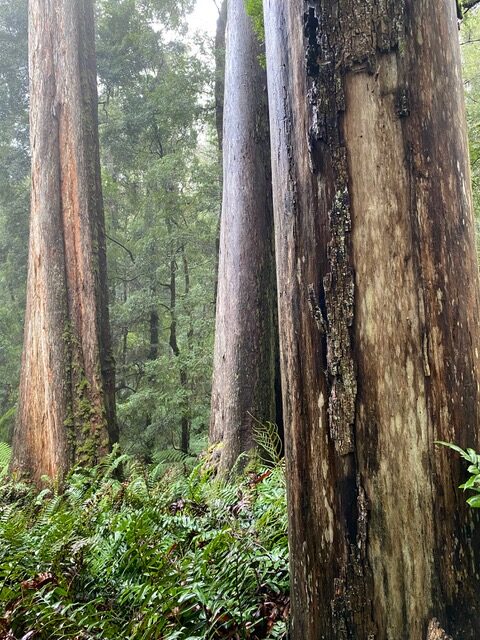
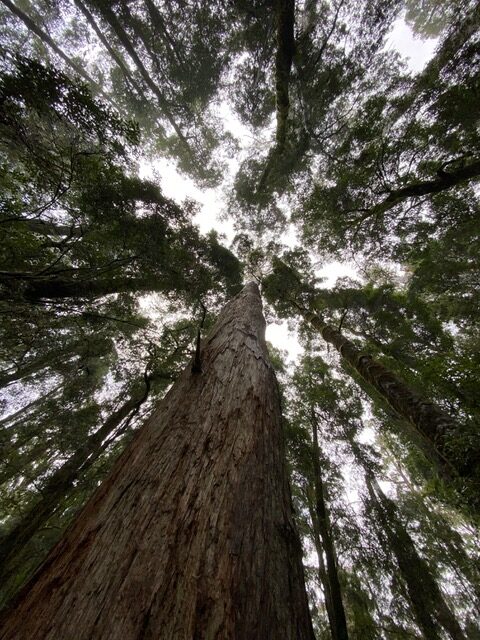
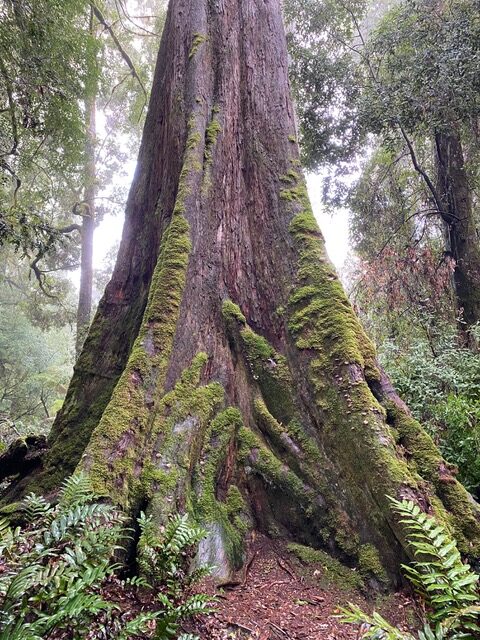
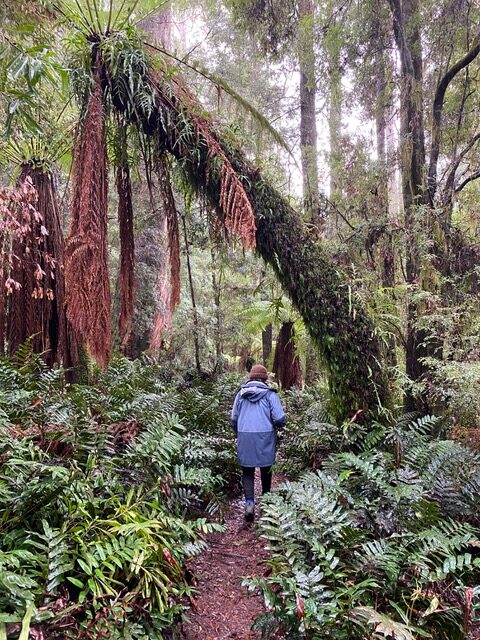
The road then leads into an area thick with rainforest and world-class tall and wide trees. Our stops on the Tarkine Drive included walking tracks in the rainforests at Balfour Track, Lake Chisholm and Milford Hills. At these places I was in my element, surrounded by nature, seeking out immense trees, placid lakes, tramping through thick rainforest, seeing no other people on a winter’s day, hearing only silence.
The trees along these walks in the Tarkine are extraordinary. There are more than 400,000 hectares of virgin rainforest in the Tarkine, a land where mountain ash (Eucalyptus regnans) reach for the sky. Their girth is astounding – one tree was measured at 33 metres in diameter. We walked for several hours beneath the ash trees and felt humbled, quietly in awe.
I could have walked all day in these forests, but the weather was closing in, and as it was winter, it was starting to get dark by four in the afternoon. I had to remind myself that I was here for just a look around, scouting out for future expeditions. Is a taste of honey worse than none at all? Not here, the taste of the Tarkine was urging me on to discover more in the future.
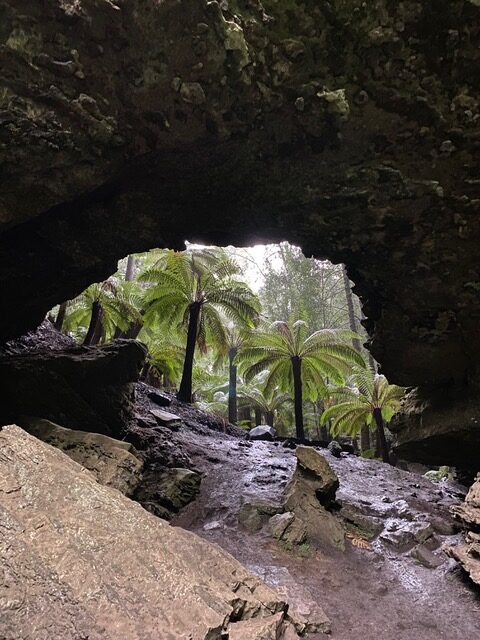
As we drove out, we had one last hike through the rainforests at Trowutta Arch. Here we saw the strange pre-historic green lake that is beneath a huge limestone cave that one can walk through to see the sinkhole. Walking through the arch seemed like I was visiting the Triassic, or was suddenly in Jules Verne’s novel, journeying to the centre of the earth, surrounded by verdant rainforest trees and giant tree ferns, carefully stepping around a primordial basin of pea-green water beneath the rocky cave.
The rain returned and the sky drew dark, I brought my mind back to reality, and we hiked out back to the car. Like everywhere on this trip, I wished I could have spent more time here, and (of course) I vowed to return to as soon as possible … to take walk further….
As we drove out through scarred areas where plentiful forests had once been, we wondered when the Tarkine would be protected forever as a national park. The area has global significance. Can’t we be a bit wiser in Tasmania?
. . .
That night we slept outside the Tarkine at Rocky Cape (heading up to hike in the National Park the next day) and we reflected on our four-day trip to the Tarkine. For our brief encounter it was a huge and inspiring experience. We now know there are many trips ahead for us in this area, to try to learn how to more deeply appreciate its diversity and beauty. The Tarkine is a faraway never-never place that should be experienced and respected by every Tasmanian. I can’t wait to return.