
“Looks like a heavy bag there, mate. Do you wanna lift?” I smile and nod. I throw my bag in the back and hop in the passenger seat. The driver asks what I’ve been doing. For a moment I have no idea what to say.
writer and photographer JASON MacLEOD
I feel ridiculous. I am lugging a boat up a mountain to launch it in a river. To say such a thing invites disbelief, even in me. My backpack is bulging and weighs about 25kg. Inside it is a paraglider. Strapped on top is a raft. A paddle has been dismantled and stuffed in an external compartment of my backpack.
Every gram adds to my sense of foolishness.
It is slow going trudging up the Mt Roland Face Track. The myrtle and dogwood forest gives way to Tasmanian pepperberry then scoparia as I reach the plateau. I can’t see the river yet but kooparoona niara/The Great Western Tiers are clear above the still-misty valley.
I intend to launch my paraglider from the summit of Mt Roland and fly to tulaminakali /Mersey River, more than over 10km away, where I hope to paddle out through the Alum Cliffs to Dynans Bridge Road. The plan is improbable, and I have no idea if it will work. Both paragliding and packrafting are fringe sports; combining the two puts me in the fringe of fringe. No one does this in Tasmania, and only a handful of people have attempted it elsewhere.
There is not even an agreed word to describe what I am doing, and I am not sure if the attempt is imaginative or mad. Perhaps it is a little of both.
. . .
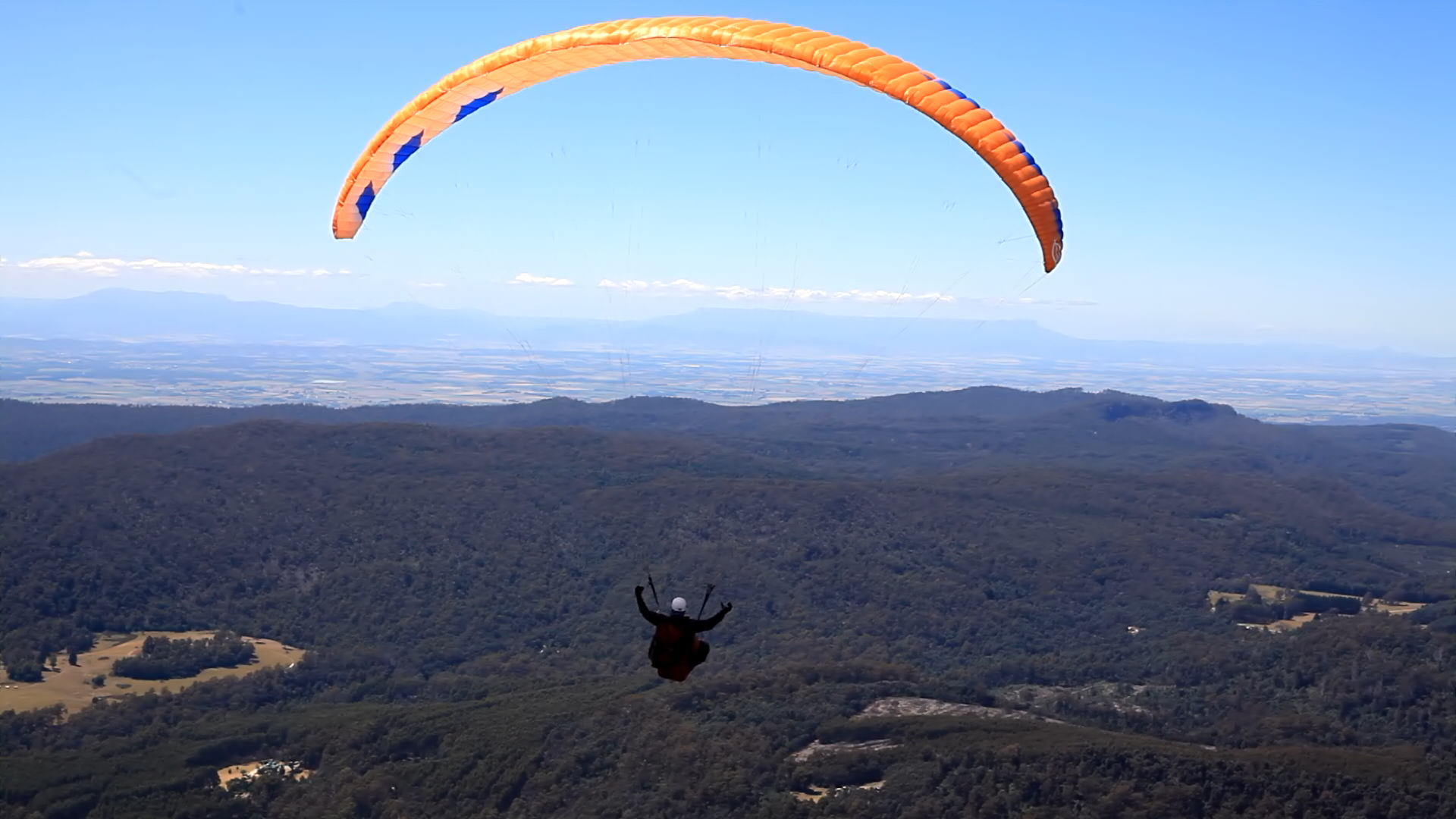
My paraglider weighs 3.5kg. In flight it looks a bit like an oblong parachute, but instead of being designed to gently slow a person’s vertical descent, it is built to glide through the air. Flying feels and looks like magic, but it’s made possible by science. A paraglider is essentially a highly engineered, solar-powered plastic bag. The sun heats the earth which in turn heats the air above it. Some of this energised air periodically goes skyward as it is released from trees, hills, and mountain tops.
Thermals. We ride in the air, lifted by rising currents, like an eagle. The aim is to get as high as possible. Height is like petrol in the fuel tank. From there we sacrifice height to glide to where we think there is more lift. Then it’s rinse and repeat, over and over, until we run out of air beneath us. On a good day it’s possible to spend hours in the air and travel significant distances. All this with an aircraft that folds up and fits in a backpack.
By the time I reach the summit, gentle puffs of lift are rolling up the face. Candy floss tendrils of cloud appear, then dissipate. The first flat-bottomed cumulus cloud, which form at the top thermals, will signal that the day is “on”.
I lay my glider on top of some low alpine heath. Flowers bloom. Insects buzz. The place smells fecund. But the beauty is also imposing. In front of me the ground slopes gently down, but 20 metres beyond that the land suddenly tilts, falling sharply into a jumble of conglomerate boulders that end in a sheer cliff. A thousand metres below launch is the valley floor, a patchwork of small farms.
The thermals are cycling through regularly now. As I feel the wind on my face I pull on the lines to inflate the glider. Once it is above my head, I bound over the low shrubs, and in seconds, I am airborne. As the ground falls away, I am filled with emotion. Flying never gets old.
A tiny barometric instrument called a Vario starts chirping, making the “happy noise” – loud beeps, close together – indicating that I’m rising. I feel it in my seat at the same time as I hear it. I am completely in the present moment now. My hearing, smell and sight are as heightened as my instruments, and years of experience guide me into the strongest core of the rising air column.
I turn circles in front of Roland’s heart-stopping cliff face. At first, I go up one metre a second. Then two. Three. A wedge-tailed eagle is in the same thermal, climbing above me. They are the masters here and I my heart expands as the eagle lets me share the sky. Before long I am soaring above the mountain, waving to walkers on the summit as I go up. I let out an exuberant, “Yeehar!”
In a few minutes I am at “cloud base” and start the transition to the Gog Range where I hope to find another climb. I arrive with plenty of height but with no lift to be found. In the distance, across a sea of forest, I can see a cloud forming. Lift! Now I have to decide. Do I take a deep line over the pine planation, hoping to reach it, or do I play it safe and turn back?
My Vario makes an occasional beep. I am sure there is something out there. I calculate that I can make it, but if I don’t, I will land in a tangled mess of felled pine trees, or on a forestry road. More beeps and I feel myself in a gentle current of air. As a thermal rises it’s replaced by more air drawing in around it. I’m sure that’s the current I’m feeling. I commit.
I am turning and maintaining height, slowly drifting into a climb. For 20 or 30 minutes I am in fight mode; on edge as I float deeper over the trees. Finally, the lift consolidates into a steady climb. The cloud is breathing me in, and I can breathe out.
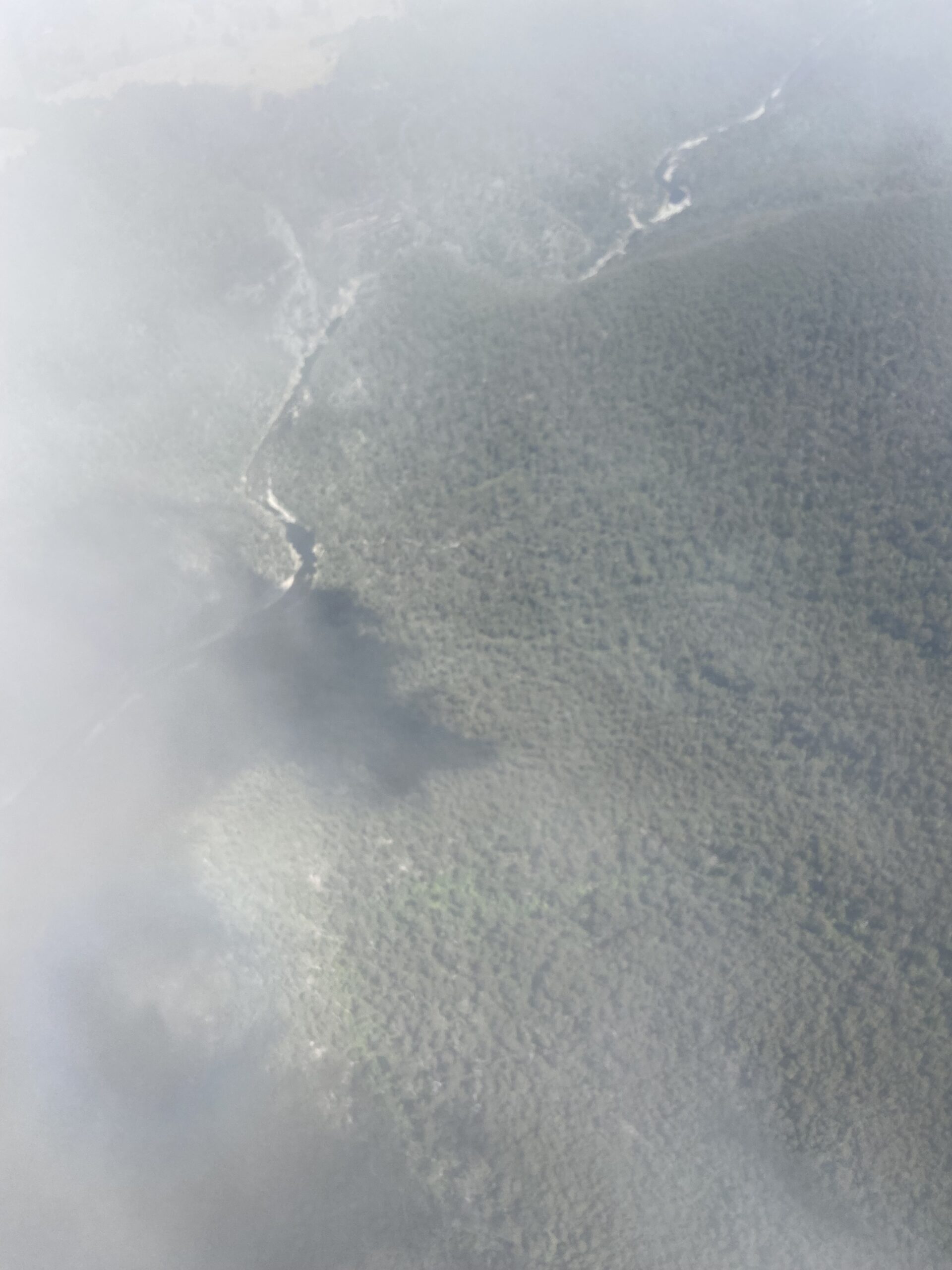
I turn away before reaching the cloud, unwilling to enter the “white room” where I’m unable to see or be seen. After what feels like an eternity, I am 2,000 metres above the Gog Range. Below me I’m elated to spot tulampanga/ Alum Cliffs.
I am suddenly tempted to try to reach the Tiers or Deloraine. Then the river calls me, and I remember what I came to do. Time slows, then rewinds. I hear palawa women singing as they gather ochre from the fabled tulampanga ochre mines. I am within an easy glide of Den Plain, once the pallittorre’s corrobboree ground.
Nearing the ground, I pick out a paddock to land in. Like I pelican alighting on a lake, its wings outstretched and tilted back to slow it down, I pull the trailing edge of my wing to act as a break, allowing me to touch down gently. As the wing floats down behind me, I laugh out loud. I can’t believe I’ve actually done it! I yell out to a couple of cows in the distance, throwing my arms in the air in celebration. The cows look up, then return to chewing grass.
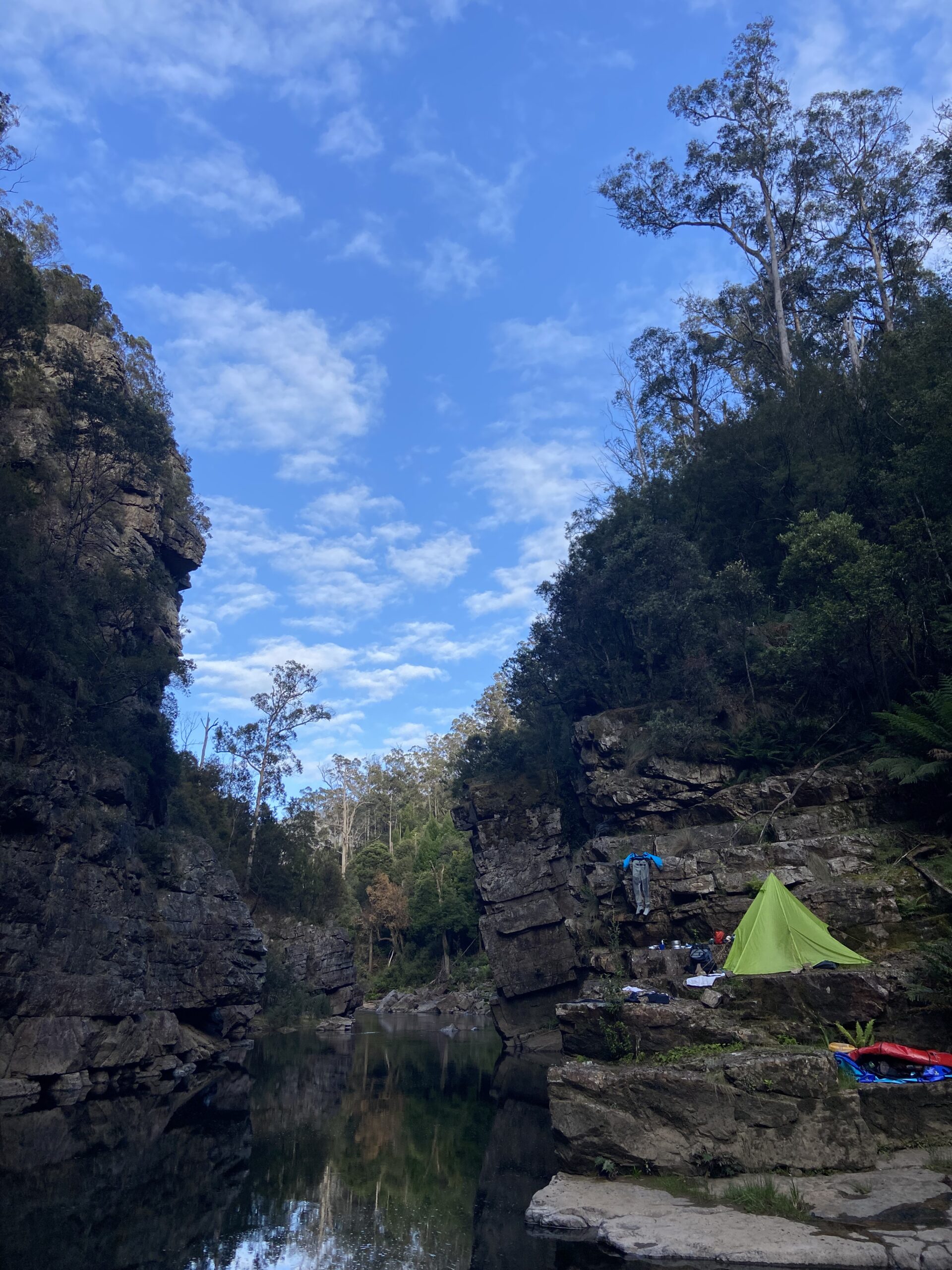
It took me just over an hour to fly a meandering 15km as I traversed from an alpine landscape to a riverine one. Still smiling, I slowly pack up my wing and switch to boat mode. The flying gear and food are stashed inside the tubes of the raft before inflating. I assemble my paddle, put on my drysuit, life vest and helmet, and drag the raft to the river. I only have a kilometre or two to paddle before I camp, just before a towering pillar of rock, a giant river guardian. I know I’ll sleep well.
The following day I set off. This section of the Mersey is like a mini Franklin. Seven hundred metre-high cliffs tower above the water. The paddling is spectacular, a continuous run of grade 2-3 whitewater. I portage the crux, a grade 3-4 section with a couple of drops. I’ve successfully navigated it before, but I am by myself now and don’t want to take any risks. To be honest, paddling whitewater scares me more than flying.
Around mid-afternoon I pull into an eddy and drag my boat up to a rock shelf metres above the river. I cool off by jumping off the rocks, plunging naked into the icy water. My body tingles as I dry off in the sun. I feel so alive. As the sun dips I cook dinner, sip some whisky and sink into another deep and contented sleep.
The final day is a long day of paddling to the Dynans bridge. At times I drag my boat over shingle rock beds, the river too shallow to paddle. In the deep still pools I see platypus. A sea eagle flies overhead.
I get to the bridge late afternoon and stuff everything back into my pack. I start walking, bursting with happiness, hoping I can hitch a lift back to the car. I feel weary now; it’s been an emotional three days. An hour or so later a bloke in a ute pulls over. “Looks like a heavy bag there, mate. Do you wanna lift?” I smile and nod, “I’m trying to get to Mt Roland.”
I throw my bag in the back and hop in the passenger seat. The driver asks what I’ve been doing. For a moment I have no idea what to say.