
I’m riding hard up a steep hill. I look to the next corner, hoping desperately that beyond it the gradient will ease. It doesn’t. I change gear, lift out of the saddle, push harder. Through my sweat I hear voices telling me e-bike riding is “cheating”. I’d like to see them try this! Then I recall that one of our group is 87 years old. I keep riding.
We’re on a five-day, 380-kilometre ride from Hobart to Devonport via the east coast. It’s a prelude to a national electric vehicles conference in Devonport. There’s a small crowd to see us off from Hobart’s CBD, and a burly policeman to escort us over the Tasman Bridge and towards the urban fringe at Cambridge.
The weather is showery and blustery, especially as we cross the causeways to Midway Point and Sorell. At the latter we stop for two of the practicalities that will become our constants: topping up our batteries and having coffee. Then we turn onto a winding gravel road that leads to Buckland via Nugent.
This is often drier countryside, but right now it is green and pleasant, the fields lush, the forested hills blushing with fresh growth. It’s not hard to love Tasmania given the chance to see, smell and hear it so intimately. On this quiet road we relax, sometimes travelling two or three abreast, getting to know each other. And comparing e-bikes.

They all have in common a small, battery-powered motor that is only activated when you pedal. That’s a good thing on the Nugent Road when we’re climbing some 300 metres while getting hammered by rain and hail.
After lunch and a recharge in Buckland, we rejoin the highway for the run into Triabunna. The rain freshens, and we’re soaked by the time we stop. It’s been 85 wet, windy kilometres. We’re tired, but also pleased with our first day’s achievement.
We’re even more pleased when we wake to sunny skies. Our gear has dried and we feel ready to ride again. Although most of day two’s 55 kilometres is on the busy Tasman Highway, we’ve begun to trust our support vehicle system. Two vehicles with bright yellow signs warning “Cyclists Ahead” are behind us. Our other support vehicle, an emission-free Nissan Leaf, is ahead of us with a “Cycle Event: Slow Down” warning sign.
We spread out along the flattish section north of Triabunna, cycling past paddocks filled with spring lambs. Riding single file on the busy road keeps conversation minimal. Each of us has something different occupying his or her head. I chuckle as I hear one rider bleating a greeting to a sheep.

After lunch the day grows warm, the wide blue sky wisped with high cirrus. It’s hard not to be mesmerised by the broad views across Great Oyster Bay towards the Freycinet Peninsula. We stop often for photographs as beach gives way to beach: Lisdillon, Mayfield, Kelvedon, Spiky. All the while the water, the mountains, the sky form a backdrop that’s a rhapsody in blue.
We Tasmanians are blessed with a variable climate. We think of yesterday, and know that this place will not always produce these stunning views. We exult in it while we can, breathing in the blue as we dawdle towards our overnight stop in Swansea.
As much as we’ve loved the east coast, we leave it on day three and head west. From Swansea we’ll take the Lake Leake Highway. It’s a quiet road, but we’ll have to gain more than 600 metres in elevation over a short distance, and on a day that promises to be warm and sunny.
Riding towards that turnoff, I ponder the settlers’ English landscape fantasies: stone walls, hawthorn hedges, fields filled with sheep and vines and groves of walnuts. At one point we ride through a tunnel of deciduous trees, their late spring leaves a dazzling green. But as we turn off towards Lake Leake, gum trees and dry paddocks return, and the spell is broken. It’s Australia after all. The fierce sun reinforces that, and as we climb we’re quickly using both water supplies and battery power.
The view is our compensation. We stop in one forest clearing to look back towards a distant Freycinet Peninsula. By the time we pause at our high point, some of us have low batteries, and the road leading to Lake Leake Inn comes only just in time.

The hospitality at the inn is very welcome, and we have a long break before heading downhill towards Campbell Town. While regulations for e-bikes mean that the motor cuts out at about 25kmh, gravity and momentum obey a different law. It’s an exhilarating ride!
In the 19th century, Campbell Town was an overnight stop for coaches travelling between the north and the south. Having ridden at little more than horse-and-coach speed, I wonder if we’re so different from those top-hatted gents and bonneted women. We’re certainly just as keen to rest our weary bones in a Campbell Town inn.
Day four has us on backroads from Campbell Town to Deloraine via Cressy and Bracknell. At more than 100km it’s our longest day, but through some of rural Tasmania’s most gently pleasing countryside. Nineteenth century explorer Thomas Mitchell called the lush pastures of western Victoria Australia Felix, meaning fortunate or happy Australia. For me this is Tasmania Felix. As we ride through quilted fields quartered by hawthorn hedges and grazed by fortunate livestock, the visual feast is all the richer for the backdrop of the Western Tiers. These dolerite eminences rise some 1,200 metres straight up from the Midlands to the wild Central Plateau.
We stop in Cressy for lunch and a recharge, and to talk electric vehicles with students from the school. When some of the students are test-riding our e-bikes, I chat with a couple of calculatingly uninterested high school girls. They warm up a little after we share a few stories, but I leave with the impression that this isn’t necessarily Tasmania Felix for them. Perhaps if they exchanged this peace and beauty for some urban grunge they’d recognise what they once had. I wonder how true that is for a lot of Tasmanians.

. . .
As a child I loved drawing imaginary scenes. My landscapes were full of trees, fields and mountains, but somehow I’d always manage to fit in a waterfall as well. This afternoon’s scene brings some of those drawings to life. After Bracknell we draw close to the Western Tiers. Forests tumble down from the rocky heights and meet deep green fields, some cropped, some grazed. And I know that just up there is Liffey Falls, a beautiful set of falls cascading out of the wilderness above.
Our overnight stop is at Drumreagh, a farm just out of Deloraine, and when we wake it is to bright sunshine and the waft of frying bacon. Some brekky angels are busy in the kitchen. Being in no hurry to start our final day’s riding, we savour a very leisurely breakfast in the sun.
From Deloraine we make for lunch in Railton, riding backroads through Dunorlan, Weegena and Kimberley. The countryside is stunning, its verdant hills varying from tight to relaxed. After lunch we start to encounter more traffic as we head towards Latrobe. But when we cross the Mersey River and turn onto River Road, it proves both quieter and prettier; the perfect way to ease into the city of Devonport. The blue, sparkling waters of the Mersey estuary match our growing sense of accomplishment, of a job almost done.
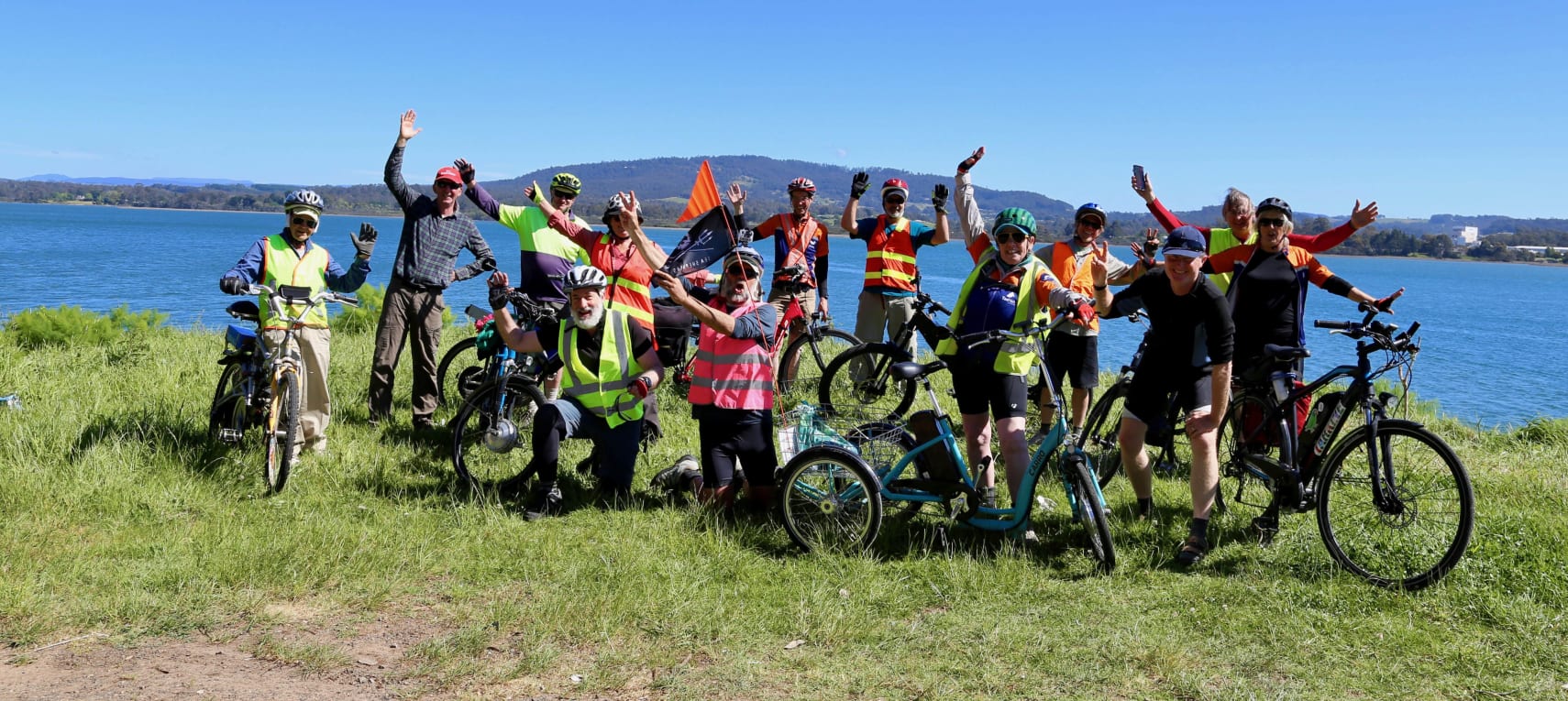
Keeping our peloton tight, we cross the main bridge, then turn towards our finish at Devonport’s Waterfront Function Centre. The Nissan Leaf leads us into the carpark. With our bicycle bells tinkling, arms waving and voices hollering, we’re welcomed into Devonport by a small crowd of supporters. Our faces wide with smiles, we exchange hugs and high-fives and congratulate each other. We’ve done it! We’ve ridden more than 380km, arriving not only safe but with a rejuvenated sense of what an incredible island we share.

For me, more a wilderness walker than a cyclist, this has been a chance to fall in love afresh with the tamer parts of Tasmania. Of course the wild and the tamed should never be separated. As John Muir put it, “When we try to pick out anything by itself, we find it hitched to everything else in the universe.”
Perhaps the Mersey River, running from wild highland lakes and streams down to the estuary by which we stand, embodies this necessary connection between wild and tamed. There are very few places in the world where the struggle to hold together such sometimes opposing values is still being fought. After this ride across our beautiful island, I fervently hope Tasmania continues the struggle.
Click here to read more from Peter Grant’s column, The Patch.