

The other day I found myself crouching in the dirt, for several hours. The sun was out, though it was hardly warm; I wore long trousers and, kneeling, the dampness in the soil seeped into the fabric. But I had been held up by a scene that I had never noticed before.
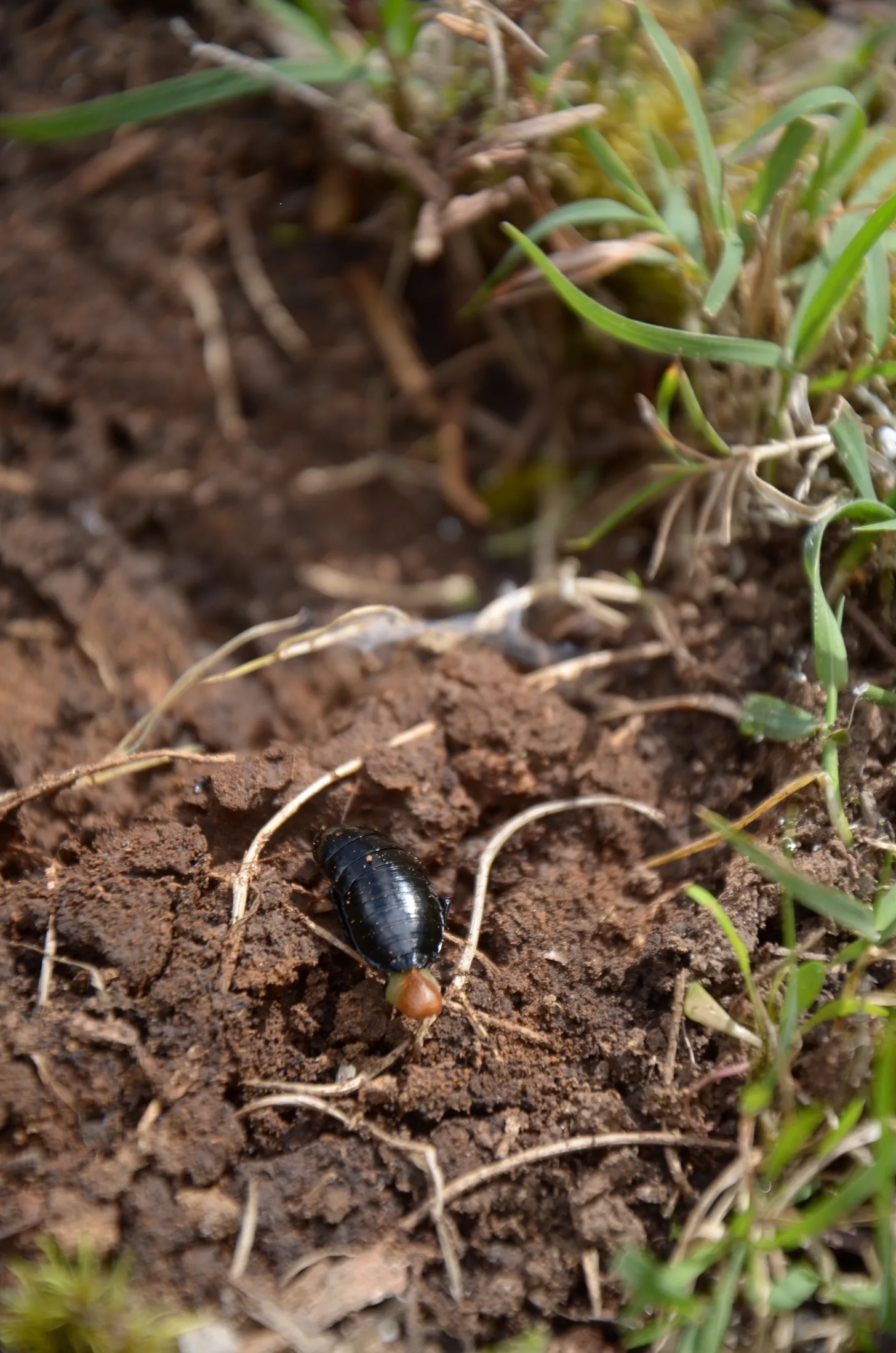
I’d picked up a rock (as is my wont) and found a cockroach with her face pressed down into the ochre earth like a zealot in prayer. Her rear end was aloft. An aperture there had come partly ajar, as if someone had cracked open two of the black shutters from which her exoskeleton seemed to be made. From the gap came a colourful tube, rounded and glossy, with a sheen of copper and mint green. It was an egg sac, I realised, or – to use the word I learned a short time later – an ootheca.
This procedure looked very uncomfortable. I set up my observation station above the cockroach (a species of the Blattidae family, for those who wish to know such things). I put the rock back in place but left it slightly offset so that I could still watch the development of this entomological miracle.
Maybe it makes sense that miracles happen slowly, but it looked excruciating. The cockroach, as the ootheca came out of her, was entirely incapacitated. It was hard to picture what was happening inside: the oval shape of the ootheca was so big that I could only imagine that most of the cockroach’s internal organs were bunched up, compacted, shoved into a corner. Mind you, I don’t know much about the insides of a cockroach.
I left for a while and came back with a magnifying glass, some snacks, and a book. Eventually I had to leave the scene for a longer time, to make dinner. As the evening wore on, I checked back at intervals. Even five hours later I observed that minimal progress had been made. When I looked again in the morning, though, neither cockroach nor ootheca was anywhere to be seen.
Last week I caught wind of the news that the poet Robert Gray had died. I am not one to feel particularly emotional about the death of strangers; as is often the case with those whom we know only by name, Gray could well have been dead for yonks and I wouldn’t have been aware of it.
But I have been enriched by his writing and decided to honour the deceased by looking through a collection of his selected works. By chance, I opened up to the long poem Dharma Vehicle, one of my favourites, which gives an account of the poet’s thoughts from some coastal shack. It is an engrossing interaction between Buddhist philosophy and the Australian bush.
Gray was drawn to a form of Buddhism that, he says, affirms nature. The suggestion is that there is no value in the systems of thought that dismiss the physical world or aim for any kind of negation. The crux of Dharma Vehicle is an anecdote from the literature of his preferred form of Buddhism.
“It was the monk
Fa Ch’an-ang, in China,
dying,
heard a squirrel screech
out on the moon-wet tiles, and who told them
‘It’s only this.’ ”
. . .
Over the course of an arduous and slow-moving season, I have become susceptible to hurt or melancholy about my writing work. For one thing, I am making very little money from it at present, even as I more than ever pour my energy and heart into it. I look around and see that there must be easier routes, short-cuts perhaps, but what comes from taking those seems thin and bloodless, or shrill and posturing.
Other artists, near and far, express a grating sense that they’re getting trampled upon, or that they are tainted by collaborating their talents with those who fund its presentation, teaming up with history as it unfolds around us. There’s plenty to think about; late at night, a person might find themselves speaking silent monologues, accusations or apologias, as though someday we will be put in the dock for having chosen such impractical careers.
Writing is a lonely pursuit, often harrowing or dreary. I feel like a gardener standing in an acidic bog, trying to grow flowers. Yet no exhilaration compares to the moment when I bring together the elements of an idea with some elegance, scribble a beautiful sentence or mark out a passage that resounds with truth.
It is plausible that my life will pass without the work of which I’m most proud making it to print. Despite the lack of immediate audience, some days it’s as though I have performed a great act on stage. I think of the ballet dancer’s high, leg-splayed leap; I dream of that delicate landing, and practise achieving it with a gracious smile.
Come morning, I untie myself from midnight’s knots, throw open the double-doors and get the wind in my hair. There is yet another ornery westerly, which harasses the trees of the forest, but a rosella blithely whistles on, undeterred. The highest branches of the gum trees are sloshed together, sounding like a waterfall, or a whale’s spout, as if all the liquid that gets pumped through its trunks has to come out at the top.
I stretch out, breathe deeply and press my fingers in the dirt. I move stones, heavy and coarse under my fingertips – the ferric content offering up a nourishing scent, like potatoes roasted in a cast-iron pot – and inspect the insects as they breed bewilderingly in the slowly-warming soil.
Another poet, Wallace Stevens, once said, “The greatest poverty is not to live in a physical world.” The sentence returns to me often, in the mornings. If I were to leave this place, you understand, my procession through the world would no doubt be a bit smoother. But what a manic gamble! In staying here, I spare myself the sorrow of living out of reach of what really matters. It is, after all, only this.
. . .
I have been thinking of a particular mountain path that I stride upon, over and over again. The process of repeat visits opens me up; when I first took up bushwalking, I was a self-obsessed adolescent. It was a slow process, but my years on a long, linear walking track have had a centrifugal effect. They have distracted me from my self-consciousness; I spiral outwards to involve myself with the wider world. All writers could do with such a hobby.
In a memoir, called The Land I Came Through Last, Robert Gray nuts out exactly what it is that drew him to words. He cites the moment in which his mind was first boggled by a metaphor, and how language makes experiences stick to his memory. “Having been made aware of something, in our mind, we are able to notice similar things more fully in the world afterwards,” he writes.
It was guiding that did this first for me: for the punters’ sake, I was forced to frame ecological processes in pithy sentences that made sense to them. What I was aiming for, unwittingly, was the work of poetry. There is something special in sharing knowledge in natural history in figurative language, in colourful stories. There, a human’s narrative instinct meshes with the activities of the world, as it has for aeons.
At poetry readings I almost always mention that there will be no quiz; a metaphor is not a puzzle to be solved. I only hope for a line or two to stay with members of the audience, so that when they go outside they have a new turn of phrase or poetic image to use. If asked to give a eulogy for Robert Gray, I would say: because of that man, I picture more vividly the bones of currawongs, winter sunlight, a cow’s teats.
. . .
A cockroach, I read, might spend up to three days laying her ootheca. It is hard yakka. Head tilted to the dirt, she drags around the case, half her size, unable to contemplate anything else.
“All that has beauty in human experience,” writes Gray in the poem At the Inlet, “only exists this way because of death. And the nothingness of death is not so vast or terrible; it is more like something intimate. It’s of my size, exactly.”