Influencer selfies seem invariably to be taken on cloudless days, but the Tasmanian wilderness is not known for its friendly weather or ease of access. I’m yet to see an influencer photograph themselves huddled in a rain poncho in sideways hail, complete with snot icicles, waiting for someone more sensible to happen by.
writer and photographer SONIA STRONG
People don’t like it when I say this, but many of Tasmania’s best places are reserved for the privileged. If you just felt a rush of indignation, bear with me. I’m referring to the privilege of being in the know, not the kind which arrives in a private helicopter.
It was once considered good manners, if you’d ventured off the usual tourist route, to share your latest travel finds so others could go there too. This often took the form of painfully long slide nights. The click of the carousel, endlessly projecting covetous holiday snaps onto a repurposed bedsheet, was made tolerable with wine and cheese. Slide nights have gone the way of the thylacine. These days, one’s digitally-optimised travel bragging can reach thousands, sometimes millions, of people through social media. Curiously however, these posts are also changing, becoming noticeably more generic, artful and, dare I say it, cagey.
Authorities everywhere are closing the door on high-visitation attractions, loved to the point of unattractiveness. On a local level, informal gatekeepers are similarly drawing their own lines. Access rights to many remaining treasures are sparingly dispensed through a mysterious vetting process, and the cautious gifting of knowledge. These gatekeepers have little regard for how many “followers” someone has, nor can they be bought. You won’t know when you’ve met one. It’s only in hindsight I’ve realised when I’d spoken with such a person, having apparently sat some nebulous test of character and deemed worthy. I can’t help but wonder how often I’ve unwittingly been assessed and found wanting.
Perhaps you’re a gatekeeper yourself. You may know of a special outcrop, campsite or swimming hole which you’ve shared with only one or two others. Maybe you visit a secret cove by kayak, or a waterfall requiring kilometres of upstream wading to get to, and haven’t said anything about it online. If so, you already understand (in a way that the authors of guidebooks on “local secrets” do not) that such wonders are to be protected against overtourism and its inevitable consequences.
I know I’m among the privileged, having had my share of whispers and nods on where to point my boots. I’m also lucky in that my circumstances allow me to go exploring. As a consequence of all this good fortune (and the fact that my adventures are often guided by weather, inquisitiveness and a slightly questionable appetite for challenge), I’ve happened upon several of my own guarded gems. Privilege it seems, can sometimes arrive with the freedom to wander, with curiosity and respect, away from the beaten track. If you want to find one of these places yourself, the first step seems an obvious one – spend time outdoors, and walk in the opposite direction from everyone else.
If you’re already out there climbing things, paddling down others and generally mooching about in the bush, you may have chatted with a ranger about the “Leave No Trace Principles (LNT)”.* These seven internationally recognised guidelines outline how to stay safe outdoors and avoid ruining what you’ve come to see. Most seasoned outdoor enthusiasts agree with rangers on the value of the LNT, instructing novice adventurers through example and even shaping the principles’ evolution. Recently, an unofficial eighth principle has joined the list. Known as the “no geotagging” principle, it urges against identifying sensitive locations too precisely or encouraging others to find them.
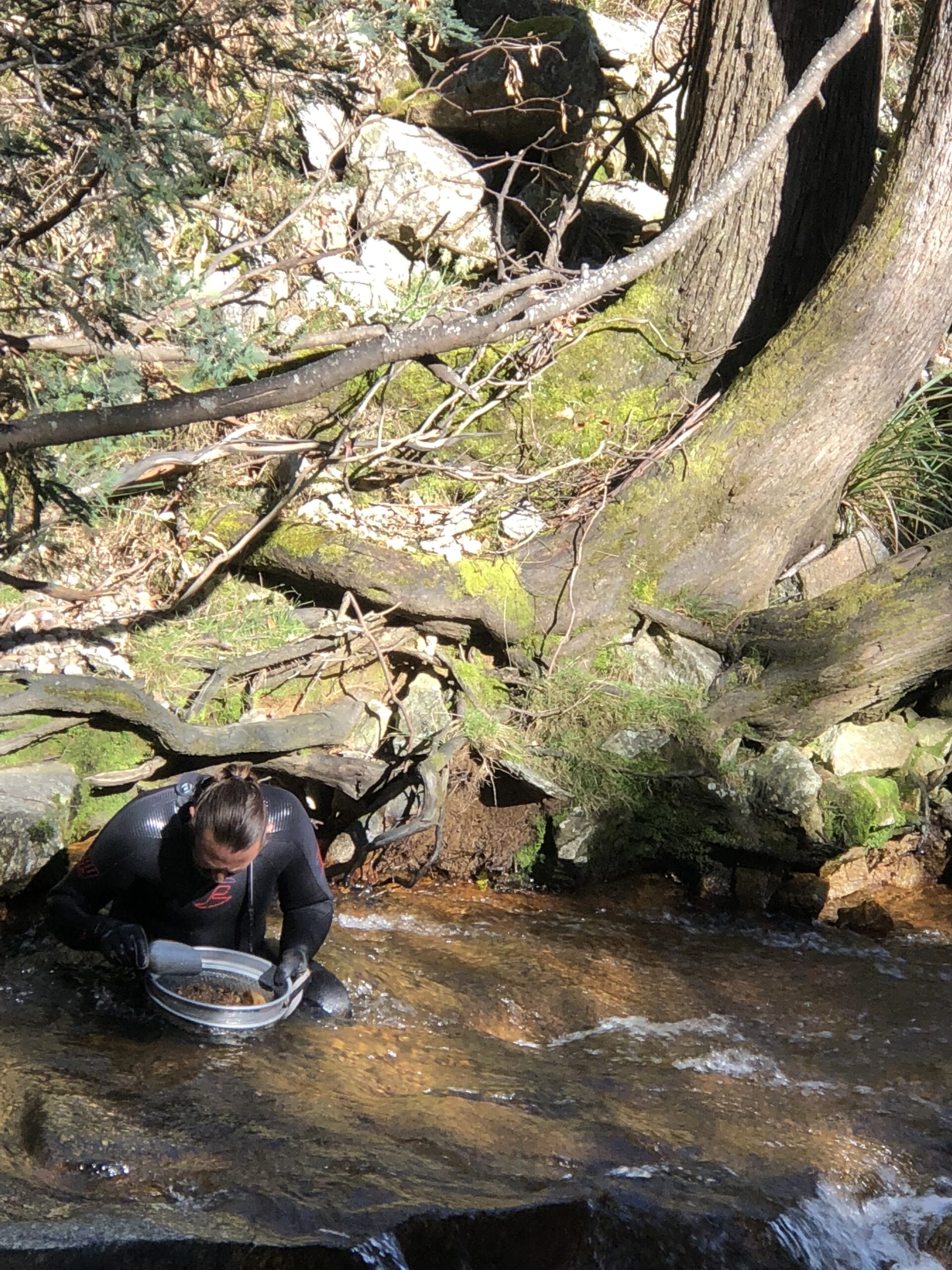
Fossickers all have their favourite spots. Just don’t ask them where they are.
Alongside this evolving code of outdoor behaviour, online conversations around social media’s impact on natural areas are gaining traction. In one discussion thread I discovered the term “digital silence”. It describes the ethical decision to share only the feeling of a place through storytelling, visual art, poetry and music, without describing where it is. It seems that divulging the exact location of one’s discoveries online has become decidedly uncool.
What makes a place worthy of secrecy? Invariably it contains something rare or special. It may be culturally significant, exceptionally beautiful or hold a valuable resource. Such sites include historical structures, remarkable vistas and refuges for rare and threatened species, like the last known King’s Lomatia (Lomatia tasmanica). Somewhere in Tasmania’s south-west, this isolated clonal plant, likely the last of its kind, quietly gets on with being one of the world’s oldest living beings. Whilst support for conservation efforts relies on people understanding the plant’s importance, being left alone is critical to its survival, so its exact location remains confidential. There are yet other places whose very existence is practically unknown, knowledge of them passed down through family and cultural lines, or tightly held within departmental, scientific and historical society vaults. You likely won’t have heard of them.
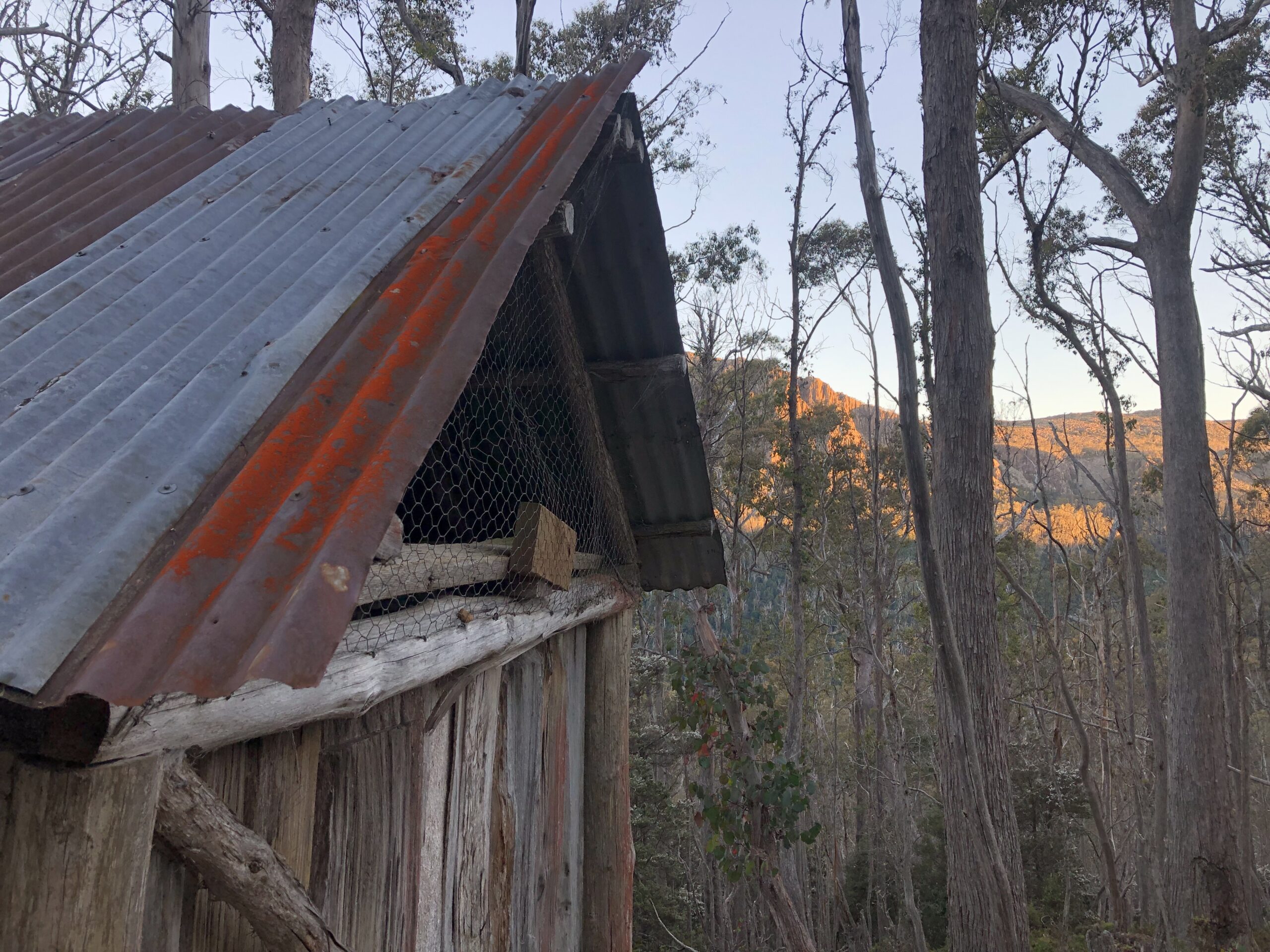
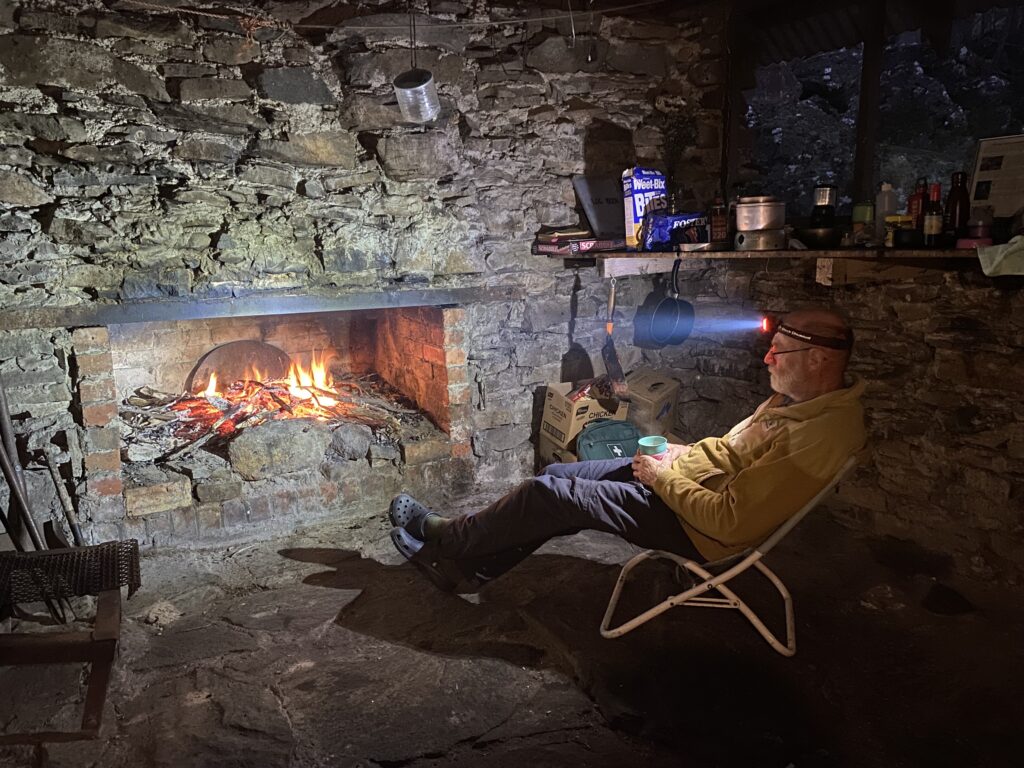
Tasmania’s historical huts span all levels of secrecy, from household name to hardly known. Many huts, past refuges for trappers, stockmen and bushwalkers, are loved so much they have their own preservation society and celebratory calendar. Others are known only to a few who, pleasingly, seem to be keeping things that way. I’ve witnessed this same tight-lipped strength of character regarding artefacts, stands of ancient pines, underground cave access points and reliably good fishing spots. I feel good when I do.
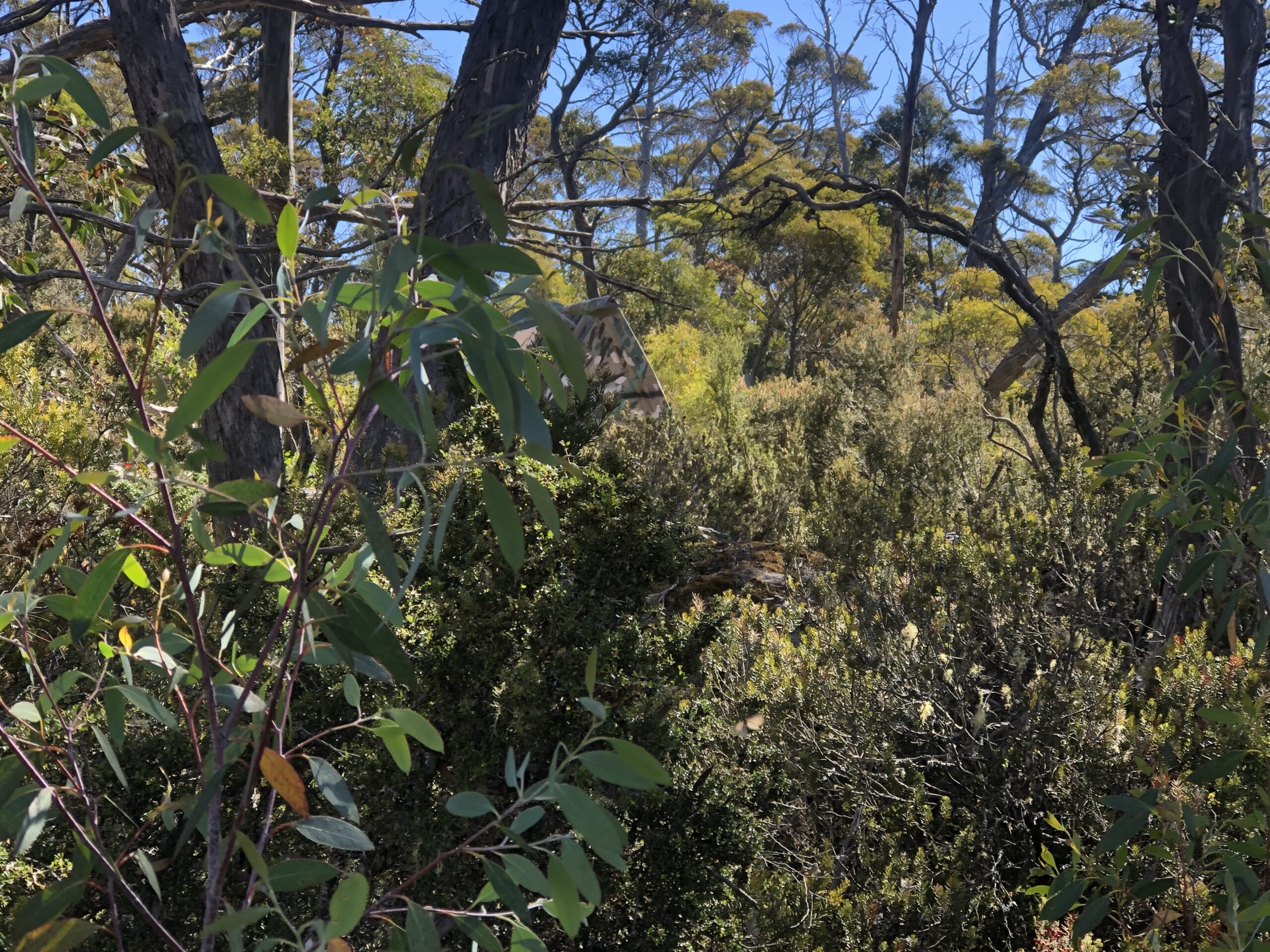
I hope, for personal reasons, that blind luck is a legitimate path to being in the know, as some of my best discoveries have happened that way. There’s a certain highland hut I know of only because I literally stumbled across it. The structure was so well camouflaged by vegetation and green and brown-painted cladding, that I realised I’d walked within metres of it the day before and missed it. I can’t know for sure, but the dates on yellowed newspapers and canned food indicated no-one had been there in years. Some who had visited were obviously descendants of the original builder, their love of the place evident in children’s drawings and hand-written notes. I like to think it only looked unused because those who came were as careful as I was to leave things as they found them. I’m assuming by now you know not to ask where it is.
. . .
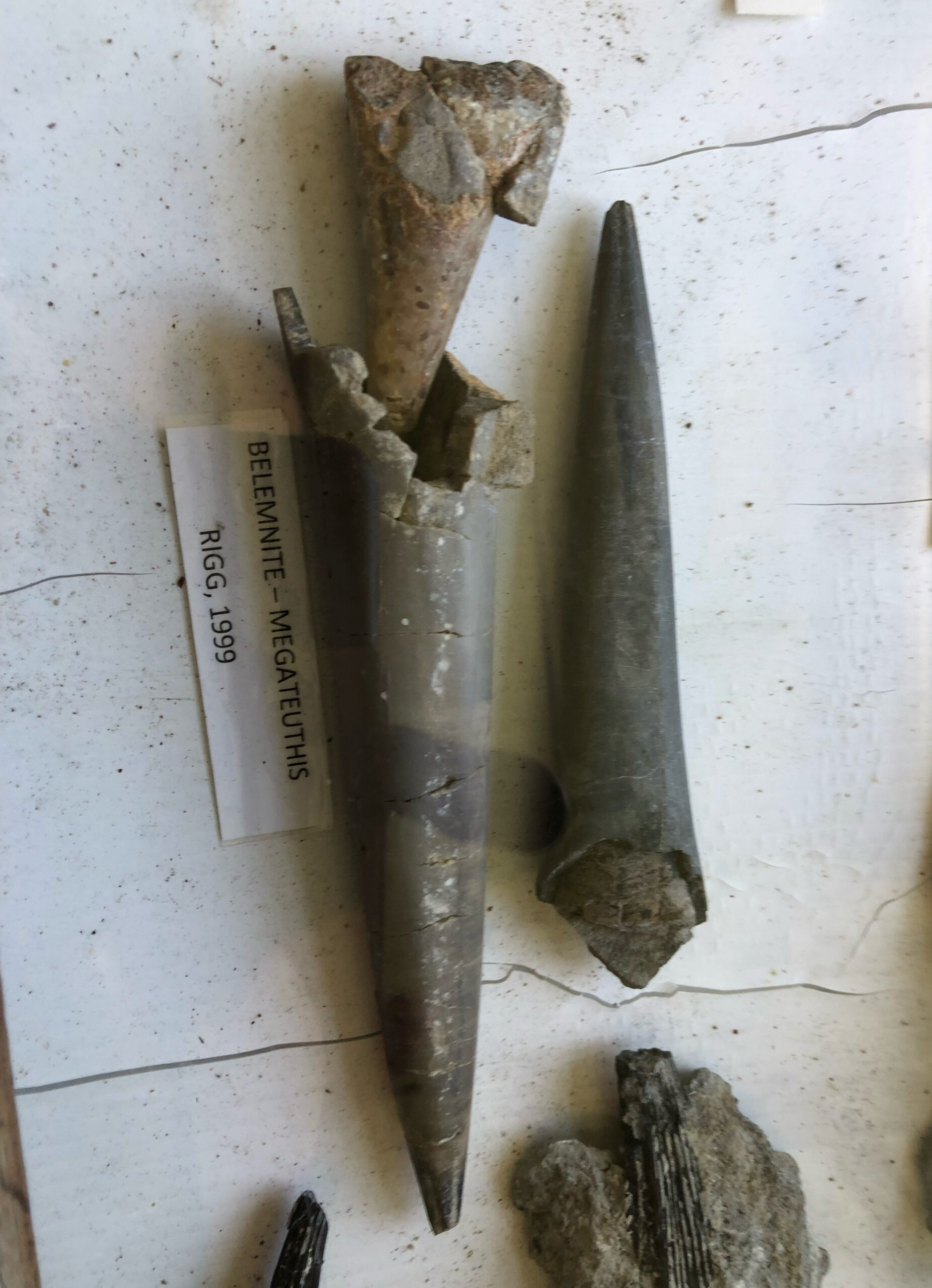
I’m pleased to say that the underground society of secret-keepers appears to be global. In a burst of post-pandemic travel, I found myself hunting ancestors and fossils on Scotland’s Isle of Skye. Aware that my family history traced back there, I visited the local museum to see if they could further enlighten me. After a lengthy, wide-ranging chat with the curator, he showed me the impressive fossil display. The belemnites – an extinct relative of squid and cuttlefish – in particular caught my eye. For a time, they’d ruled the oceans, flourishing in their quadrillions. It was sobering to think that such a successful animal was now completely gone, but that is the way of things. For even the most dominant of creatures, everything changes.
Belemnite fossils at the Skye Museum of Island Life, Isle of Skye, Scotland
I don’t know whether it was discovering that his wife and I shared an ancestor, or he’d concluded I wasn’t the type to broadcast coordinates, but unprompted, I was told how to locate Skye’s fossil bed. Only after this conversation, was it obvious the curator was a gatekeeper. So it was that, unlike other summer tourists chasing their Outlander experience at the Fae Pools or climbing The Old Man of Storr, I spent my day on Skye poking about the beach for belemnites.
Belemnite fossils occur in the hundreds of trillions. These ones were from a dynamic environment, beaten about by the sea, and where collection was allowed, so a couple found their way into my pocket. But did I really need to take them? Probably not. Did it cause a great butterfly effect of negative consequences? Probably not. I certainly can’t claim ignorance that, regardless of legal permissions and permits, by definition, fossicking transgresses the “leave what you find” principle.* Whilst fossils obviously aren’t essential to survival, collecting them highlights the broader reality that we don’t exist without removing, relocating, killing, harvesting and otherwise altering our surroundings. Regardless of one’s lifestyle choices, being human is to change our environment through consumption and consequence, albeit to varying degrees. Owning this truth and being able to sit with our choices is something each of us must make peace with. We perform an integrated and complex dance with the rest of the natural world. It is a dance most of us are pretty clumsy at, and perfecting our dance steps can take a lifetime.
. . .
Reflecting on my own evolution, the more time I’ve spent outdoors, the more considered I hope my interactions have become. This doesn’t mean I try not to take or change anything; it means I’ve become more aware of my influence. I don’t see myself as separate. At the very least, by spending time outside and paying attention to the return vibrations of the web, we improve our chances of making better choices out in nature, and everywhere else.
A much-loved trappers hut
Not long after returning to Tasmania, I met another Scotsman, here visiting family. His son had shown him a campsite cave, used by Aboriginal people and a few other locals, but obviously not known to the masses. Describing in detail the cave’s smoke hole, glorious ocean outlook and sheltered sleeping ledges, he said nothing of its whereabouts. Clearly, he understood how this worked. Our conversation turned to his friend’s book, Dark Tourism, on the apparent appeal of visiting places where death and suffering has occurred**. While such sites can serve educational and commemorative purposes, there’s definitely a point at which seeking them out can tip into distasteful voyeurism. It can also be dangerous.
If you’ve not read the excellent 1996 John Krakauer novel Into the Wild, or seen Sean Penn’s film adaptation, I encourage you to take a look. This tragically true story tells the tale of Christopher McCandless, a man seemingly with the world at his feet, who gives away his college savings and disappears into the Alaskan wilderness. Whether he went in search of self, to connect with nature or as a rejection of society, is debated. I’m going to spoil the ending for the purpose of making a point, but in essence, he becomes stranded on the wrong side of the snowmelt-swollen Teklanica River and starves to death in an abandoned bus. He was 24. Every year, hundreds of tourists follow in his footsteps in search of infamous Bus 142. After two deaths, and 15 emergency search and rescues, of pilgrim tourists trying to cross that same river, Bus 142 has been airlifted to Anchorage to save people from themselves.
Whether you exercise restraint for your own safety, or for the good of the places you visit, or both, there is wisdom in doing so. McCandless’ disciples provide a cautionary example about not chasing the same remote, iconic selfies taken by thousands of others. Every time someone posts a geotagged, humble-brag portrait of themselves at a remote tarn or summit, they’re potentially encouraging others to risk their safety and the future of the place they’re promoting. Influencer selfies seem invariably to be taken on cloudless days, but the Tasmanian wilderness is not known for its friendly weather or ease of access. These cropped, posed and filtered images in designer wild-wear rarely tell us much of value about a place or what’s required to be there. I’m yet to see an influencer photograph themselves huddled in a rain poncho in sideways hail, complete with snot icicles, waiting for someone more sensible to happen by.
There remains much out there to discover if you choose to explore rather than follow. If you’re lucky enough to have your own belemnite or hidden-hut experience, and I really hope you are, I urge you to hold the ‘where’ of it close to your chest. These perfect collisions of time and space invite entry into the society of gatekeepers, an offer which is as much one of responsibility, as it is of privilege. Whether you’re one of us, comes down to a question only you can answer … can you keep a secret?
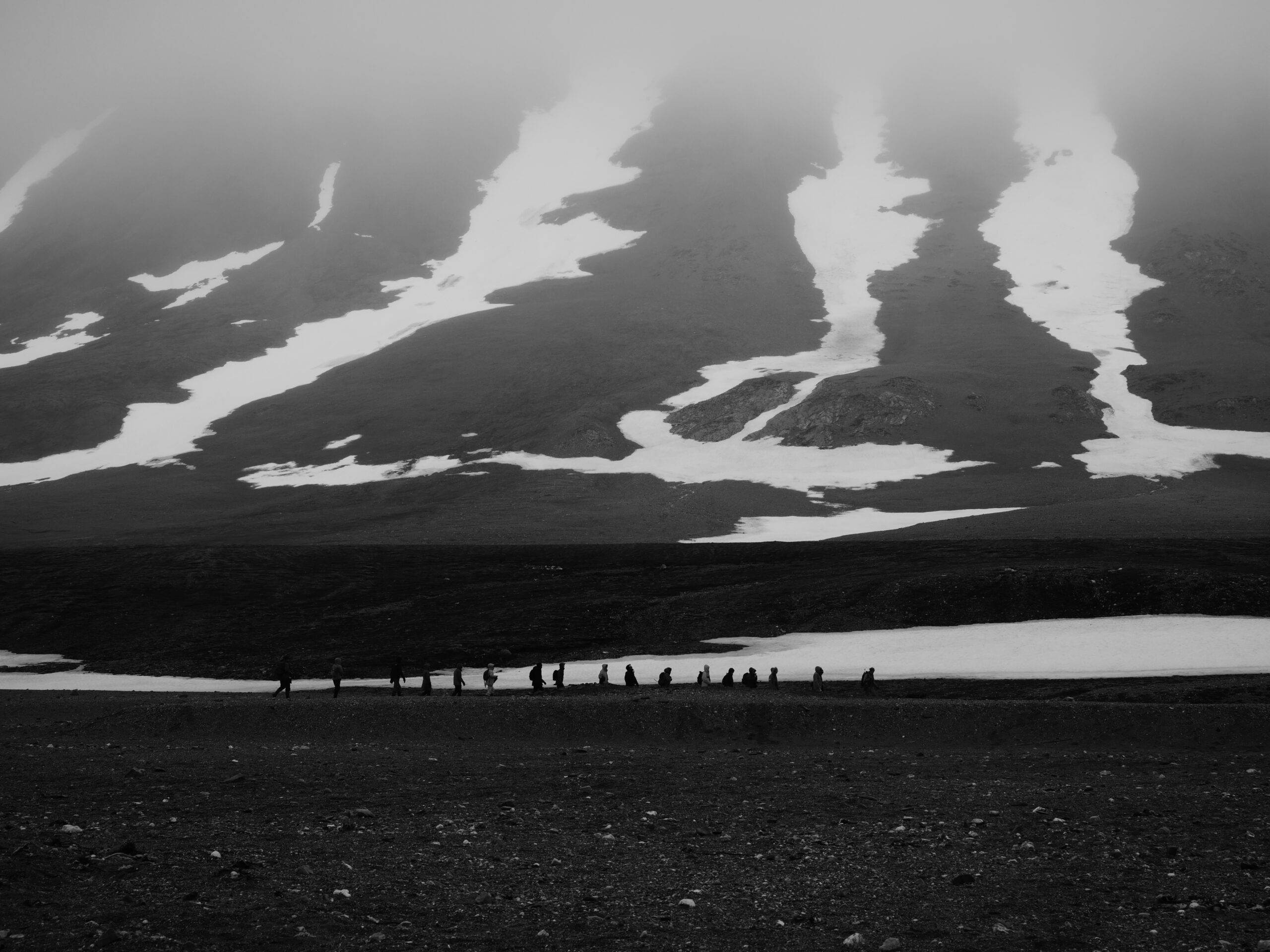
Exploring or following … a question posed by the author to herself while photographing this scene in Svalbard, Norway
* Leave no trace principles:
1) Plan ahead and prepare
2) Travel and camp on durable surfaces
3) Dispose of waste properly
4) Leave what you find
5) Minimise campfire impacts
6) Respect wildlife
7) Be considerate of others
and unofficially …
8) Be mindful of social media’s impact (aka No geotagging).
** Tasmania punches above its weight when it comes to Dark Tourism (see “Playing spectre-detector at Port Arthur”, Forty South Tasmania, Issue 117).
Sonia Strong moved to Tasmania in 2005 and lives on the forested slopes of Mount Arthur. She has worked in conservation and alpine/marine park management, as a paramedic and, now, as Assistant Publisher at Forty South Publishing. She is also a metalsmith, writer and painter. Sonia is captivated by remote islands, dramatic weather and unconventional people and is happiest when creating or exploring wild places. She has published several children’s books through Forty South, including “Tazzie The Turbo Chook Finds Her Feet”. You can follow her on Instagram, @soniastrongartist